The Grey Abbey Conservation Project
It is intended to include historical and archaeological material relating to Grey Abbey and Kildare Town, as well as keeping you posted on the work of the Project. The Grey Abbey Conservation Project is based in Kildare Town, County Kildare.
Latest...
POEM BY PADDY McCORMACK DEDICATED TO ST. BRIGID [Jan 30, 2009]Poem by Paddy McCormack of Kildare Town dedicated to St. Brigid, to commemorate St. Brigid's Day, 1st February. The McCormack family have long been in business in Kildare Town and Paddy McCormack, who was well known for his poems and songs throughout Ireland and the US, is buried in Lackagh Cemetery. ...more
Contained within this splendid site are many pieces about Saint Brigid, including, from the November 14, 1840 issue of the Irish Penny Journal, the lovely tale-within-a-tale of Saint Brigid's Shawl, as told to "T.E." by the extraordinary character, Pat Mowlds.
THE IRISH PENNY JOURNAL.
NUMBER 20. SATURDAY, NOVEMBER 14, 1840. VOLUME I.
BY T. E., AUTHOR OF “DARBY DOYLE,” ETC.
AMONGST the many extraordinary characters with which this country abounds, such as fools, madmen, onshochs, omadhauns, hair-brains, crack-brains, and naturals, I have particularly taken notice of one. His character is rather singular. He begs about Newbridge, county of Kildare: he will accept of any thing offered him, except money—that he scornfully refuses; which fulfils the old adage, “None but a fool will refuse money.” His habitation is the ruins of an old fort or ancient stronghold called Walshe’s Castle, on the road to Kilcullen, near Arthgarvan, and within a few yards of the river Liffey, far away from any dwelling. There he lies on a bundle of straw, with no other covering save the clothes he wears all day. Many is the evening I have seen this poor crazy creature plod along the road to his desolate lodging. There is another stamp of singularity on his character: his name is Pat Mowlds, but who dare attempt to call him Pat? It must be Mr Mowlds, or he will not only be offended himself, but will surely offend those who neglect this respect. In general he is of a downcast, melancholy disposition, boasts of being very learned, is much delighted when any one gives him a ballad or old newspaper. Sometimes he gets into a very good humour, and will relate many anecdotes in a droll style.
About two years ago, as I happened to be sauntering along the border of the Curragh, I overtook this solitary being.
“A fine morning, Mr Mowlds,” was my address.
“Yes, sur, thank God, a very fine morning; shure iv we don’t have fine weather in July, when will we have it ?“
“What a great space of ground this is to lie waste—what a quantity of provisions it would produce—what a number of people it would employ and feed!” said I.
“Oh, that’s very thrue, sur; but was it all sown in pittaties, what would become ov the poor sheep? Shure we want mutton as well as pittaties—besides, all the devarshin we have every year.—Why, thin, maybe ye have e’er an ould newspaper or ballit about ye?“
I said I had not, but a couple of Penny Journals should be at his service which I had in my pocket.
“Och, any thing at all that will keep a body amused, though I have got a great many of them; but among them all I don’t see any pitcher or any account of the round tower furninst ye; nor any account ov the fire Saint Bridget kept in night an’ day for six hundred years; nor any thing about the raison why it was put out; nor any thing about how Saint Bridget came by this piece ov ground; nor any thing about the ould Earl ov Kildare, who rides round the Curragh every seventh year with silver spurs and silver reins to his horse—God bless ye, sur, have ye e’er a bit of tobacky?—there’s not a word about this poor counthry at all.”
My senses were now driven to anxiety—I gave him some tobacco. He then resumed:—
“Och, an’ faix it’s myself that can tell all about those things. Shure my grandfather was brother to one of the ould anshint bards who left him all his books, and he left them to my mother, who left them to me.”
“Well, Mr Mowlds,” I said, “you must have a perfect knowledge of those things—let us hear something of their contents.”
“Why, thin, shure, sur, I can’t do less. Now, you see, sur, it’s my fashion like the priests and ministhers goin’ to praich: they must give a bit ov a text out ov some larned book, and that’s the way with me. So here goes—mind the words:
“The seventeenth ov March, on King Dermot’s great table,
Where ninety-nine beeves were all roast at a time,
We dhrank to the memory, while we wor able,
Ov Pathrick, the saint ov our nation;
And gaily wor dhrinkin’, roarin’, shoutin’,
Cead mille faltha, acushla machree.
There was Cathleen so fair, an’ Elleen so rare!
With Pathrick an’ Nora,
An’ flauntin’ Queen Dorah!
On Pathrick’s day in the mornin’.
Whoo!!!
County Kildare an’ the sky over it!
Short grass for ever !”
He thus ended with a kick up of his heel which nearly touched the nape of his neck, and a flourish of his stick at the same time. Then turning to me he said,
“I am not going to tell you one word about the fire—I am going to tell you how Saint Bridget got all this ground. Bad luck to Black Noll (a name given to Cromwell) with his crew ov dirty Sasanachs that tore down the church; and if they could have got on the tower, that would be down also. No matther—every dog will have his day. Sit down on this hill till we have a shaugh ov the dhudheen. In this hill lie buried all the bones ov the poor fellows that Gefferds killed the time ov the throuble, peace an’ rest to their souls!”
“But to the story, Mr Mowlds,” I said, as I watched him with impatiencc while he readied his pipe with a large pin.
“Well, sur, here goes. Bad luck to this touch, it’s damp: the rain blew into my pocket t’other night an’ wetted it—ha, I have it.
Now, sur, you persave by the words ov my text that a great feast was kept up every year at the palace of Castledermot on Saint Pathrick’s day. Nothing was to be seen for many days before but slaughtering ov bullocks, skiverin’ ov pullets, rowlin’ in ov barrels, an’ invitin’ all the quolity about the counthry; nor did the roolocks and spalpeens lag behind—they never waited to be axt; all came to lind a frindly hand at the feast; nor war the kings ov those days above raisin’ the ax to slay a bullock. King O’Dermot was one ov those slaughtherin’ kings who wouldn’t cringe at the blood ov any baste.
‘Twas on one ov those festival times that he sallied out with his ax in his hand to show his dexterity in the killin’ way. The butchers brought him the cattle one afther another, an’ he laid them down as fast as they could be dhrained ov their blood.
Afther layin’ down ninety-nine, the last ov a hundhred was brought to him. Just as he riz the ax to give it the clout, the ox with a sudden chuck drew the stake from the ground, and away with him over hill an’ dale, with the swingin’ block an’ a hundred spalpeens at his heels. At last he made into the river just below Kilcullen, when a little gossoon thought to get on his back; but his tail bein’ very long, gave a twitch an’ hitched itself in a black knot round the chap’s body, and so towed him across the river.
Away with him then across the Curragh, ever till he came to where Saint Bridget lived. He roared at the gate as if for marcy. Saint Bridget was just at the door when she saw the ox with his horns thrust through the bars.
‘Arrah, what ails ye, poor baste?’ sez she, not seein’ the boy at his tail.
‘Och,’ sez the boy, makin’ answer for the ox, ‘for marcy sake let me in. I’m the last ov a hundred that was goin’ to be kilt by King O’Dermot for his great feast to.morrow; but he little knows who I am.’
Begor, when she heard the ox spake, she was startled; but rousin’ herself, she said,
‘Why, thin, it ‘ud be fitther for King O’Dermot to give me a few ov yees, than be feedin’ Budhavore: it’s well you come itself.’
‘Ah, but, shure, you won’t kill me, Biddy Darlin,’ sez the chap, takin’ the hint, as it was nigh dark, and Biddy couldn’t see him with her odd eye; for you must know, sur, that she was such a purty girl when she was young, that the boys used to be runnin’ in dozens afther her. At last she prayed for somethin’ to keep them from tormenting her. So you see, sur, she was seized with the small-pox at one side ov her face, which blinded up her eye, and left the whole side ov her face in furrows, while the other side remained as beautiful as ever
‘In troth you needn’t fear me killin’ ye,’ sez she; ‘but where can I keep ye?’
‘Och,’ says the arch wag, ‘shure when I grow up to be a bull I can guard yer ground.’
‘Ground, in yeagh,’ sez the saint; ‘shure I havn’t as much as would sow a ridge ov pittaties, barrin’ the taste I have for the girls to walk on.’
‘And did you ax the king for nane?’ sed the supposed ox.
‘In troth I did, but the ould budhoch refused me twice’t.’
‘Well, Biddy honey,’ sez the chap, ‘the third offer’s lucky. Go to-morrow, when he’s at dinner, and you may come at the soft side ov him. But won’t you give some refreshment to this poor boy that I picked up on the road? I fear he is dead or smothered hanging at my tail.’
Well, to be sure, the chap hung his head (moryeah) when he sed this.
Out St Bridget called a dozen ov nuns, who untied the knot, and afther wipin’ the chap as clean as a new pin, brought him into the kitchen, and crammed him with the best of aitin’ and drinkin’; but while they wor doing this, away legged the ox. St Bridget went out to ax him some questions consarnin’ the king, but he was gone.
“Pon my sowkins,’ sed she, ‘but that was a mighty odd thing entirely. Faix, an it’s myself that will be off to Castledermot to-morrow, hit or miss.’
Well, sur, the next day she gother together about three dozen nuns.
‘Toss on yer mantles,’ sez she, ‘an’ let us be off to Castledermot.’
‘With all harts,’ sez they.
‘Come here, Norah,’ sez she to the sarvint maid. ‘Slack down the fire,’ sez she, ‘and be sure you have the kittle on. I couldn’t go to bed without my tay, was it ever so late.’
So afther givin’ her ordhers off they started.
Well, behould ye, sur, when she got within two miles ov the palace, word was brought to the king that St Bridget and above five hundred nuns were on the road, comin’ to dine with him.
‘O tundheranounthers,’ roared the king, ‘what’ll I do for their dinner? Why the dhoul didn’t she come an hour sooner, or sent word yestherday? Such a time for visithers! Do ye hear me, Paudeen Roorke?’ sez he, turnin’ to his chief butler: ‘run afther Rory Condaugh, and ax him did he give away the two hind quarthers that I sed was a little rare.’
‘Och, yer honor,’ sed Paudeen Roorke, ‘shure he gev them to a parcel of boccochs at the gate.’
‘The dhoul do them good with it! Oh, fire and faggots! what’ll become ov me?—shure she will say I have no hospitality, an’ lave me her curse. But, cooger, Paudeen: did the roolocks overtake the ox that ran away yestherday?’
‘Och, the dhoul a haugh ov him ever was got, yer honor.’
‘Well, it’s no matther; that’ll be a good excuse; do you go and meet her; I lave it all to you to get me out ov this hobble.’
‘Naboclish,’ said Paudeen Roorke, cracking his fingers, an’out he started. Just as he got to the door he met her going to come in. Well become the king, but he shlipt behind the door to hear what ud be sed. ‘Bedhahusth,’ he roared to the guests that wor going to dhrink his health while his back was turned.
‘God save yer reverence!’ said St Bridget to the butler, takin’ him for the king’s chaplain, he had such a grummoch face on him; ‘can I see the king?’
‘God save you kindly!’ sed Paudeen, ‘to be shure ye can.
Who will I say wants him?’ eyeing the black army at her heels.
‘Tell him St Bridget called with a few friends to take pot luck.’
‘Oh, murther!’ sed Paudeen, ‘why didn’t you come an hour sooner? I’m afraid the meat is all cowld, we waited so long for ye.’
‘Och, don’t make any bones about it,’ sed St Bridget: ‘it’s a cowld stummock can’t warm its own mait.’
‘In troth that’s thrue enough,’ sed Paudeen; ‘but I fear there isn’t enough for so many.
‘Why, ye set of cormorals,’ sed she, ‘have ye swallied the whole ninety-nine oxen that ye kilt yestherday?’
‘Oh, blessed hour!’ groaned the king to himself, ‘how did she know that? Och, I suppose she knows I’m here too.’
‘Oh, bad scran to me!’ said Paudeen, ‘but we had the best and fattest keepin’ for you, but he ran away.’
‘In troth you needn’t tell me that,’ sez she; ‘I know all about yer doings. If I’m sent away without my dinner itself, I must see the king.’
Just as she sed this, a hiccup seized the king, so loud that it reached the great hall. The guests, who war all silent by the king’s order, thought he sed hip, hip!—so. Such a shout, my jewel as nearly frightened the saint away.
‘In troth,’ ses she, ‘I’d be very sorry to venthur among such a set of riff-raff, any way. But who’s this behind the door?’ sez she, cockin’ her eye. ‘Oh, I beg pardon!—I hope no inthrusion—there ye are—ye’ll save me the trouble ov goin’ in.’
‘Oh,’ sed the king (hic), ‘I tuck a little sick in my stummock, and came down to get fresh air. I beg pardon. Why didn’t you come in time to dinner?’
‘I want no dinner,’ said she; ‘I came to speak on affairs ov state.’
‘Why, thin,’ said the king, ‘before ye state them, ye must come in and take a bit in yer fingers, at any rate.’
‘In troth,’ sez she, ‘I was always used to full and plenty, and not any scrageen bits; and to think ov a king’s table not having a flaugooloch meal, is all nonsense: that’s like the taste ov ground I axt ye for some time ago.’
Begor, sur, when she sed that, she gev him such a start that the hiccough left him.
‘Ah, Biddy, honey,’ sez he, ‘shure ye wor only passin a joke to cure me: say no more—it’s all gone.’
Just as he sed this, he heard a great shout at a distance: out he pulled his specks, an’ put them on his nose; when to his joy he saw a whole crowd ov spalpeens dhrivin’ the ox before them. The king, forgettin’ who he was spaikin’ to, took off his caubeen, and began to wave it, as he ran off to meet them.
‘Oh! mahurpendhoul, but ye’re brave fellows,’ sez he; ‘whoever it was that cotch him shall have a commission in my life guards. I never wanted a joint more. Galong, every mother’s son ov yees, and borry all the gridirons and frying-pans ye can get. Hand me the axe, till I have some steaks tost up for a few friends.’
So, my jewel, while ye’d say thrap-stick, the ox was down, an’ on the gridirons before the life was half out ov him.
Well, to be shure, St Bridget got mighty hungry, as she had walked a long way. She then tould the king that the gentlemen should lave the room, as she could not sit with any one not in ordhers, and they being a little out ov ordher. So, to make themselves agreeable to her ordhers, they quit the hall, and went out to play at hurdles.
When the king recollected who he was goin’ to give dinner to, sez he to himself, ‘Shure no king ought to be above sarvin’ a saint.’ So over he goes to his wife the queen.
‘Dorah,’ sez he,’ do ye know who’s within?’ ‘Why, to be shure I do,’ sez she; ‘ain’t it Bridheen na Keogue?’
‘Ye’re right,’ sez he, ‘and you know she’s a saint; an’ I think it will be- for the good ov our sowls that she kem here to-day. Come, peel off yer muslins, and help me up wid the dinner.’
‘In troth I’ll not,’ sez the queen; ‘shure ye know I’m a black Prospitarian, an’ bleeve nun ov yer saints.’
‘Arrah, nun ov yer quare ways,’ sez he: ‘don’t you wish my sowl happy, any how?—an’ if you help me, you will be only helpin’ my sowl to heaven.’
‘Oh, in that case,’ sez she, ‘here’s at ye: and the sooner the betther. But one charge I’d give ye: take care how ye open your claub about ground: ye know she thought to come round ye twice before.
So in the twinklin’ ov an eye she went down to the kitchen, an’ put on a prashkeen, an’ was first dish at the table.
The king saw every one lashin’ away at their dinner except Bridget.
‘Arrah, Biddy, honey,’ sez he, ‘why don’t ye help yerself?’
‘Why, thin,’ sez she, ‘the dhoul a bit, bite or sup, I’ll take undher yer roof until ye grant me one favour.’
‘And what is that?’ sez the king; ‘shure ye know a king must stand to his word was it half his kingdom, and how do I know but ye want to chouse me out ov it: let me know first what ye want.’
‘Well, thin, Mr King O’Dermot,’ sez she, ‘all I want is a taste ov ground to sow a few pays in.’
‘Well, an’ how much do ye want, yer reverence,’ sez he, all over ov a thrimble, betune his wife’s dark looks, and the curse he expected from Bridget if he refused.
‘Not much,’ sez she, ‘for the present. You don’t know how I’m situated. All the pilgrims going to Lough Dhearg are sent to me to put the pays in their brogues, an’ ye know I havn’t as much ground as would sow a pint; but if ye only give me about fifty acres, I’ll be contint.’
‘Fifty acres!’ roared the king, stretching his neck like a goose.
‘Fifty acres!’ roared the queen, knitting her brows; ‘shure that much ground would fill their pockets as well as their brogues.’
‘There ye’re out ov it,’ said the saint; ‘why, it would’nt be half enough if they got their dhue according to their sins; but I’ll lave it to yerself.’
‘How much will ye give?’ ‘Not an acre,’ said the queen.
‘Oh, Dorah,’ sed the king, ‘let me give the crathur some.’
‘Not an inch,’ sed the queen, ‘if I’m to be misthress here.’
‘Oh, I beg pardon,’ sez the saint; ‘so, Mr King O’Dermot, you are undher petticoat government I see; but maybe I won’t match ye for all that. Now, take my word, you shall go on penance to Lough Dhearg before nine days is about; and instead ov pays ye shall have pebble stones and swan shot in yer brogues. But it’s well for you, Mrs Queen, that ye’re out ov my reach, or I’d send you there barefooted, with nothing on hut yer stockings.’
When the king heard this, he fell all ov a thrimble. ‘Oh, Dorah,’ sez he, ‘give the crathur a little taste ov ground to satisfy her.’
‘No, not as much as she could play ninepins on,’ sez she, shakin’ her fist and grindin’ her teeth together; ‘and I hope she may send you to Lough Dhearg, as she sed she would.’
‘Why, thin, have ye no feeling for one ov yer own sex?’ sez the saint. ‘I’ll go my way this minit, iv ye only give me as much as my shawl will cover.’
‘Oh, that’s a horse ov another colour,’ sez the queen; ‘you may have that, with a heart and a half. But you know very well if I didn’t watch that fool ov a man, he’d give the very nose off his face if a girl only axt him how he was.’
Well, sur, when the king heard this, he grew as merry as a cricket. ‘Come, Biddy,’ sez he, ‘we mustn’t have a dhry bargain, any how.’
‘Oh, ye’ll excuse me, Mr King O’Dermot,’ sez she; ‘I never drink stronger nor wather.’
‘Oh, son ov Fingal,’ exclaimed the king, ‘do ye hear this, and it Pathrick’s day!’
‘Oh, I intirely forgot that,’ sez she. ‘Well, then, for fear ye’d say I was a bad fellow, I’ll just taste. Shedhurdh.’
Well, sur, after the dhough-an-dheris she went home very well pleased that she was to get ever a taste ov ground at all, and she promised the king to make his pinance light, and that she would boil the pays for him, as she did with young men ov tendher conshinses; but as to ould hardened sinners, she’d keep the pays till they’d be as stale as a sailor’s bisket.
Well, to be shure, when she got home she set upwards ov a hundhred nuns at work to make her shawl, during which time she was never heard of. At last, afther six months’ hard labour, they got it finished.
‘Now, sez she, ‘it’s time I should go see the king, that he may come and see that I take no more than my right. So, taking no one with her barrin’ herself and one nun, off she set.
The king and queen were just sitting down to tay at the parlour window when she got there.
‘Whoo! talk of the dhoul and he’ll appear,’ sez he. ‘Why, thin, Biddy honey, it’s an age since we saw ye. Sit down; we’re just on the first cup. Dorah and myself were afther talkin’ about ye, an’ thought ye forgot us intirely. Well, did ye take that bit ov ground?’
‘Indeed I’d be very sorry to do the likes behind any one’s back. You must come to-morrow and see it measured.’
‘Not I, ‘pon my sowkins,’ sed the king: ‘do ye think me so mane as to doubt yer word?’
‘Pho! pho!’ sed the queen, ‘such a taste is not worth talkin’ ov; but, just to honour ye, we shall attind in state to-morrow. Sit down.’
She took up her station betune the king an’ queen: the purty side ov her face was next the king, an’ the ugly side next the queen.
‘I can’t be jealous ov you, at any rate,’ sod the queen to herself, as she never saw her veil off before.
‘Oh, murther!’ sez the king, ‘what a pity ye’re a saint, and Dorah to be alive. Such a beauty!’
Just as he was starin’, the queen happened to look over at a looking-glass, in which she saw Biddys pretty side.
‘Hem!’ sez she, sippin’ her cup. ‘Dermot,’ sez she, ‘it’s very much out ov manners to be stuck with ladies at their tay. Go take a shaugh ov the dhudheen, while we talk over some affairs ov state.’
Begor, sur, the king was glad ov the excuse to lave them together, in the hopes St Bridget would convart his wife.
Well, sur, whatever discoorse they had, I disremember, but the queen came down in great humour to wish the saint good night, an’ promised to be on the road the next day to Kildare.
‘Faix,’ sez the saint, ‘I was nigh forgettin’ my gentility to wish the king good night. Where is he?’
‘Augh, and shure myself doesn’t know, barrin’ he’s in the kitchen.’
‘In the kitchen!’ exclaimed the saint; ‘oh fie!’
‘Ay, indeed, just cock yer eye,’ sez the queen, ‘to the a key-hole: that dhudheen is his excuse. I can’t keep a maid for him.’
‘Oh! is that the way with him?.—never fear: I’ll make his pinance purty sharp for that. At any rate call him out an’ let us part in friends.’
So, sur, afther all the compliments wor passed, the king sed he should go see her a bit ov the road, as it was late: so off he went. The moon had just got up, an’ he walked alongside the saint at the ugly side; but when he looked round to praise her, an’ pay her a little compliment, he got sich a fright that he’d take his oath it wasn’t her at all, so he was glad to get back to the queen.
Well, sur, next morning the queen ordhered the long car to be got ready, with plenty ov clean straw in it, as in those times they had no coaches; then regulated her life guards, twelve to ride before and twelve behind, the king at one side and the chief butler at the other, for without the butler she couldn’t do at all, as every mile she had to stop the whole retinue till she’d get refreshment. In the meantime, St Bridget placed her nuns twenty-one miles round the Curragh. At last the thrumpet sounded, which gave notice that the king was coming. As soon as they halted, six men lifted the queen up on the throne, which they brought with them on the long car. The king ov coorse got up by her side.
‘Well, Dorah,’ sez he in a whisper, ‘what a laugh we’ll have at Biddy, with her shawl!’
‘I don’t know that neither,’ sez the queen. ‘It looks as thick as Finmocool’s boulsther, as it hangs over her shoulder.’
‘God save yer highness,’ sed the saint, as she kem up to them. ‘Why, ye sted mighty long. I had a snack ready for ye at one o’clock.’
‘Och, it’s no matther,’ sez the queen; ‘measure yer bit ov ground, and we then can have it in comfort.’
So with that St Bridget threw down her shawl, which she had cunningly folded up.
Now, sur, this shawl was made ov fine sewin’ silk, all network, each mesh six feet square, and tuck thirty-six pounds ov silk, and employed six hundred and sixty nuns for three months making it.
Well, sur, as I sed afore, she threw it on the ground.
‘Here, Judy Conway, run to Biddy Conroy with this corner, an’ let her make aff in the direckshin ov Kildare, an’ be shure she runs the corner into the mon’stery. Here, you, Nelly Murphy, make off to Kilcullen; an’ you, Katty Farrel, away with you to Ballysax; an’ you, Nelly Doye, away to Arthgarvan; an’ you, Rose Regan, in the direckshin of Connell; an’ you, Ellen Fogarty, away in the road to Maddenstown an’you, Jenny Purcel, away to Airfield. Just hand it from one to t’other.’
So givin’ three claps ov her hand, off they set like hounds, an’ in a minnit ye’d think a haul ov nuns wor cotched in the net.
‘Oh, millia murther!’ sez the queen, ‘she’s stretchin’ it over my daughter’s ground.’
‘Oh, blud-an’-turf!’ sez the king, ‘now she’s stretchin’ it over my son’s ground. Galong, ye set ov thaulabawns,’ sed he to his life-guards; ‘galong, I say, an’ stop her, else she’ll cover all my dominions.’
“Oh fie, yer honour,’ sez the chief butler; ‘if you break yer word, I’m not shure ov my wages.’
Well behould ye, sur, in less than two hours Saint Bridget had the whole Curragh covered.
‘Now see what a purty kittle of fish you’ve made ov it!’ sez the queen.
‘No, but it’s you, Mrs Queen O’Derrnot, ‘twas you agreed to this.’
‘Ger out, ye ould bosthoon,’ sez the queen, ‘ye desarve it all: ye might aisy guess that she’d chouse ye. Shure iv ye had a grain ov sinse, ye might recollect how yer cousin King O’Toole was choused by Saint Kavin out ov all his ground, by the saint stuffin’ a lump ov a crow into the belly ov the ould goose.’
‘Well, Dorah, never mind; if she makes a hole, I have a peg for it. Now, Biddy,’ sez he, ‘though I gave ye the ground, I forgot to tell ye that I only give it for a certain time. I now tell ye from this day forward you shall only have it while ye keep yer fire in.’”
Here I lost the remainder of his discourse by my ill manners. I got so familiar with Mr Mowlds, and so interested with his story, that I forgot my politeness.
“And what about the fire, PAT ?” said I, without consideration.
Before I could recollect the offence, he turned on me with the eyes of a maniac—
“The dhoul whishper nollege into your ear. Pat! — (hum)
—Pat!—Pat!—this is freedom, with all my heart.”
So saying, he strode away, muttering something between his teeth. However, I hope again to meet him, when I shall be little more cautious in my address.
[Original spelling and grammar retained – no attempt has been made to correct or explain the conversational vernacular used to present the story. It is of course quite possible that the author has merely invented Mr. Mowlds as a literary vehicle for poking fun at the Irish peasantry or simply a vehicle to make the story humourous for the readers of the Irish Penny Journal. There are obvious historical inaccuracies which may indicate confusion in the maintenance of the oral history or a deliberate attempt to entertain the reader by introducing characters and places familiar to the listener –King Dermot may mistakenly refer to Dermot Mac Murrough and his supposed connection to Castledermot but he died in the 12th century – Airfield may be a corruption of a local 19th century name in connection with Eyre Powell, the main landlord in Newbridge. It would be nice to think that the names of the nuns who held the corners of the cloak for Brigid in the story were actual names of real nuns that survived through oral tradition – Mario Corrigan]
Below is the cover of the issue of the Irish Penny Journal of 1840 which contained the story of St. Brigid's Shawl. The image is of Malahide Castle, Co. Dublin.
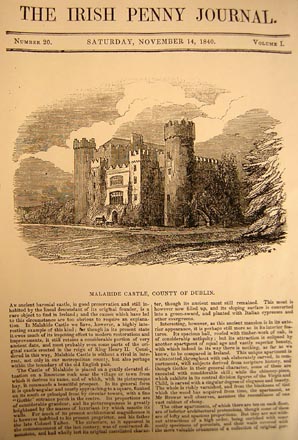
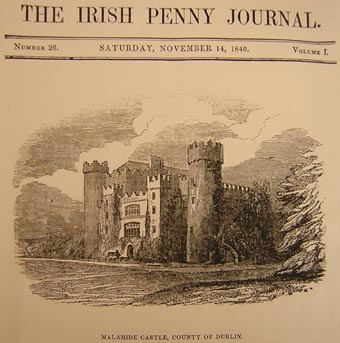
In November 1840 the Irish Penny Journal carried a story of how St. Brigid's extended her Shawl across the Curragh to claim the land for her monastey at Kildare. It is told in the form of a conversation the author had with a local man, Pat Mowlds who probably lived at at Walshestown, Newbridge.
Posted by mariocorrigan at 10:49 PM


 introduced legislation to allow the landmarking of publicly accessible interiors in privately owned buildings.