- Browse by county, speaker or title using the links on the left, or by clicking a county on the map.
- Information on the speakers’ background, together with a Google Map link, may be found by clicking on the ‘Speakers’ link on the left.
- You can also enter keywords in the search field on the left, e.g. ‘Fionn’, ‘Róisín Dubh’.
Wednesday, November 02, 2016
Two New Brigit Courses (with Mael Brigde)
I can't believe I forgot to post these here! I have launched two courses on Brigit with Goddess Ink and the Mystery School of the Goddess. The first is a brief introduction which lays the groundwork for the second, a thirty day activation course. Next year I plan to launch a longer immersion course as well.
Something you might want to know before signing up: Discovering Brigit (the intro) is $15 US, but if you follow the link at the end of the course to sign up for Stepping Into Brigit you will receive a discount of $13. Not a bad deal.
It was very rewarding putting these courses together, despite this being a difficult year in other ways. Returning over and over to Brigit and her lore and traditions in the midst of loss gave me sustenance and joy. Now I get to share those efforts with others; a real blessing.
Mael Brigde
(Click below for more details on the courses.)
Monday, October 31, 2016
Oh, Dear. Sacred Beer.
Everybody loves the prayer attributed to Saint Brigit about serving ale to Jesus and his crew. I love it. But maybe this new product is going a tad too far. (AND it is an odd "translation". Although, who knows, maybe they had a different original than the one I'm familiar with. To be fair.) But I bet I will be in the minority on this one. Even sober I can't help cracking a bit of a smile at it.
That is:
I’d like to give
A lake of beer to God.
I’d love the Heavenly
Host to be tippling there
For all eternity.
I’d sit with the men,
The women of God
There by the lake of beer.
We’d be drinking
Good health forever
And every drop
Would be a prayer.
And now the "real" translation. (Of course, I have not read the Old Irish, myself, so what do I know?)
Aengus Cèile Dè
“I should like a great lake of ale
For the king of kings;
I should like the family of heaven
To be drinking it through time eternal.”
(8th century)
Translation found in Beith, M., (1995) Healing Threads: Traditional Medicines of the Highlands and Islands. Thanks to Morgan Daimler, Pagan Portals: Brighid for this.
***
If you would like to purchase, or simply gawp at, this plaque, go to The Catholic Company site:
Product Description
- Creative tin sign themed for Ireland's faith and drink of choice
- Original gift idea
- Easy to feature in a den or office
- Features poem by St. Brigid, Patroness of Ireland
- Exclusive to The Catholic Company
- Item #: 9850126
- Price: $16.95
Details
How about an aluminum sign that instantly enhances the character of a room? This one rouses authentic faith and good spirits.
Saint Brigid's timeless words are captured on a Guinness-inspired pint, and set against a map that traces the geography of Ireland's roving hills.
The size makes it easy to feature in home or office, and has layers of rich meaning and substance every bit as cool as St. Brigid herself.
Dimensions & Specifications
- 8" (W) x 12" (L)
- 2 side holes for easy hanging
- Material: Aluminum
Wednesday, October 05, 2016
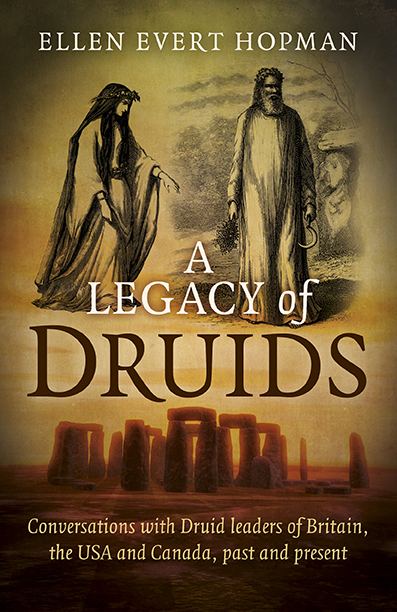
Review: Legacy of Druids - Conversations with Druid leaders of Britain, the USA and Canada, past and present by Ellen Evert Hopman
Review of Legacy ofDruids: Conversations with Druid leaders of Britain, the USA and Canada, pastand present by Ellen Evert Hopman (2016) Moon Books.
- Paperback £14.99 || $25.95Apr 29, 2016
978-1-78535-135-8 - e-book £6.99 || $9.99Apr 29, 2016
978-1-78535-136-5
Full disclosure: I was, to my amazement then and now,
interviewed for this book. That is not why I like it, though I confess it is
why I wanted to read it in the first place.
Why Review Legacy
of Druids on Brigit’s Sparkling Flame?
I wouldn’t normally review a book like this on BSF as it
isn’t actually about Brigit. However,
there are two reasons to:
1) it contains an early interview of me (September 3, 1996) which
discusses my own spiritual path, and of course that involves the origin of the
Daughters of the Flame in 1993 and its workings till 1996 (pp 29-39).
2) More generally, it is fascinating from a historical
perspective for Neo-Pagans generally, particularly but not exclusively those
who identify as Druids or follow a Celtic-based path. Many Brigidines of course
are in that number.
Thursday, September 08, 2016
Cartimandua and Brigit
The key paragraph here, where Koch and Carey suggest that Brigit and Briganti are correspondents, and that Brigit arose from Brigantes in the Kildare area, and even that she had a "mortal high priestess" there is all speculation, unproven and as far as I know unsupported, but this does help explain why so many people assume it to be true.
![]() |
| from The Celtic Heroic Age by Koch and Carey, 4th edition, 2003. |
Monday, August 08, 2016
Three Loaves of Bread
This is lovely.
4 Then eight other
virgins also received
the veil together
with saint Brigit and the
virgins with their
parents said, 'Don't leave
us. Instead stay
with us and make your
home in these
parts.'
5 Thereafter saint
Brigit stayed with them.
One day there
came to Brigit
and her nuns three
devout men who were
pilgrims and she
regaled them with bread
and cooked bacon.
The men ate the bread
but hid the three
portions of bacon as they
did not want to eat
it.
2 The following day
Brigit greeted them
and said, 'See how
much bread you have
left over!' When
they looked they saw that
the three portions
of bacon were three
loaves of bread.
From "Vita Prima Sanctae
Brigitae Background and Historical Value", by Sean Connolly. The Journal of the Royal Society of Antiquaries
of Ireland, Vol. 119 (1989), pp. 5-49.
Image: By L.Kenzel (Own work) [GFDL (http://www.gnu.org/copyleft/fdl.html) or CC BY-SA 3.0 (http://creativecommons.org/licenses/by-sa/3.0)], via Wikimedia Commons
Saturday, August 06, 2016
Art: Lorenzo Lotto, The Legend of St. Brigid
From the Web Museum at Christian Iconography Info, Lorenzo Lotto's mural, The Legend of St. Brigid:
1523-24
Fresco
Suardi Chapel, Trescore, Italy
The panel on the left portrays St. Brigid's taking the veil – that is, her consecration as a nun. The bishop is identified in one source as St. Mel and in another as a St. Maccaille"1 On the floor at Brigid's left are her former clothes; on the step above them is the white veil she will be wearing. White is traditionally St. Brigid's color, so the yellow habit she wears throughout the fresco scenes is a bit puzzling.2
Above the group of women on the right of this panel we see painted a scene of Brigid distributing milk to the poor. Her veil is not white but gray, a reference to the fact that this episode in her life occurred before her consecration.3
The middle panel gives us three scenes with four episodes from the life of St. Brigid. In the lower foreground, she blesses food and water, turning the water into beer.4 Behind her is a further episode in which she cures a blind man. The figure in rags behind the blind man is the "leprosus" who guided him to the saint.5 (The texts use leprosus indiscriminately for any poor person who is also ailing in some way.)
In the upper left of the middle panel, Brigid blesses a wild boar who was about to attack a flock (of pigs in the story, here a flock of sheep). Above her is a further scene in which the boar, having been blessed, grazes peacefully among the other animals.6
In the panel's upper right scene, the saint calms a storm that was threatening to ruin the harvest.7 In a nice touch of Renaissance perspective, Lotto places a well-satisfied harvester in the foreground with a big sheaf on his shoulder.
The episodes in the right panel are most likely drawn from some specific text. In the Suardi Chapel frescoes Lotto tends to follow his written source faithfully.8 However, I have yet to find a Life that corresponds to the scenes shown. In the foreground of the street scene, the saint takes a glass pitcher of milk from someone at a window. At her feet, two poor men have taken the pitcher, which is now empty (and perhaps broken – it is hard to tell from the photograph).
Behind her, a number of what seem to be officials or soldiers are hustling a poor man off-stage. There is one episode in the Latin vitae in which a poor man is condemned to death for breaking a precious vase and Brigid saves him by restoring the vase.9 Conjecturally, that could be what she is doing as she sits above the crowd scene on the second floor of the building.
Lotto's source for these episodes is most likely a work based on Cogitosus' Vita Sanctae Brigidae and partly on the Saint-Omer Vita in the Acta Sanctorum.10 Of the five vitae presented in the Acta Sanctorum, only Cogitosus has all five of the episodes in the left and middle panels, though Lotto departs from Cogitosus in a few details. Like Cogitosus, Lotto ignores or suppresses the references to fire signs in most other vitae. (Mysteriously prophetic fires are seen while Brigid is still in the womb, after she is born, and when she is consecrated as a nun.11) In Cogitus, this suppression is just one aspect of a persistent de-mythologizing of earlier tales. In the miracle episodes, for example, the narrator continually attributes these wonders to God.12 {See my note below regarding this last statement.}
Detail of the right panel
Detail of the foreground of the middle panel
Detail of the boar scene
Detail of the storm scene
I take exception to the last statement, that Cogitosus is suppressing and demythologizing earlier stories. The evidence points toward Cogitosus's vita being the earliest, and as various authors have argued, much is added in later tales for a variety of reasons: each author from Cogitosus onward has had reasons for portraying Saint Brigit in the way they have chosen. (See Lisa Bitel, Landscape with Two Saints and Isolde Carmody and Chris Thompson "Revisiting Mythical Women 05: The Search for Brigid", for example.)
Christian Iconography Info, by the way, is quite a neat website. It endeavours to help viewers of Christian art unpack what is going on. Attend:
ChristianIconography.info
(formerly at www.aug.edu/augusta/iconography)
Read the stories that the paintings refer to.
Find out the "why" behind traditional elements in paintings of scriptural events.
Use this search engine.... {HINT: You'll have to go to their actual page to use their search engine.}
Example: if you're curious about a picture of a saint shown with a tower, just enter "tower" into the search field (without the quotation marks). You'll learn she is St. Barbara, and you can read about her, view similar images, and follow a link to the medieval legend about her.
.....or learn how artists have portrayed specific saints, topics, or scriptural events by clicking on any one of these links:
A
Aaron Abel Abraham Acisclus and Victoria ... {Have a look! There are saints galore.}
Friday, July 15, 2016
Book Review: Pagan Portals - Brigid by Morgan Daimler
Daimler, Morgan. Pagan
Portals—Brigid: Meeting the Celtic Goddess of Poetry, Forge, and Healing Well,
Moon Book (2016). 112 pages.
- Paperback
£4.99 || $9.95Mar 25, 2016
978-1-78535-320-8 - e-book
£2.99 || $3.99Mar 25, 2016
978-1-78535-321-5
AVAILABLE ONLINE FROM: Amazon US, Amazon UK,
Hive, Indiebound.
__________________________________________________________________________
An excellent primer, and the best available for getting a a
handle on the sources, ancient and modern, for our understanding of Brigit. I
can't recommend it highly enough.
Morgan
Daimler is the author of a number of books and shorter works of poetry,
fiction, and nonfiction, and is gaining a reputation for clearly written, well
researched, and extremely useful handbooks such as this one on Brigit.
Brigit is the spiritual being to whom I have devoted decades of my life, in study and devotion and in supporting others in their journeys on Brigit’s path. I discovered in Pagan Portals—Brigid, to my joy, a book that wastes no words—it is a slim volume indeed—but packs into those pages more clear and illusion-lifting information than I have ever seen set out about Brigit.
The reason is this: Daimler has gone straight to the
medieval texts, finding references to Brigit and explaining them lucidly—indeed,
clarifying for the reader which text treats her in which way, rather than
allowing them to blur together in our minds; she tackles the early geography of
goddesses-who-may-be-Brigit; she takes the complex blend of ancient, folk, and
modern conceptions of Brigit and sorts them deftly out so the reader can see
where commonly heard assertions come from and make up her own mind about where
to follow and where not.
Daimler explores animal and plant associations and symbols
commonly associated with Brigit, such as triplicity, touches on her holidays,
prayers, chants, and charms, and looks at the rise of modern Brigidine myths and flame-tending, as
well as providing hints for honouring Brigit today and supplying a diverse
resource list and bibliography.
She ends each chapter with a short essay on her personal
connection to Brigit, thus grounding the theory in personal practice. Indeed, although
emphasis is put on making assertions supported by solid academic material and distinguishing
these from our personal beliefs, she is careful to point out that she does not
believe that “the religious framework we use to connect to the Gods matters as
much as the effort to honor the old Gods itself. I think we can all do this
respectfully and with an appreciation for history without the need for any
particular religion. Whether we are Reconstructionists, Wiccans, or Celtic pagans
all that really matter is that we are approaching our faith with sincerity and
a genuine intention.” I would add that this book would be useful to anyone
interested in Brigit, goddess or
saint, be they NeoPagan, Christian, or secular scholar, for the information is
so well laid out that any further studies or devotions would only be enhanced by
the reading of this book.
____________________________________________________________________________
From the publisher's website:
Pagan Portals - Brigid is a basic introduction to the Goddess Brigid focusing on her history and myth as well as her modern devotion and worship. Primarily looking at the Irish Goddess but including a discussion of her Pan-Celtic appearances, particularly in Scotland. Her different appearances in mythology are discussed along with the conflation of the pagan Goddess with Catholic saint. Modern methods for neopagans to connect to and honor this popular Goddess include offerings and meditation, and personal anecdotes from the author's experiences are included as well.
Who was Brigid to the pre-Christian pagans? Who is she today to neopagans? How do we re-weave the threads of the old pagan Goddess and the new? Learn about Brigid's myths among the pagan Irish, the stories of Bride in Scotland, and the way that people today are finding and honoring this powerful and important deity to find the answer.
Thursday, July 07, 2016
Saint Brigid Press
Well, you can see why this item caught my eye. Apart from the name, unexplained on the website, I see nothing directly referring to Brigit. BUT, I can easily see the associations.
Saint Brigit's monastery was said to have produced fine books; a not uncommon feature of Irish monasteries was the scriptorium. The goddess Brigit was said to be patron of poets, and although they were not then scribbling down their words, we scribble as much as possible now. What finer way to present words than in finely crafted books and broadsheets?
Saint Brigid Press creates these the old-fashioned way. No, not by quill and squinting, but by setting gorgeous typefaces on gorgeous paper and then gluing and sewing and making splendid.
In their own words:
St Brigid Press is a letterpress print shop in the Blue Ridge Mountains of central Virginia. Emily Hancock is proprietor and printer.
We are dedicated to learning, practicing, and passing-on the art and craft of letterpress printing with hand-set type, hand-carved illustrations, foot-powered presses, and hand-sewn books...
“Working with language on an intimate level, from the first ephemeral thoughts of a poem, to the physical sculpture of the letters themselves —
all collaborating to render beauty from experience to expression.”
Monday, June 06, 2016
Brat agus teagasc Bhríde - Seán Ó Colláin
A tale of Brigit, in Irish, with English translation, by Seán Ó Colláin. "Saint Brigit's mantle and teaching" was recorded in 1930 in Co. Galway by Karl Tempel. You can download a copy of the file at the site.
The time when Saint Bridget was in this life, she was the daughter of a poor person. She had spent all of her father's wealth on God's poor. The father did not know what he would do with her. He brought her to the province of Leinster to sell her to (...). He left her outside at the gate. He had a sword and scabbard. He left it with her to keep until he came out...
From the website:
The Doegen Records Web Project
Irish Dialect Sound Recordings 1928-31
Welcome! This archive of Irish dialect sound recordings made during 1928-31 contains folktales, songs and other material recited by native Irish speakers from 17 counties. Crucially, it includes examples of dialects that are now extinct. The collection also includes a speech in English by W.T. Cosgrave, who was head of the Irish government that funded the recording scheme.
We hope that you will enjoy engaging with these songs, stories and speakers and that you will find the experience an enriching one. We welcome further information from you on the speakers or on the data. To send further information for the site please use the feedback facility.
This multi-media archive is a project of the Royal Irish Academy Library in collaboration with the Digital Humanities Observatory.
Sunday, May 22, 2016
Song: Chronilus “Brigid”
About a year ago the band Chronilus played Seattle's Pocket Theater, with the belly-dancing troupe Rags Nocturna. Here is their song “Brigid”, written by Caera Aislingeach.
You can download the song (and hear the words more clearly) at the band's CD Baby page.
Thursday, May 12, 2016
Cure for Headache...
This was actually number 13. in the list of headache cures on the page
Old Cures
from Firoda National School in Castlecomer, between Portlaoise and Kilkenny.- Wrap “Brat Bride” around the forehead. This is a scarf placed on the outer door handle on the eve of St. Bridgid to be blessed by the saint as she passes around Ireland.
From blindness to childblains to "a child with wind", you will find the cure for what ails you here.
Remember, though, not all headaches look alike. If it's a migraine you're plagued with, these are the tried and tested cures:
MIGRAINE
|
Image: by Mael Brigde (2006)
Monday, May 09, 2016
Story Archaeologists Revisit Brigit
![]() |
| Sculpture by Annette McCormack |
Last July I posted about Chris Thompson and Isolde Carmody and the Brigit-related entries on their excellent site, Story Archaeology . The site combines well-informed and good-natured podcasts, blog entries, and images. This link will take you to my original posting, and through that to their original postings. But they have recently revisited Brigit and her world, and I want to share those new links with you as well. I very much enjoyed the new podcast (as Facebook has no doubt noticed, since I posted links to it in every group I belong to). Here is a link to it, and to the blog postings.
Revisiting Mythical Women 05: The Search for Brigid
They provide downloadable files of all their podcasts (mp3s), or you may subscribe to them through iTunes. (Hint: I have found with iTunes in this particular case that I need to download the podcasts one at a time. Can't just click on them all and walk away.)
The clip below (which looks like video but is actually audio stuck on a picture of Saint Brigit's Well at Faughart) is from the original podcast.
Hear also (of course!) the podcast on Brig's husband Bres in the Cath Maige Tuired, and read the associated blog postings.
![]() |
| Bres by Jim Fitzpatrick |
Sunday, May 01, 2016
"My Story" by Peter O'Leary
![]() |
| Cover Art by Jack Yeats, brother of W.B. Yeats |
Canon O'Leary's "Mo Scéal Fein" (My Story) was first published in 1915, but did not see print in English until 1970. At that time, the addition of generous notes and appendices allowed a context for his memories, giving those of us with a weak grasp on Irish history and issues of moment a better understanding of what he is describing.
This highly readable autobiography offers glimpses of the
Great Hunger, the launching of efforts to rescue Irish from extinction, and the
successful resistance of farmers against landlords at a time when rent was
insisted upon despite the lack of harvest and funds. From a poor background
himself, Father O'Leary worked tirelessly to bring education to the boys and young men of
rural Ireland, gathering books from The Poets and Poetry of Munster to Shakespeare and Milton, and teaching Irish, Latin, and Ancient Greek in exchange for their
commitment to abstain from drink, the destructiveness of which raised him to a
passion. He witnessed and frequently participated in much more besides,
including the Easter Rising and the War of Independence, about which he had
firm opinions—as he did about every other thing.
Though he only mentions her a few times, Canon O'Leary was
deeply devoted to Saint Brigit, and his trust in her was complete. Whether we
see things from his viewpoint or not is unimportant; that we are given the
opportunity to see her, and their shared world, through his eyes is the
wonderful thing.
"We put the entire business, ourselves and the library, under the protection of St. Brigid."
Wednesday, April 20, 2016
BRIGIT Strikes a Blow for the Environment!..............(I Think.)
Well, here's an odd one. As you know, I often find ideas for my posts by simply entering the name "Brigit" in my search engine and seeing what pops up.
Till today I did not know, for instance, that since August 2012 a four year research and development project involving sixteen partners in the European Union has been operating under the name of BRIGIT.
But why? I mean, why the name? I have written them, and I hope I can report back to you. There is no obvious explanation on the site. It isn't an acronym, it has nothing to do with Ireland, but look at the logo. A sort of half-Celtic knot, half-pentacle thing, no? And look at what they are doing:
'New tailor-made biopolymers produced from lignocellulosic sugars waste for highly demanding fire-resistant applications'BRIGIT aims to develop a cost-competitive and environmentally friendly continuous process to produce biopolymers (polyhydroxybutyrate, PHB, and succinate-based biopolyesters, PBS-Poly-Butylene-Succinate) from waste-derived lignocelullosic sugar feedstock liquor of wood sulphite pulping process based on “in-situ” fermentation process and new fermentation culture technology without alteration of the quality of current lignosulphonates (they have a high market demand as additive). Other non-wood plant waste, used nowadays in the pulp production, will be also considered as alternative sugar source in this project.
In comparison with previous projects to obtain biopolymers from different sources, the main innovation in BRIGIT is the use of an existing sugar-rich waste stream and the process integration with the existing industrial operation, that will permit an overall reduction in resource consumption and in greenhouse gas emissions and a dramatic reduction of operational costs due to the use of non-sterile steps, without the need of intermediate discontinuous bioreactors and avoiding waste transport.
Okay. So, like our Brigit, BRIGIT has a connection to fire, though in her case, she is resisting it, not igniting it. On the other hand, if we look back to Saint Brigit's vitae, when she was a baby flames were seen to be coming from her chamber while she herself was untouched. So maybe they are onto something here.
Taken further, BRIGIT is apparently concerned with the health of the land, as Saint Brigit and her goddess counterpart--and any self-respecting sovereign goddess would do. At least, the thrust seems to be to reduce the use of natural resources and decrease greenhouse gas emissions (besides saving investors a bucketload of cash, though I'm not sure our Brigit is too concerned about that).
Going a few steps further even still, notice that they are making polymers. It would not be too great a stretch to see the goddess Brigit's role as smith here. Where her devotees originally shaped metals, these modern day smiths shape plastics, bio-plastics, even--indeed, they are shaping molecules themselves. Which is pretty darn cool; the stuff of goddesses.
So I don't know if we have a hidden Brigidine in here, or if the woman who thought of the project named it after herself (or the man who thought of it named it after his mother) or what. But I like the parallels, and I like the logo, and for that matter, I like the project, from what I can understand of it.
I'd be interested to hear your thoughts on the matter. And if I hear back on the name, I'll post it here.
Tuesday, March 29, 2016
Upcoming Events at Solas Bhríde
There are some tantalizing events coming up at Solas Bhríde, the home of the Brigidine Sisters in Kildare, Éire. The new centre and hermitages are up and running, so if you are going to be in Ireland over the next couple of months, you might want to try securing a place there and attending.
| Date/Time | Event |
|---|---|
| 23/04/2016 10:00 am - 1:00 pm | Spring Awakening COMPLETED Solas Bhride, Kildare Town Co. Kildare |
| 29/04/2016 8:00 pm - 9:00 pm | A Celebration of Bealtaine Solas Bhride, Kildare Town Co. Kildare |
| 10/05/2016 7:30 pm - 9:00 pm | An Introduction to the Mystics Solas Bhride, Kildare Town Co. Kildare |
| 14/06/2016 10:30 am - 12:30 pm | Sacred Dance Solas Bhride, Kildare Town Co. Kildare |
| 21/06/2016 7:30 pm - 9:00 pm | A Celebration of the Summer Solstice Solas Bhride, Kildare Town Co. Kildare |
Wednesday, March 16, 2016
Brigid's Wayside Well: Kildare, with Erynn Laurie
I have lifted the bulk of the text (but not all the directions, and none of the photos) from Erynn Laurie's blog, Searching for Imbas: A Professional Madwoman's Search for Poetic Inspiration. The post is about finding Brigit's Wayside Well in Kildare. Please go to the original posting for the full directions and helpful photos.
One of the more challenging things I had to deal with in preparing for the 2012 Ireland pilgrimage was finding the original Brigid's Well in Kildare Town from five thousand miles away, with only vague hints on the web to go by. I looked for a couple of weeks, only able to find the occasional photo of the well itself, with very vague descriptions of its location that made little sense to me, having never been to Kildare before.
I've been told "oh, well, it wasn't that hard for me to find," by people who had found it when they were in Kildare. Truthfully, once you're in Kildare, you can ask about the Wayside Well and some of the people who live there can tell you where it is pretty easily, but I had a lot of trouble ahead of time. So if you want to go to Kildare and visit the older well, this is how you can find it without having to shanghai some stranger on a Kildare street corner.
Here is the little hand-drawn map from the book Rekindling the Flame: A Pilgrimage in the Footsteps of Brigid of Kildare by Rita Minehan, CSB. The book is small and sometimes not easy to find online, but I got a copy for about $17 from Amazon UK. If you look, you might be able to find one yourself. It has photos of the Brigid sites in Kildare, along with a pilgrimage route and some liturgical material primarily geared for a Catholic audience associated with some of the places.
The Brigidine Sisters who live in Kildare sell the book at their home/shrine, but if you want to visit them, I highly recommend you contact them in advance and arrange for a visit with them. They are very kind and accepting of people of all paths and are well worth talking to. Their ceremony for gifting Brigid's flame to pilgrims is simple but moving, and they are willing to spend time telling stories of Brigid's life and her mission, as well as acknowledging Brigid as the goddess of poets, smiths, and healers.
From Kildare Town, on Bride Street, it's about 2km south of town. Bride Street turns into Tully Road about when it crosses the M7. You'll turn LEFT at the sign for The Curragh, which is the Irish National Stud Farm, and for the Japanese Gardens. Just a little up that road is an entrance for a parking lot. You'll enter and head back toward Tully Road from there. Park at the very end of the parking lot.
Sunday, February 14, 2016
Book: "Pagan Portals - Brigid: Meeting the Celtic Goddess of Poetry, Forge, and Healing Well" by Morgan Daimler
This is an EXCELLENT book.
I have read it cover to cover, and have seen nothing else that comes close to it in clearly and briefly presenting the facts and confusions around the goddess Brigit. (Not the saint. Different book.)
I can't recommend it highly enough.
From the publisher's website:
Pagan Portals - Brigid is a basic introduction to the Goddess Brigid focusing on her history and myth as well as her modern devotion and worship. Primarily looking at the Irish Goddess but including a discussion of her Pan-Celtic appearances, particularly in Scotland. Her different appearances in mythology are discussed along with the conflation of the pagan Goddess with Catholic saint. Modern methods for neopagans to connect to and honor this popular Goddess include offerings and meditation, and personal anecdotes from the author's experiences are included as well.
Who was Brigid to the pre-Christian pagans? Who is she today to neopagans? How do we re-weave the threads of the old pagan Goddess and the new? Learn about Brigid's myths among the pagan Irish, the stories of Bride in Scotland, and the way that people today are finding and honoring this powerful and important deity to find the answer.
Morgan Daimler is an Irish Reconstructionist with Heathen tendencies who has been a polytheist since the early ’90′s. Morgan is a Druid in the Order of the White Oak and witch who follows a path inspired by the Irish Fairy Faith. A wandering cleric of Odin and dedicant of Macha, Morgan teaches classes on Irish myth and magical practices, fairies, and related subjects around the northeastern United States and has appeared as a guest on the podshows, the New Normal and Raven Radio. Morgan has been published in multiple anthologies as well as in Circle magazine, Witches and Pagans magazine, and the CR journal Air n-Aithesc. Besides the titles available through Moon Books Morgan has self-published By Land, Sea, and Sky, a book of Irish language translations called The Treasure of the Tuatha De Danann, and an urban fantasy/paranormal romance series called Between the Worlds and through Spero publishing a children's book called A Child's Eye View of the Fairy Faith. Connecticut, USA.
Course: Weaving the Protection of Brighid - A Goddess Activation Course with Jude Lally
Goddess Ink, publishers of Brigit: Sun of Womanhood, are offering a week-long Goddess Activation course with Jude Lally:
From the website:
This week long Goddess Activation course introduces several traditional ways of invoking Brighid's protection, from creating a Brighid's Wheels to casting the Caim. You will explore each of the six aspects, learning the history and then adapting and integrating them into your daily life. Each lesson is a journey in building and deepening your relationship with Brighid through study, altars, guided meditation and personal rituals...
... Jude Lally is an artist, a writer and holder of sacred space. She grew up a few miles from Loch Lomond, where the river Leven meets the mighty River Clyde, on the West Coast of Scotland.
She gained her masters degree (MSc) in Human Ecology at the University of Strathclyde, Glasgow, Scotland with her thesis "Fire in the Head, Heart and Hand: A Study of the Goddess Brigit as Goddess Archetype and her Relevance to Cultural Activists in Contemporary Scotland."
Find out more about the course and sign up at Weaving the Protection of Brighid.
Cost is $35 US.
Subscribe to:
Posts (Atom)