Saturday, January 28, 2017

“What the Goddess Brigit Means for Women and Men Today” (Excerpt from Course)


Genevieve of Goddess Ink excerpted a lesson from my course Discovering Brigit for her blog post last week. Here's the link, and here's a quote:

Why has the Goddess Brigit become so popular, and with so many different kinds of people?
Apart from a lull in her popularity in the last century*, Brigit has always been beloved, especially among the Irish and Scots—and where they have migrated churches bearing the name “Saint Brigit’s” or “Saint Bride’s” have popped up with great regularity. So many Irish girls were baptized with her name that its diminutive—Biddy—came to apply to Irish women generally (not in the most flattering way, at all times, but that’s another story), just as their men became known as Paddies, after Saint Patrick.
Brigit’s fortune seems ever on the rise... 

Monday, January 23, 2017

Friends of Bride's Mound: Gathering, Archaeology, Hedge-Laying


C/O Glastonbury Opportunities, Unit 7 Abbey Mews, BA6 9DY.
Email; friendsofbridesnew@yahoo.co.uk 

January 2017 Newsletter

IMBOLC – Wednesday 1st February 2017 
The Friends of Brides Mound invite you to join us for the day, the feast day of St. Brigid. 

9.30am White Spring opens (tbc)
 10am Ceremony at the White Spring (tbc)
12 noon Meditation at the Well Head at Chalice Well
10.00 – 1.00pm Refreshments available at Chalice Well

1pm Walk to Bride's Mound with Serena Roney-Dougal; 
Meet outside the White Spring, where the White and the Red springs join.
Wear clothing and footwear suitable for wet and muddy conditions! 
2.30pm Gathering around the fire on Bride's Mound.

AGM.  The Library of Avalon, Glastonbury 22nd March from 7.30pm to 9.30pm.  All welcome.

Archaeology on the Mound 
Somerset skeletons are oldest evidence of monks found in UK

As you might have seen on the national news, Richard Brunning of Southwest Heritage Trust led a team doing the first archaeological dig on the mound since Philip Rahtz’s dig in the 1960s. All very exciting!

An ADF Imbolc Ritual


I realized today that I have not offered here any actual ritual for Imbolc, or indeed for flame-keeping, and that doing so might be of help to some readers. After poking around in my computer I further realized that it has been so long since I have felt the need to write out my rituals ahead of time (I've found over time I'm happier keeping it direct and simple), I don't have any to hand.

So I went noodling around on the internet and found this. It has many interesting ideas and although I would make changes if I were using it (such as not using the word invoke, as I don't feel I have the power or the cheek to summon a deity--invite, maybe), I think it is a great jumping off place. Kudoes to Rob and Kami for their work here.

A Solitary Imbolc Ritual

by Rob Henderson and Kami Landy
written March 31st, 1999
Adapted from the Shining Lakes Grove 1999 Imbolc Rite, written by the SLG Liturgists
with sections shamelessly stolen from the StoneCreed Grove Solitary Liturgy
(This is my first attempt at writing a solitary ADF ritual. Well, perhaps "writing" isn't the right word, more like "assembling". Our Grove's Imbolc Rite this year was more scripted than our usual fare, and I thought it would be a good opportunity to do a solitary ritual. I'm adding some running commentary in the parentheses, so you can understand not only what you're doing, but why you're doing it. -- Rob)
[Kami's commentary will be in brackets, like so.]
(If you've got your Dedicant's shrine set up, you should use that for this ritual. If you don't have such a shrine, you can make do with representations for the well (a bowl of water) with a piece of silver for the Well offering (a coin is fine), the fire (a candle - three candles, or a three-wicked candle, would be best), and the tree (a branch placed in a pot of soil is good). You'll also need:
  • a separate bowl of water and a candle (to receive the blessings of Brigit)
  • offerings for Brigit (see below for suggestions)
  • offerings for the Outsiders (food or drink)
  • For purifications: mud or red ochre; salt water; incense or smudge stick
  • a straw "dolly" or rowan stick to represent Brigit, and a straw bed for her (optional)
  • For the return blessing: red, white, and black ribbons attached to the frame of a doorway (optional)

Wednesday, January 18, 2017

St. Brigid's LGBTQ-Affirmative Christian Community

I was strolling down Burrard in downtown Vancouver a couple of weeks ago and as I passed Christchurch Cathedral I glanced at the schedule of events. To my great surprise there was a thing called "St. Brigid's Eucharist" on Sundays at 5:30 PM. Curious, I went online to find out more.

Here's what the St. Brigid's people say about themselves.


WELCOME!

Welcome to St. Brigids, a community of Christ-followers in downtown Vancouver. We are an emerging LGBTQ-affirming Christian congregation of Christ Church Cathedral where questions are honoured, faith is nurtured, and discipleship pursued.

St. Brigids is a community that loves to sing, laugh, eat, serve and worship God together in ways that send us refreshed and renewed into our daily lives – wherever that may take us.

If you are new to Vancouver, or are newly seeking a spiritual home, we invite you to join us for Sunday worship. We are a growing, newly formed congregation that welcomes people from diverse backgrounds.

Our hope is that you’ll be able to get to know us through the website and in person so you’ll have what you need in order to decide whether St. Brigids is a community where you can plant roots. You’re invited to get to know us in a way that makes the most sense to you:

We look forward to welcoming you to St. Brigids!

(So how cool is that? say I.)

Tuesday, January 17, 2017

Hymn to Saint Brigid


Philomena Breslin

I've found a lovely rendition (if you like "High Voice", which I do) of a hymn sung by many Irish schoolchildren in earlier times--twentieth century, and if I read things right, nineteenth century as well. (I wonder if it is ever sung in schools there now.) 

It is sung by Philomena Breslin on her album My Wild Irish Rose, and can be purchased on iTunes for $0.99 CDN (or similar in your local monetary dialect). You can preview the song to get the tune and see if you like it. This is (I blush to say) my very first purchase on iTunes. For a more folky version, turn to Michael Connolly on YouTube.

Called here "Hymn to Saint Brigid", the song is also known as "Far Above Enthroned in Glory", and was written by Brigidine Mother Cecilia Sinnott of Goresbridge, a village in County Kilkenny in northern Leinster. The Australian Sisters have the words on their site:


Hymn to St. Brigid

Words by Mother Cecilia, Brigidine Convent, Goresbridge. Circa 1911.
Music by Sinnott (1863-1902)
Music by M.S.
Far above enthroned in glory
Sweetest Saint of Erin’s Isle
See thy children kneel before thee
Turn on us a Mother’s smile.
Sancta Mater, hear our pleading
Faith and hope and holy love
Sweet St. Brigid, Spouse of Jesus,
Sent to us from Heaven above.
Sweet St. Brigid, Erin’s children,
Far and near o’er land and sea
In the world and in the cloister
Fondly turn with love to thee.
Sancta Mater, sooth the mourner
Shield the weary tempted soul
Sweet St. Brigid, guide thy children
To thy bright and happy home.

Marcella, of Trias Thaumaturga, offers the Irish language version of the text, collected by Douglas Hyde. She says of it, " I much prefer the Irish version as the lyrics don't convey the rather twee Victorian-parlour sentimentality of the English."

Twee or not, Philomena's singing and the familiar-sounding melody are pleasant to my old-fashioned ears. 

I am a tad puzzled by the dates given on the Sisters' site, though. If Mother Cecilia died in 1902, I am unsure how she could have written this in 1911. But Saint Brigit is known for her miracles. Maybe this is another such.


Sunday, December 18, 2016

Amy Panetta: Brigit Classes, Updates, and the Fundraiser is Ending In Five Days!


Amy has been raising money to finance a research project in Ireland, which I posted about last month. She has been sending out updates and brewing all sorts of ideas. I thought I would share her latest (and last?) letter with you below. Of particular interest, perhaps, to those of you in the eastern United States, who might be able to attend her classes, but there is much more besides.

From her bio:

Amy Panetta, MA has been teaching music for over a decade in public schools, independent schools (including Montessori, Waldorf, and college preparatory), music studios in Northern New Jersey and the Central Vermont/Burlington areas.  She has experience facilitating West African and Caribbean drumming classes for adults and children in grades 1-12, as well as arranging percussion music for local high school productions.  Other related community involvement includes empowering teenagers in her previous role as Youth Program Coordinator at a Northern New Jersey Unitarian church.  Currently, Amy facilitates WorldSpirit Drum & Song sessions, leads classes discussing the music of Brigid, the pre-Christian goddess and Irish saint, and teaches a variety of private and group music lessons.
Amy holds a Masters of Arts in Ethnomusicology from the Irish World Academy of Music and Dance at the University of Limerick where she spent time studying the dynamics of an on-campus Irish traditional music session; investigating songs written in dedication to Robert Emmet, an Irish hero; formation of community drumming groups; and sacred music written in dedication to Brigid, the pre-Christian goddess and Irish saint.  She has been active in NJ, NY, and MA since 2007 participating in drum circles and classes.  She has studied and been influenced by Marafanyi Percussion, Sanga-of-the-Valley, Mark Wood, Aimee Gelinas, the late Frisner Augustin, and John Bowker in Ireland.  Her related interests include work in the Positive Discipline program for teaching social and life skills, Compassionate/Non-Violent Communication, peace education, progressive/holistic teaching approaches, instructing a special needs population, and integrating spirituality and music.


Message body
Hello all!

I hope you are all doing well and having a good time getting ready for holiday festivities.  I certainly wish you and your loved ones the warmest holiday season!  

As you know, I started the fundraiser Music of Brigid, Ireland's Patroness back on November 1st (All Souls Day).  This fundraiser drive will end on December 21st - that's only five days away.  If you are feeling generous and would like to support this project, now is a great time to do it!  Just over 20% has been raised.  Thank you all who have contributed!  While the drive will formally end on December 21st, contributions can still be accepted afterwards (if you have any problem with this on the webpage, you can email me for my postal address).

I am happy to announce that I will be teaching several classes coming up in the new year discussing the Music of Brigid, which will include:

  • Who the historical Brigid was, both the saint and pre-Christian goddess.
  • The traditions in Ireland on St Brigid's Feast Day/Imbolc.
  • Weaving Brigid's crosses.
  • The nature of the songs dedicated to Brigid and where they are performed.
  • Hearing a selection of songs that people have recently composed.
  • Learning a song dedicated to Brigid in Irish Gaelic.  (All musical skills are welcome!)

Dates and Locations:

1/12/2017: AwenTree in Easthampton, MA
1/18/2017: Upstairs above the Grian Herbs Apothocary in Montpelier, VT
1/19/2017: Spirit Dancer in Burlington, VT
1/21/2017: Mystic Spirit in Montclair, NJ

You can find out complete information about these classes on my website.  More classes are being added soon.
I am excited that some other opportunities are brewing, such as being a guest lecturer for high school and college students in VT.  Also, I have been accepted to speak at the Celtic Studies Association of North America conference coming up in British Columbia!  

I should mention also, that to make my research more widely accessible, I have decided to start up a new podcast in January 2017!  I should be posting one episode each month with the composers of Brigid songs, as well as experts in disciplines such as Irish and Celtic studies, folklore, and ethnomusicology.  Yay!  

If you are interested in supporting my research project, as well as the contribution I will be giving to the Brigidine sisters in Kildare, Ireland, please visit the following webpage (that includes a short video and description):


I thank you very much for your generosity!  Please share this email with anyone who you think might be interested!

Beannacht,

Amy Panetta

Wednesday, November 23, 2016

Review by Morgan Daimler of Stepping Into Brigit (A Course by Mael Brigde)


I was delighted to discover this review on my Facebook feed today. Morgan Daimler (Pagan Portals: Brigid, among others) reviews the second of my online Brigit courses. (The first is Discovering Brigit. If you do that one, at the end you will find a coupon for Stepping Into Brigit which essentially reimburses $13 of the $15 you spent to take DB.)

This review is from Living LiminallyReflections on Reconstructionist Polytheism, devotion to the Déithe and an-déithe, and living Paganism in a modern world

Top of Form

Bottom of Form
TUESDAY, NOVEMBER 22, 2016
  Many people are familiar with my dedication to the Morrigan but what may not be as widely known is my love of Brighid. It is, by its nature, a different sort of love, but it is just as much a presence in my life in its own way. So when I was asked to help Beta test* a new course 'Stepping Into Brigit' designed for people interested in Brighid to learn about and connect to her I jumped at the chance.


The course is set up as an 11 module course, with each module containing multiple lessons, and is meant to be done - ideally - over a month. With roughly 38 overall lessons to complete (course surveys excluded) one would need to either decide to do one or more lessons a day or set aside time every few days to do a full module in order to finish in a month. What I liked about the set up though is the learning is self paced, so that you can choose to it at whatever speed you like and in whatever fashion works best for you. I took the 'chunky' approach myself and did a full module at a go because that was what worked best with my schedule, although other people may find a slower spacing better.


Each lesson is fairly thorough but also brief. At some points I felt perhaps a bit too brief, but the idea was to take time with each one and contemplate it, write down thoughts and reflections on the material, and really process it, rather than rushing through to get to the next one. They often included outside recommended reading or references to follow up, such as the Story Archaeology's entry on discussing her which should take some time to do. With that in mind the size of each lesson is pretty good, and it really was designed to encourage engagement from the student. I also like the use of mixed media throughout the course which used text, images, videos, and audio clips.

The material looks at Brighid in a holistic manner including both the pagan Goddess as well as the Christian saint, and while I didn't feel the same engagement with the material relating to the saint that reflects more of my own bias than any flaw in the course. It certainly was the most well-rounded view I think I've seen and I can't fault it's fairness in giving an equal voice to all sides. the material is generally presented without any favoring of one opinion over another and with clear citation of sources, allowing a student to draw their own conclusions for the most part about the very complex subject of Brighid pagan roots and Christian history.

Speaking of sources, I really did like the way the course offered a lot of quotes directly from source material. I think often this is the best way to let a student contemplate the original material without the filter of an author's opinion. I also like the amount of poetry included and the way that allowed me, as a student, to experience the material without overthinking it and to appreciate the beauty of the ideas presented. I also liked the option of entering feedback after each lesson, to share personal experiences or thoughts. I did feel there was a lack of more directed exercises beyond the journaling being encouraged, but I acknowledge that not all students want to feel like they have written homework to complete. The overall feel of the course was contemplative and engaging without being tedious or excessively 'school-like' in its feel, which I think will have a wide appeal to modern adult spiritual seekers.

There are many people out there interested in Brighid and many seeking classes or courses online to help them better connect to spiritual things of interest. For those looking to learn about and connect to Brighid I think this course would be a good option, if you find that online courses are generally a good option for you. As with any such course it requires a person to be self-motivated to do the lessons, and to incorporate the material in a practical manner. However for someone who has the desire to truly make use of what this course is offering I think a great deal of valuable knowledge can be gained here.


*to be clear - I was asked to Beta test the course by its creator, but this review is being offered by me freely and without any compensation. As far as I am aware I was asked to help test the course in part because of the book I had written on Brighid and my knowledge of Her, and in the interest of transparency my book Pagan Portals Brigid is recommended reading for this course. However I would not and will not endorse nor recommend anything I do not genuinely see value in and my opinions offered here are honest; had I not seen value in the course on its own merits I would simply not have reviewed it. 
___________________________________________________

ABOUT Morgan
My name is Morgan Daimler. I have been a witch since 1991, an Irish reconstructionist since about 1994, and heathen since 2006; I also practice seidhr. I love studying other paths and other ways of doing things and I enjoy discussing religion, philosophy and spirituality with people from diverse paths. I am a Druid in the CR Druid group the Order of the White Oak, as well as a member of ADF. I try to stay active in the pagan community and am always interested in hearing about how other people are doing things. I have had my poetry and prose published in different places including eight anthologies, Circle magazine, as well as Witches and Pagans magazine. I am the author of the book By Land, Sea, and Sky, the children's book a Child's Eye View of the Fairy Faith which is published through Spero Publishing, and through Moon Books: Where the Hawthorn Grows, Fairy Witchcraft, Pagan Portals: the Morrigan, Pagan Portals: Irish Paganism, and the forthcoming Pagan Portals: Brigid. I also have a self published urban fantasy/paranormal romance series, Between the Worlds.


Sunday, November 13, 2016

“Là Fhèill Brìghde”, by Annie Loughlin


Tairis

Check out Annie Loughlin's article “Là Fhèill Brìghde” on her site Tairis: A Gaelic Polytheist Website.

Annie is a careful researcher and clear writer, who, bless her heart, graces her site with footnotes. She is also writing from a Scottish perspective, though of course she covers the Irish material as well.

I'll tantalize you with her opening:

Throughout the Gaelic world Brìde is one of the most popular saints, and is commonly known as the foster-mother of Christ and midwife of Mary. An apocryphal tale tells of how Brìde was in Bethlehem at the time of Christ’s birth. She answered a knock on the door and found Mary and Joseph looking for a place to stay, but was forced to turn them away. Before they left, however, she gave them water and some of her own bannock, seeing that they had had a long journey. Once they had left, Brìde turned round to find the bannock miraculously whole and the stoup of water full again. Knowing something out of the ordinary was happening, Brìde went looking for the couple and, seeing a strange star in the sky, followed it and found them in the stable, where Mary was about to give birth. Full of compassion, Brìde went to Mary’s aid and helped deliver her child.1
It is because of the events in this tale that Brìde is given the day before Candlemas as her own festival. Candlemas celebrates the ritual purification of Mary after giving birth, since Mary was said to be so grateful to her for her help. In parts of Ireland, it is said that Brìde helped distract the crowd present when Mary brought Jesus to the temple by parading ahead of Mary wearing a headdress of lighted candles, and it was because of this that Mary decreed that Bride should have a festival dedicated to her on the day before Mary’s own.2
There is often some confusion over the dating of Là Fhèill Brìghde, which is often given the same date as the Christian festival of Candlemas, on February 2. However, bearing in mind the tradition of Brìde being Mary’s midwife, Là Fhèill Brìghde actually falls on February 1 (or February 13, Old Style) the day before Candlemas. Candlemas and Là Fhèill Brìghde are therefore not the same festivals.
Now! Off with you to her website to read the full text.

Friday, November 04, 2016

Fund-Raiser for Brigit Music Research by Amy Panetta


Back in 2006, I was completely inspired by the story of Brigid, who is a pre-Christian goddess and saint, and a remarkable figure important to Irish culture and Celtic heritage.  I was going through a time in my life when it seemed that Brigid revealed herself to me through a very interesting series of synchronicities.  I was so taken by her that I read as much as I could about her, and ended up going to Ireland in 2008 for my own pilgrimage.  I was still enraptured by her story long after I returned to the US.  Brigid and the beautiful emerald Isle of Ireland was calling to me, so much so that I took a year-long break from teaching music to study ethnomusicology at the Irish World Academy of Music and Dance at the University of Limerick in Ireland.  My masters thesis was entitled: The Feminine Face of God: Spiritual Vocal Music Dedicated to the Pre-Christian Celtic Goddess and Irish Saint, which discussed the phenomenon since the early 1990s, of songs being written dedicated to Brigid.  I was able to go to her week-long festival around her feast day on February 1st 2010 called the Féile Bríde, to participate and sing songs in the candlelit ritual on Brigid's Eve and attend all of the events dedicated to her that week, including lectures, concerts, and a peace and justice conference.  Since graduating with my masters degree, I have been giving classes to a variety of different types of groups, such as adults, fellow faculty members, and students, about who Brigid is and the songs written about her.  I continue to do academic research and have submitted proposals to speak at conferences.     

I am running this indiegogo campaign, starting on All Souls' Day, November 1, 2016 and ending on Winter Solstice, December 21, 2016, because I intend to raise funds for a research trip to Ireland for the 2017 Féile Bríde festival in Kildare, Ireland.  

By going to this festival, it will help me to continue to do research about songwriters and the songs they write about Brigid.  In addition, this trip will help me to continue to share the beautiful story of Brigid as pre-Christian Goddess and Saint that has already touched the lives, captured the imagination of so many people, and is so important to Irish and Celtic culture and heritage.   

How will my trip benefit others?

  • I will provide information through articles I publish to my own research blog that can be accessible by all people with internet access, as well as in future academic journal articles.  
  • The information gained will be used in the classes and professional lectures that I give about Brigid.
  • This trip will help inspire me to compose my own songs dedicated to Brigid in a songbook that will be due out by February 1st, 2018!  I want to provide others with songs dedicated to Brigid to provide music for individuals and groups to use in their own spiritual practices. 
  • Some proceeds from this campaign will be given directly to the Brigidine order of sisters in Kildare to continue to support the hermitage that they just built and finished, as well as their great work of hosting pilgrimages, events, and promoting peace, justice, generosity, and compassion, as well as Irish and Celtic heritage.  
 I thank you so much for your help in this project!  It is my dear intention that this project will inspire a new connection for both you and I!  I am excited to announce that there are several donation levels and rewards that are currently offered that will provide something of value to you, such as classes, academic lectures, and other things!  Check back often to see new rewards offered.  If you are interested in a class, they can be arranged for February or another month that works for both of our schedules.  

Please visit http://worldspiritmusic.wordpress.com for more information.

Click here to get to Amy's fundraising page.

What is Generosity? 
Read our mission statement.

Wednesday, November 02, 2016

Two New Brigit Courses (with Mael Brigde)


I can't believe I forgot to post these here! I have launched two courses on Brigit with Goddess Ink and the Mystery School of the Goddess. The first is a brief introduction which lays the groundwork for the second, a thirty day activation course. Next year I plan to launch a longer immersion course as well.

Something you might want to know before signing up: Discovering Brigit (the intro) is $15 US, but if you follow the link at the end of the course to sign up for Stepping Into Brigit you will receive a discount of $13. Not a bad deal.


It was very rewarding putting these courses together, despite this being a difficult year in other ways. Returning over and over to Brigit and her lore and traditions in the midst of loss gave me sustenance and joy. Now I get to share those efforts with others; a real blessing.

Mael Brigde

(Click below for more details on the courses.)


Monday, October 31, 2016

Oh, Dear. Sacred Beer.


Everybody loves the prayer attributed to Saint Brigit about serving ale to Jesus and his crew. I love it. But maybe this new product is going a tad too far. (AND it is an odd "translation". Although, who knows, maybe they had a different original than the one I'm familiar with. To be fair.) But I bet I will be in the minority on this one. Even sober I can't help cracking a bit of a smile at it.


That is:

I’d like to give
A lake of beer to God.
I’d love the Heavenly
Host to be tippling there
For all eternity.
I’d sit with the men,
The women of God
There by the lake of beer.
We’d be drinking
Good health forever
And every drop
Would be a prayer.


And now the "real" translation. (Of course, I have not read the Old Irish, myself, so what do I know?)


Aengus Cèile Dè

I should like a great lake of ale
For the king of kings;
I should like the family of heaven
To be drinking it through time eternal.”


                             (8th century)


Translation found in Beith, M., (1995) Healing Threads: Traditional Medicines of the Highlands and Islands. Thanks to Morgan Daimler, Pagan Portals: Brighid for this.


***

If you would like to purchase, or simply gawp at, this plaque, go to The Catholic Company site:


Product Description

  •     Creative tin sign themed for Ireland's faith and drink of choice 
  •     Original gift idea
  •     Easy to feature in a den or office 
  •     Features poem by St. Brigid, Patroness of Ireland 
  •     Exclusive to The Catholic Company
  •    Item #: 9850126
  •    Price: $16.95

Details

How about an aluminum sign that instantly enhances the character of a room? This one rouses authentic faith and good spirits.
Saint Brigid's timeless words are captured on a Guinness-inspired pint, and set against a map that traces the geography of Ireland's roving hills.
The size makes it easy to feature in home or office, and has layers of rich meaning and substance every bit as cool as St. Brigid herself.

Dimensions & Specifications


  •     8" (W) x 12" (L)
  •     2 side holes for easy hanging 
  •     Material: Aluminum


Wednesday, October 05, 2016

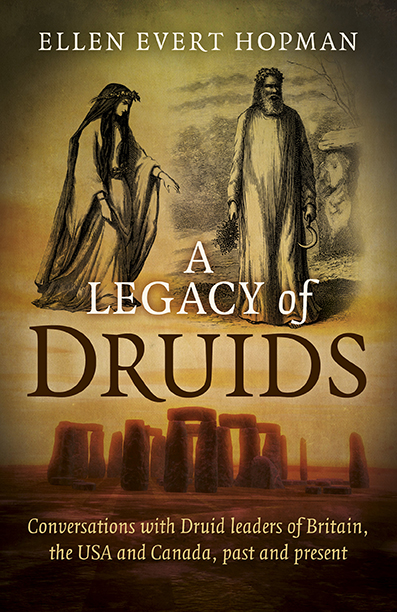
Review: Legacy of Druids - Conversations with Druid leaders of Britain, the USA and Canada, past and present by Ellen Evert Hopman


Review of Legacy ofDruids: Conversations with Druid leaders of Britain, the USA and Canada, pastand present by Ellen Evert Hopman (2016) Moon Books.

  • Paperback £14.99 || $25.95Apr 29, 2016
    978-1-78535-135-8

  • e-book £6.99 || $9.99Apr 29, 2016
    978-1-78535-136-5


Full disclosure: I was, to my amazement then and now, interviewed for this book. That is not why I like it, though I confess it is why I wanted to read it in the first place.

Why Review Legacy of Druids on Brigit’s Sparkling Flame?
I wouldn’t normally review a book like this on BSF as it isn’t actually about Brigit. However, there are two reasons to:

1) it contains an early interview of me (September 3, 1996) which discusses my own spiritual path, and of course that involves the origin of the Daughters of the Flame in 1993 and its workings till 1996 (pp 29-39).

2) More generally, it is fascinating from a historical perspective for Neo-Pagans generally, particularly but not exclusively those who identify as Druids or follow a Celtic-based path. Many Brigidines of course are in that number.

Thursday, September 08, 2016

Cartimandua and Brigit


The key paragraph here, where Koch and Carey suggest that Brigit and Briganti are correspondents, and that Brigit arose from Brigantes in the Kildare area, and even that she had a "mortal high priestess" there is all speculation, unproven and as far as I know unsupported, but this does help explain why so many people assume it to be true.

from The Celtic Heroic Age by Koch and Carey, 4th edition, 2003.

Monday, August 08, 2016

Three Loaves of Bread


This is lovely.

4 Then eight other virgins also received
the veil together with saint Brigit and the
virgins with their parents said, 'Don't leave
us. Instead stay with us and make your
home in these parts.'

5 Thereafter saint Brigit stayed with them.
 One day there came to Brigit
and her nuns three devout men who were
pilgrims and she regaled them with bread
and cooked bacon. The men ate the bread
but hid the three portions of bacon as they
did not want to eat it.

2 The following day Brigit greeted them
and said, 'See how much bread you have
left over!' When they looked they saw that
the three portions of bacon were three
loaves of bread.


From "Vita Prima Sanctae Brigitae Background and Historical Value", by Sean Connolly. The Journal of the Royal Society of Antiquaries of Ireland, Vol. 119 (1989), pp. 5-49.

Image: By L.Kenzel (Own work) [GFDL (http://www.gnu.org/copyleft/fdl.html) or CC BY-SA 3.0 (http://creativecommons.org/licenses/by-sa/3.0)], via Wikimedia Commons


Saturday, August 06, 2016

Art: Lorenzo Lotto, The Legend of St. Brigid


From the Web Museum at Christian Iconography Info, Lorenzo Lotto's mural, The Legend of St. Brigid:

1523-24
Fresco
Suardi Chapel, Trescore, Italy


The panel on the left portrays St. Brigid's taking the veil – that is, her consecration as a nun. The bishop is identified in one source as St. Mel and in another as a St. Maccaille"1 On the floor at Brigid's left are her former clothes; on the step above them is the white veil she will be wearing. White is traditionally St. Brigid's color, so the yellow habit she wears throughout the fresco scenes is a bit puzzling.2

Above the group of women on the right of this panel we see painted a scene of Brigid distributing milk to the poor. Her veil is not white but gray, a reference to the fact that this episode in her life occurred before her consecration.3

The middle panel gives us three scenes with four episodes from the life of St. Brigid. In the lower foreground, she blesses food and water, turning the water into beer.4 Behind her is a further episode in which she cures a blind man. The figure in rags behind the blind man is the "leprosus" who guided him to the saint.5 (The texts use leprosus indiscriminately for any poor person who is also ailing in some way.)

In the upper left of the middle panel, Brigid blesses a wild boar who was about to attack a flock (of pigs in the story, here a flock of sheep). Above her is a further scene in which the boar, having been blessed, grazes peacefully among the other animals.6

In the panel's upper right scene, the saint calms a storm that was threatening to ruin the harvest.7 In a nice touch of Renaissance perspective, Lotto places a well-satisfied harvester in the foreground with a big sheaf on his shoulder.

The episodes in the right panel are most likely drawn from some specific text. In the Suardi Chapel frescoes Lotto tends to follow his written source faithfully.8 However, I have yet to find a Life that corresponds to the scenes shown. In the foreground of the street scene, the saint takes a glass pitcher of milk from someone at a window. At her feet, two poor men have taken the pitcher, which is now empty (and perhaps broken – it is hard to tell from the photograph). 

Behind her, a number of what seem to be officials or soldiers are hustling a poor man off-stage.  There is one episode in the Latin vitae in which a poor man is condemned to death for breaking a precious vase and Brigid saves him by restoring the vase.9 Conjecturally, that could be what she is doing as she sits above the crowd scene on the second floor of the building.

Lotto's source for these episodes is most likely a work based on Cogitosus' Vita Sanctae Brigidae and partly on the Saint-Omer Vita in the Acta Sanctorum.10 Of the five vitae presented in the Acta Sanctorum, only Cogitosus has all five of the episodes in the left and middle panels, though Lotto departs from Cogitosus in a few details. Like Cogitosus, Lotto ignores or suppresses the references to fire signs in most other vitae. (Mysteriously prophetic fires are seen while Brigid is still in the womb, after she is born, and when she is consecrated as a nun.11) In Cogitus, this suppression is just one aspect of a persistent  de-mythologizing of earlier tales. In the miracle episodes, for example, the narrator continually attributes these wonders to God.12  {See my note below regarding this last statement.}

Detail of the right panel
Detail of the boar scene
Detail of the storm scene
More of St. Brigid


I take exception to the last statement, that Cogitosus is suppressing and demythologizing earlier stories. The evidence points toward Cogitosus's vita being the earliest, and as various authors have argued, much is added in later tales for a variety of reasons: each author from Cogitosus onward has had reasons for portraying Saint Brigit in the way they have chosen. (See Lisa Bitel, Landscape with Two Saints and Isolde Carmody and Chris Thompson "Revisiting Mythical Women 05: The Search for Brigid", for example.)

Christian Iconography Info, by the way, is quite a neat website. It endeavours to help viewers of Christian art unpack what is going on. Attend:

ChristianIconography.info
(formerly at www.aug.edu/augusta/iconography)

Learn how to identify the saints in medieval and renaissance art. 

Read the stories that the paintings refer to. 

Find out the "why" behind traditional elements in paintings of scriptural events. 

Use this search engine....  {HINT: You'll have to go to their actual page to use their search engine.}

Example: if you're curious about a picture of a saint shown with a tower, just enter "tower" into the search field (without the quotation marks). You'll learn she is St. Barbara, and you can read about her, view similar images, and follow a link to the medieval legend about her. 

.....or learn how artists have portrayed specific saints, topics, or scriptural events by clicking on any one of these links: 


Aaron     Abel     Abraham     Acisclus and Victoria ... {Have a look! There are saints galore.}