Showing posts with label Books. Show all posts

Wednesday, August 06, 2025

Pagan Portals - Brigid: Meeting The Celtic Goddess Of Poetry, Forge, And Healing Well by Morgan Daimler


Do you love Brigit? (Brigid, Bridget, Brig…) Are you her devotee? Or just kind of curious?

READ THIS BOOK! (And if you’ve already read it — read it again. Every time I do I find important bits I either missed or had forgotten.)

Morgan Daimler has done such an amazing job of gathering together and delving into the sources for our many ideas about her. This is an absolutely pivotal text. Please consider (and consider taking on board) what Morgan has to say on so many controversial points. But even if you don’t want your most dear beliefs about Brigit challenged at all (and Brig knows I don’t agree with *everything* Morgan suggests), revel in what you will learn here. Such a tiny book, yet it carries enormous weight.


Image: book cover with woman smith striking an anvil. Lots of red and orange and yellow and fire!

Monday, March 17, 2025

Ten Titles (and Thirteen Books) for Brigit


I am revising my online course, Discovering Brigit, and wanted to update the brief book list included there. These books are the ones I would point people to first, for a variety of reasons. Recall that I have a slew of unread and therefore unreviewed Brigit books, which I hope to get to over the next year and a bit. But for now, I’d like to share this with you.

Only one, Ó Duinn’s Rites of Brigid, is out of print, but you should be able to get that on interlibrary loan.


Top Ten Books for Starting Out with Brigit (Also Awesome for Oldtimers)


Bitel, Lisa M. Landscape with Two Saints: How Genovefa of Paris and Brigit of Kildare Built Christianity in Barbarian Europe (2009). (Nonfiction.)


Brigde, Mael. A Brigit of Ireland Devotional - Sun Among Stars (2021). (Poetry and essays.)


Clann Bhríde. Book of Hours - For Daily and Seasonal Practice (2013).


Curtayne, Alice. Saint Brigid of Ireland (1954). Reissued (2022). (Nonfiction.) 


Daimler, Morgan. Pagan Portals Brigid: Meeting the Celtic Goddess of Poetry, Forge, and Healing Well(2016). (Nonfiction.)


Freeman, Philip. Two Lives of Saint Brigid (2024).


Minehan, Rita CSB. Rekindling the Flame: a Pilgrimage in the Footsteps of Brigid of Kildare (1999). Revised (2022). (Nonfiction.)


Mole, Chris, et al. Brigantia Vol. 1 (2021) and 2 (2024). (Graphic novels.)


Ó Duinn, Séan OSB. Rites of Brigid - Goddess and Saint (2004). (Nonfiction.) 


Phillips, M.A. Rituals of Rock Bay Series:  (Fiction.)

Book 1: River Magic (2020); Book 2: Hearth Magic (2021);

Book 3: Forest Magic (2021);


Image: "book lot on table" by Tom Hermans on Unsplash.

Wednesday, November 09, 2022


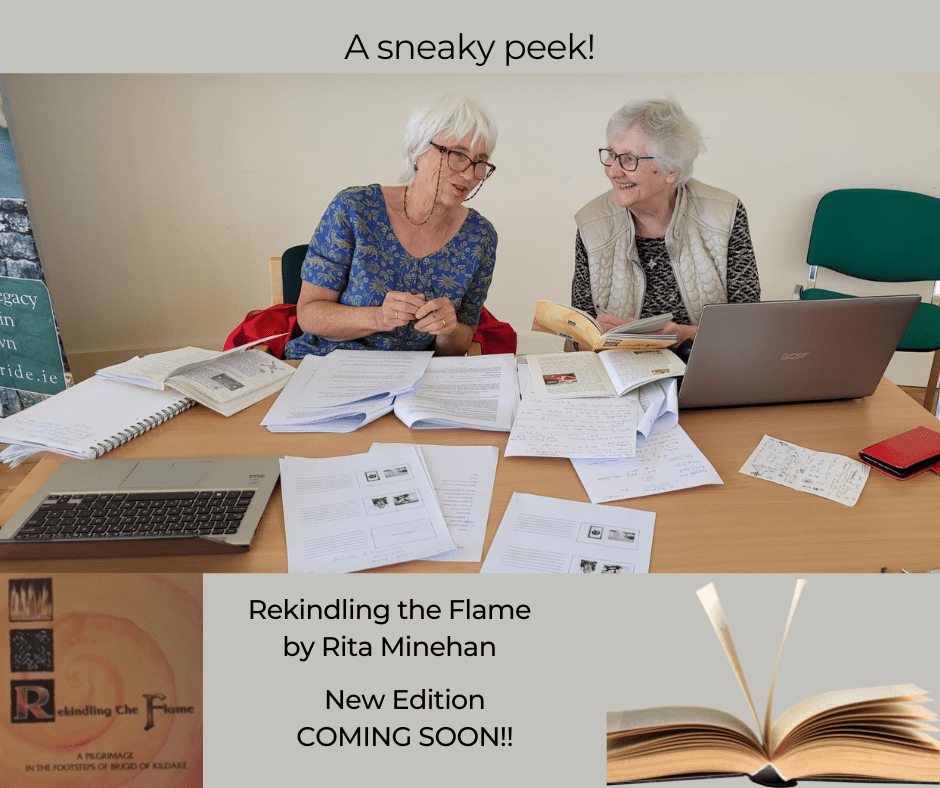
And speaking of books about Brigit! At long last, the sisters at Solas Bhríde are releasing an updated version of Sister Rita Minehan‘s book, Rekindling the Flame -  a Pilgrimage in the Footsteps of Brigid of Kildare.

From their newsletter:

Dear Friends,
The news you've been waiting on...a revised edition of 'Rekindling the Flame' is about to be published and will be available from Solas Bhríde from mid-December. The original book written by Rita Minehan csb has been hugely popular with pilgrims as it offered them a reflective guide to accompany them on their pilgrim journey in Kildare, from St Brigid's Cathedral to St Brigid's Garden and Wayside Wells. Rita's updated edition includes a history of the developments that have occurred in Kildare Town since 1999, in particular the opening of Solas Bhríde Spirituality Centre & Hermitages on Tully Road. The revised edition will appeal to those coming on pilgrimage to Solas Bhríde and Kildare Town but also to the many who have visited and wish to reflect on that journey through the story, legend, poems and meditations the book presents. The book will be officially launched on February 26th 2023, but more on that anon!!

Wednesday, November 10, 2021

Saturday, December 01, 2018

An Dagda's First Books Have Launched!


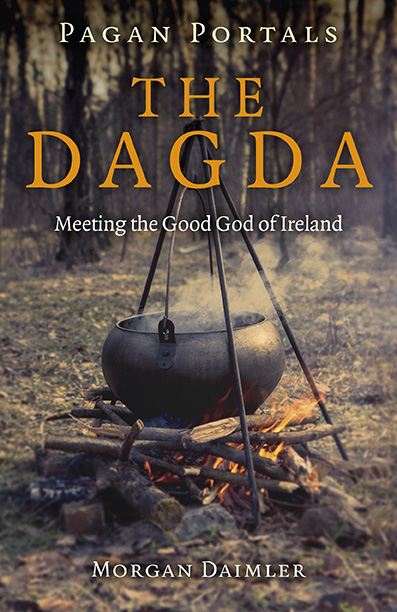
Pagan Portals - the Dagda 


I'm excited. Two separate books on The Good God, An Dagda, father of the goddesses Brigit, are now available. In my time of devotion to Brigit I have come to know her parent somewhat and fallen in love with him. I am thrilled to have these two opportunities to know him more.

Until now, those interested in The Dagda have had to scrape together their information from widely dispersed sources. In late October Morgan Daimler's Pagan Portals book, The Dagda, was released. A slim volume, like all Pagan Portals titles, it is the first book entirely devoted to this important Irish god. I haven't read it yet, but it sits on the table awaiting my attention. I've read several of Morgan's books and have never been disappointed. 

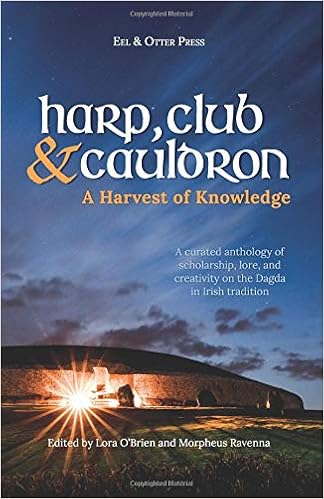
Minutes ago, Morpheus Ravenna and Lora O'Brien launched their anthology Harp, Club, and Cauldron - A Harvest of Knowledge. Many respected (and beloved) writers and artists have contributed to the book: Isolde Carmody and Chris Thompson from Story Archaeology, Anthony Murphy, author of Mythical Ireland: New Light on the Ancient Past, Segomâros Widugeni, author of Ancient Fire: An Introduction to Gaulish Celtic Polytheism, Valerie Herron, the artist responsible for the delightful works in Ravenna's book on the The Morrigan, The Book of the Great Queen, Morgan Daimler herself, and many others. (I have a poem in there, myself, speaking with Brigit about her father.) Having had a glimpse of the ebook, I am more than ever looking forward to having the book in my hands, .

Now is a great time to have the profile of the Dagda raised. A god of many abilities, protector of his people and linked to the health and balance of his land, he is a powerful ally in a world filled with disharmony and fear. His cauldron of plenty, his harp that can bring sorrow, laughter, or sleep to those who listen, his club which kills with one end and restores to life with the other, his great appetites and his ability to do what needs to be done under any circumstances--An Dagda's influence needs to be felt now more than ever.

It may take a few hours for the anthology to become available--the button is pushed, but Amazon sometimes takes a while to catch up. So if you get a "not currently available" note, fear not. It's on the way.

For those of you who have grown interested in or close with An Dagda, you might also want to join the Facebook group The Dagda's Hearth. I'll see you there, perhaps?


Original Fund-Raising Video for Harp, Club, and Cauldron:

Friday, July 15, 2016

Book Review: Pagan Portals - Brigid by Morgan Daimler


Daimler, Morgan. Pagan Portals—Brigid: Meeting the Celtic Goddess of Poetry, Forge, and Healing Well, Moon Book (2016). 112 pages.


  • Paperback £4.99 || $9.95Mar 25, 2016
    978-1-78535-320-8
  • e-book £2.99 || $3.99Mar 25, 2016
    978-1-78535-321-5

AVAILABLE ONLINE FROM: Amazon US, Amazon UK, Hive, Indiebound.

__________________________________________________________________________

An excellent primer, and the best available for getting a a handle on the sources, ancient and modern, for our understanding of Brigit. I can't recommend it highly enough.

Morgan Daimler is the author of a number of books and shorter works of poetry, fiction, and nonfiction, and is gaining a reputation for clearly written, well researched, and extremely useful handbooks such as this one on Brigit.

Brigit is the spiritual being to whom I have devoted decades of my life, in study and devotion and in supporting others in their journeys on Brigit’s path. I discovered in Pagan Portals—Brigid, to my joy, a book that wastes no words—it is a slim volume indeed—but packs into those pages more clear and illusion-lifting information than I have ever seen set out about Brigit.

The reason is this: Daimler has gone straight to the medieval texts, finding references to Brigit and explaining them lucidly—indeed, clarifying for the reader which text treats her in which way, rather than allowing them to blur together in our minds; she tackles the early geography of goddesses-who-may-be-Brigit; she takes the complex blend of ancient, folk, and modern conceptions of Brigit and sorts them deftly out so the reader can see where commonly heard assertions come from and make up her own mind about where to follow and where not.

Daimler explores animal and plant associations and symbols commonly associated with Brigit, such as triplicity, touches on her holidays, prayers, chants, and charms, and looks at the rise of  modern Brigidine myths and flame-tending, as well as providing hints for honouring Brigit today and supplying a diverse resource list and bibliography.

She ends each chapter with a short essay on her personal connection to Brigit, thus grounding the theory in personal practice. Indeed, although emphasis is put on making assertions supported by solid academic material and distinguishing these from our personal beliefs, she is careful to point out that she does not believe that “the religious framework we use to connect to the Gods matters as much as the effort to honor the old Gods itself. I think we can all do this respectfully and with an appreciation for history without the need for any particular religion. Whether we are Reconstructionists, Wiccans, or Celtic pagans all that really matter is that we are approaching our faith with sincerity and a genuine intention.” I would add that this book would be useful to anyone interested in Brigit, goddess or saint, be they NeoPagan, Christian, or secular scholar, for the information is so well laid out that any further studies or devotions would only be enhanced by the reading of this book.

____________________________________________________________________________


From the publisher's website:

Pagan Portals - Brigid is a basic introduction to the Goddess Brigid focusing on her history and myth as well as her modern devotion and worship. Primarily looking at the Irish Goddess but including a discussion of her Pan-Celtic appearances, particularly in Scotland. Her different appearances in mythology are discussed along with the conflation of the pagan Goddess with Catholic saint. Modern methods for neopagans to connect to and honor this popular Goddess include offerings and meditation, and personal anecdotes from the author's experiences are included as well.

Who was Brigid to the pre-Christian pagans? Who is she today to neopagans? How do we re-weave the threads of the old pagan Goddess and the new? Learn about Brigid's myths among the pagan Irish, the stories of Bride in Scotland, and the way that people today are finding and honoring this powerful and important deity to find the answer.

Saturday, January 23, 2016

Children's Books about Saint Brigid


Fox Leaping Through a Hoop Made from Brigit's Skirt - by Caroline Cory

I will confess right off the top that I have found these links online but have not actually seen any of the books. What a plethora compared to just a few years ago! And the ones I knew (see my reviews in the pages links above) are not even among them.

Holy cow. (As it were.)

The Truth About St Brigid - By the pupils of Saint Brigid’s School for children with special needs in Mullingar. (There is a video of the book, and all proceeds go to buying a bus for the school. If they haven't got it already - it's been a year since the posting.

Holy Crocodile!: Taming Foxes -- The story of Brigit and two foxes feature in one chapter of Cory's book about saints and animals.

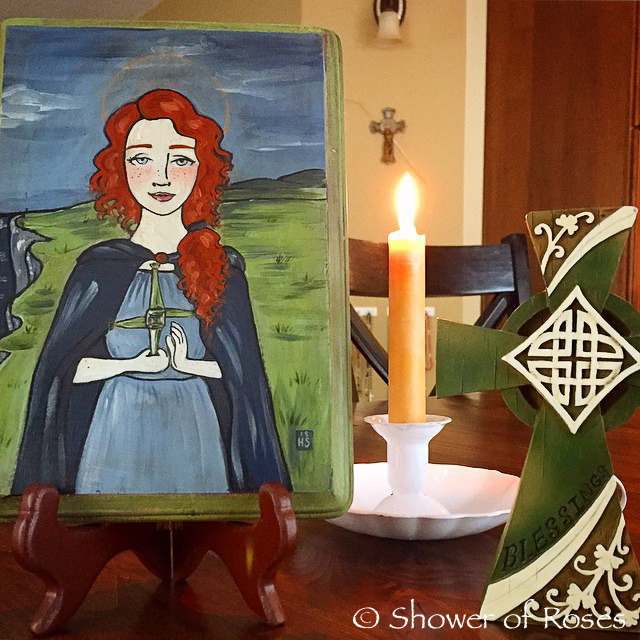
 Shower of Roses: Celebrating the Saints :: St. Brigid of Ireland -- This one is a blog posting that features different books and a personal story of her daughter's love for Saint Brigit.


Saint Brigid and the King's Wolf  -- by Rhode Island art educator and illustrator, Mary Kane Hendrickson.


Saint Brigid the Fearless - In a Nutshell -- from Poolbeg's "In A Nutshell" series.


The Story of Saint Brigid -- by Catriona Clarke


Thursday, July 31, 2014

Brigit Reviews (Series Six): Nonfiction, Academic/Popular Academic


Finally! The last installment of my promised book reviews. A pleasure it was to acquaint myself with the breadth of writing available on Brigit. I'll pin links to the reviews on the Pages tab (below the title banner of this blog) in order to make them more accessible to later readers, and will also make the whole lot available by request as a pdf. In the meantime you can find the previous reviews and introductory material at these links:


Brigit Reviews (Series Six):
Nonfiction, Academic/Popular Academic

By “academic/popular” I mean books written in a scholarly style but accessible (sometimes with a real effort) to a general audience. They are footnoted, backed up citations, and so on, and so the thinking in them can be more or less traced and verified. These I can only observe as a reader, not criticize as an expert.

The Serpent and the Goddess: Women, Religion, and Power in Celtic Ireland, Mary Condren (1989)

“Fire and the Arts” (etc) in Pagan Past and Christian Present in Early Irish

            Literature, Kim McCone (1990)

The Festival of Brigit, Séamas Ó Catháin (1995)

Celtic Goddesses: Warriors, Virgins and Mothers, Miranda Green (1996)

“Imbolc: A New Interpretation”, Phillip A. Bernhardt-House (pp 57-76) in Cosmos 18 (2002)

The Rites of Brigid, Goddess and Saint, Seán Ó Duinn (2005)

Landscape with Two Saints: How Genovefa of Paris and Brigit of Kildare Built Christianity in Barbarian Europe, Lisa M. Bitel (2009)

“Queering the Flame: Brigit, Flamekeeping, and Gender in Celtic Reconstructionist Pagan Communities”, by Erynn Rowan Laurie in The Well of Five Streams: Essays on Celtic Paganism (Immanion Press, projected release 2015) 17 pp.


Introduction

There are some delicious writings in here, with lots of obscure references and nimble interpretations; a cornucopia of ideas to mull over in building an understanding of Brigit. Two recommended sources which give abundant info on the world in which St Brigit lived are Early Medieval Ireland 400-1200 by Dáibhí Ó Crónín (1995) (not reviewed here) and Bitel’s Landscape with Two Saints: How Genovefa of Paris and Brigit of Kildare Built Christianity in Barbarian Europe. Placing her in the context of her world allows for a much deeper look into her Lives and mythos, helping us to notice where our assumptions are modern and inappropriate, and allowing us to develop a more balanced perspective.

Though the earliest of these investigations, Condren’s The Serpent and the Goddess is less about Brigit as it is the Christian church in Ireland and its treatment of women. I don’t recommend it for developing an understanding of Brigit.
In The Festival of Brigit, Ó Catháin explores the festival of Imbolc and searches far afield for evidence linking Brigit to, for example, the bear cult and horned deities. Fascinating reading, carefully explored and documented.

McCone’s Pagan Past and Christian Present contains important insights into sacred kingship, the sovereignty goddess, and the three major divisions of Celtic society and convincingly suggests their reflection in Brigit’s various personae.

Green examines the place of women and female deities in Celtic society, and focusses on a number of female-related themes and specific goddesses in Celtic Goddesses: Warriors, Virgins and Mothers. Brigit is looked at in the chapter on the transition from paganism to Christianity.

Bernhardt-House offers a detailed and unique examination of the meaning of the word Imbolc and its possible links to the wolf in ancient times in “Imbolc: A New Interpretation”.

In The Rites of Brigid, Ó Duinn examines a variety of Brigit-related folk customs. He compares in detail the perpetual fires of the Vestal Virgins and Brigit, and describes other sacred and perpetual flames in medieval Ireland.Very useful.

Bitel looks at some important Lives of St Brigit in Landscape with Two Saints, comparing that by Cogitosus of Kildare with those of later writers of Armagh, and putting them into the political context of their times. She examines the legacy of Brigit, and the changing role of women in Ireland.

A rather different perspective is offered in Laurie’s “Queering the Flame: Brigit, Flamekeeping, and Gender in Celtic Reconstructionist Pagan Communities”. This piece, which could have fit well into the Nonfiction, Popular (NeoPagan) section, I place here because of Laurie’s exacting standards of research and presentation. (Footnotes and citations and quotes, oh my!)

You may notice trouble linking to footnotes through their symbols. No worries. Just scroll to the end of the post and they are there.

Read More!

Monday, February 24, 2014

Dumb St. Brigit Joke


Knowing well my affection for the sacred woman, my niece told me a joke about St. Brigit that she got out of a book I gave the family years ago in the hopes of bestowing a cultural blessing of some sort.

The book is The Cut-throat Celts from the Horrible Histories series by Terry Deary and illustrated by the lovely Martin Brown.

Now, I don't have the book in front of me, so I have to give you my niece's version, but I suspect it's close.

Q: Why is Saint Brigit like a lonely teacher?

A: Because she only has one pupil.

Thanks, FJ!


Tuesday, February 11, 2014

Brigit Reviews (Series Five): Nonfiction, Popular (Neo-Pagan)


This post follows rather belatedly on the earlier reviews of children's Picture Books, etc. When I have completed the Sixth and final series (Academic/Popular Academic) I'll pin them all to the Pages tab below the title banner, in order to make them more accessible to later readers. In the meantime you can find the previous reviews and introductory material at these links:

Brigit Book Reviews (1): Introduction


Brigit Reviews (Series Five): Nonfiction, Neo-Pagan

Candlemas: Feast of Flames, Amber K and Azrael Arynn K (2001) Llewellyn Publications
“The Well of Her Memory” in Red-Haired Girl from the Bog, Patricia Monaghan (2003) New World Library
‘‘Imbolc—Brigit”, Alexei Kondratiev,  in Devoted to You, Judy Harrow (2003) Citadel Press
Brighid’s Healing: Ireland’s Celtic Medicine Traditions, Gina McGarry (2005) Green Magic
Ogam: Weaving Word Wisdom, Erynn Rowan Laurie (2007) Megalithica Books
Brigid: Goddess, Druidess and Saint, Brian Wright (2009) The History Press
Brighid and Me: Experiences with the Goddess, Hollee Swann, ed. (2010) copyright Helen Roberts Hollee Swann
Brigit: Sun of Womanhood, ed. Patricia Monaghan and Michael McDermott (2013) Goddess Ink
Pagan Portals—Brigid: Meeting the Celtic Goddess of Poetry, Forge, and Healing Well, Daimler, Morgan (2016) Moon Books

Introduction

We have a mixed bag in this category, some excellent, some I don’t recommend at all, and some I recommend with certain reservations. A few of these reservations crop up repeatedly, in particular the failure of authors to cite their sources and the mixing of fact with guesswork—their own or that gleaned from other writers.

A useful guideline for dealing with one sub-category of the latter problem can be found in the concept of UPG. (See below. ) It is a variation on a basic principle of nonfiction writing: only present as fact what can be established as such. Represent your own ideas and those of “the popular mind” as what they are. This does not make them less important. Insight and innovation nourish our growing appreciation of and connection to Brigit in the modern world. Delineating between our own ideas and defensible traditions simply allows each individual to draw their own conclusions, in possession of as much clear, and clearly sourced, information as possible.

The Ks’ book, Candlemas, suffers from a lack of citations—there are some but not many and they aren’t all useful—making it frequently impossible to check their statements. It also suffers in offering unproven assumptions as fact, particularly annoying when they are in doubt or disproven elsewhere. Despite this it is a lovely jumping off point for thinking about Brigit and the festival, with lots of warmth, imagination, and ideas for celebration, Neo-Pagan-style.

Monaghan’s essay, “The Well of Her Memory”, offers a well written and interesting personal perspective on Brigit and her modern celebration in Kildare. A couple of her statements, again not cited, are dubious, however, and I would verify elsewhere any new ideas you find here that you want to embrace.

Kondratiev, too, at times presents imagination as fact in ‘‘Imbolc—Brigit”. Yet he does have a good background in Celtic studies and it is a pleasure to imagine along with him. He offers numerous ways to celebrate a Neo-Pagan Imbolc, as well. Worth the read.

I can’t speak to McGarry’s herbal information, which may be solid, but, despite her obvious goodwill, as a book about Brigit or Celtic tradition Brighid’s Healing: Ireland’s Celtic Medicine Traditions is very unreliable. Nor does it have much obvious to offer around actual Irish herbal traditions. Not recommended.

Laurie has done an excellent job in Ogam: Weaving Word Wisdom. This book is not specifically about Brigit, but she appears frequently in its pages, placed to an unusual degree in the context of the Celtic mindset from which she emerged, and the Neo-Pagan landscape in which she now finds herself. It is well-footnoted and carefully distinguishes Laurie’s own ideas from tradition, offering modern innovations and explaining how they adhere to or differ from what is known of the beliefs and values of the Celts.

Despite some interesting photos and tidbits, I can’t recommend Wright’s Brigid: Goddess, Druidess and Saint. Instead of distinguishing his hypotheses from known facts, he puts forward his own imagined history, unsupported by evidence, quite forcibly as reality, thereby giving a very misleading picture of things.

Swann has put together a nice little pamphlet of personal essays by various Neo-Pagans on their relationship to Brigit in Brighid and Me: Experiences with the Goddess. I like it, and was pleased to be asked to write an essay for it, so I leave it to you to decide if I am biased.

I’m going to cheat and not actually review Monaghan and McDermott’s Brigit: Sun of Womanhood. It was published after the writing of the other reviews here, which have been long delayed in publication due to health issues in my life. Rather than delay yet longer as I read and review Sun of Womanhood  I will say only that it exists, and that it is a collection of largely Neo-Pagan writings, though there are offerings from Christians as well.


Daimler’s Pagan Portals: Brigit is a short (112 pg.) and very focussed look at the goddess Brigit. If you can afford only one book about Brigit, this is it.


Useful Terms:

When discussing books written by authors of a spiritual bent, the terms UPG, SPG, and CG can come in very handy.

UPG (Unsubstantiated Personal Gnosis): Information gained through meditation, intuition, visions, etc., which cannot be substantiated by lore or research but is usable in the individual’s practice. Labelling as UPG helps prevent misunderstandings about verifiable sources and preserves intellectual honesty. “UPG” specifically indicates beliefs arrived at via mystical means, not ideas or intellectual conclusions reached from academic research.

SPG (Shared Personal Gnosis) — A mystical vision and belief shared by a number of people.

CG (Confirmed Gnosis) — Substantiating evidence for UPG or SPG may later be found in the lore, rendering it CPG (Confirmed Personal Gnosis). These instances are highly valued, and have served to bolster individual and community faith in the Deities, spirits or ancestors from whom the information was received. Instances of CG are also very important in that over time they help us learn to distinguish true imbas from imagination. (Imbas is the Old Irish word for “inspiration.” In Modern Irish it is spelled iomas. )

                                                   Distilled from the CR FAQ (available online or in book form.)


Click below to read the reviews.

Monday, February 10, 2014

REVIEW: Brigid: Goddess, Druidess and Saint, by Brian Wright


This book review by Dorothy Ann Bray was first published in Folklore 121 (December 2010): 346–362.


Brigid:Goddess, Druidess, Saint. By Brian Wright. Stroud: History Press, 2009. 255 pp. Illus.
£18.99 (pbk.). ISBN 976-0-75244-865-7

Saint Brigid of Kildare is considered one of Ireland’s foremost saints of the early Christian period, along with Saint Patrick and Saint Columba. Her floruit was supposedly the late fifth century to the early sixth century and she is credited with the foundation of a major monastic community of both monks and nuns at Kildare. Her cult spread from Ireland into Wales, Scotland, England, and the Continent, and continues to the present day. Her hagiographical tradition is extensive, with her earliest Life dating from the mid-seventh century. Her folkloric tradition is even more extensive: on her feast day, 1 February, she is celebrated with special rituals and customs; several holy wells have been dedicated to her; in the Hebrides, she has been associated with the Virgin Mary—as her midwife, no less; and she has been closely identified in the modern era with a pagan Irish deity of the same name, to the extent that many people believe that she is the goddess Christianised. A book that draws together her early and later traditions, and examines the popular folklore surrounding her, ought to be welcomed—but, unfortunately, not this book.

Brian Wright does draw together Brigid’s early traditions in his first few chapters, beginning with a discussion of the origins of the goddess Brigantia who became venerated as “Brighid” (sic) in Ireland, thanks to the druids (according to him). Brigid the saint, he believes, was a druidess who converted to Christianity and, with her fellow druids and druidesses, founded the monastery of Kildare. Alas, there is no evidence whatsoever for this. Wright offers a potted history of pre-Christian and early Christian Ireland that takes theories for fact and makes use of sources in an uncritical way. His account of the goddess Brighid, about whom he admits few tales exist, is devised in a similar fashion, where he synthesises several discrete strands of mythological lore and speculative ideas.

When it comes to relating the customs and traditions connected to Saint Brigid, Wright proceeds from the firm conviction that many of these stem from the pre-Christian beliefs and lore surrounding the goddess; most of the miracles of Saint Brigid, including the multiplication of food and drink and control of the weather, are, according to him, survivals of the deeds of the pagan goddess. He does not take into consideration the miracles of Christ (except once, on page 235, where the hagiographer himself does it), although he does allow that her early hagiographers adapted these deeds for a Christian moral purpose. ButWright’s purpose is not to examine these tales, customs, and beliefs in any scholarly way; this is meant as popular book for a non-academic audience. There are no references to his sources in either footnotes or endnotes. Translations of hymns, prayers, and saints’ lives go unacknowledged. This, however, is a disservice to his readers, academic and non-academic alike, both of whom might like to follow up his sources. Although he provides a list of Further Reading, this is a jumble of the scholarly and nonscholarly, and a mess in terms of citation; journal articles are cited as if they were books, and one item is, in fact, cited twice, owing it seems to some confusion over the authors’ names (Amber, K and Azreal Arynn K or K, Amber and K, Arynn—which is it?).

Wright does actually provide some extensive compilations of folk customs and traditions surrounding Brigid, including Saint Brigid’s Day celebrations. However, his account is no substitute for Séamus Ó Cathaín’s The Festival of Brigit: Celtic Goddess and Holy Woman (1995). On the other hand, Wright does tell his readers how to make a Saint Brigid’s cross in Chapter Seven, “Celebrating the Goddess-Saint in Ireland,” and Chapters Eight and Nine contain a compendium of Brigid’s traditions in Scotland, Wales, and the Isle of Man. Chapter Eleven, on holy wells, also brings together several of Brigid’s folk customs and beliefs associated with wells, although Wright does not consider the possibility that not all wells dedicated to Saint Brigid may have been pre-Christian sites of worship. It is simply assumed as a fact.Wright is billed as a teacher of folklore and British mythology in Somerset and Devon, and his local interests are evident in his chapter on the tradition of Brigid’s association with Glastonbury (Chapter  Ten). In his final chapter, he lists some of the modern manifestations of the veneration of the “goddess-saint” and ends with a brief advertisement for the Friends of Bride Mound at Glastonbury.

Had he stuck with simply bringing together the modern folk customs and beliefs of Saint Brigid—and had he offered proper references—Wright might have produced a book both interesting and useful. As it is, this book is seriously limited in value. It is also very poorly written. Individual chapters are badly organised internally, and the entire text is riddled with grammatical errors (sentence fragments abound) and mistakes in spelling and punctuation. For example, a common and consistent error is the use and misuse of the apostrophe (“it’s” for “its,” and vice versa); these and mistakes like “Keeting” instead of “Keating” (p. 70), “formerly” for “formally” (p. 135), and   “Cannon” for “Canon” (p. 189), to name but a few, suggest that no human copy-editor laid eyes on the manuscript prior to publication. Yet the material quality of the publication is high: it is printed on good, heavy paper; the photographs and line drawings are well reproduced; and the front and back covers are colourful and eye-catching. But priced at £18.99, this is asking too much for what it is. The content just does not live up to the packaging.

Dorothy Ann Bray, McGill University, Montreal, Canada


©2010, Dorothy Ann Bray