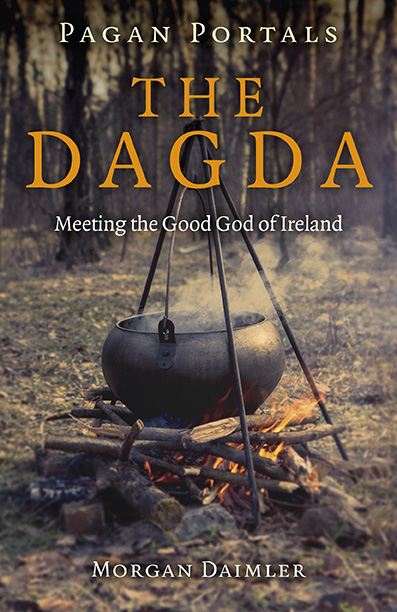
Pagan Portals – The Dagda: Meeting
the Good God of Ireland
Morgan Daimler (2018)
It’s strange to feel so excited to
read a book that has actually been waiting in my bedside cabinet for nearly two
years. But that’s how it is. And now that I have now finally read The Dagda,
I can’t stop raving about it. It is a jewel on my bookshelf.
Pagan Portals – The Dagda is far from the first book I’ve
read by Morgan Daimler, nor will it be the last. They have become one of my favourite authors
for a few simple reasons: their
research is meticulous, they draw together the important myths, gleaned
from early and modern
texts – they even taught
themself how to read old Irish because they wanted more than the translations
they had on hand were offering. Daimler has
a wonderful way of looking at things from a new angle, and this book continues
in that tradition.
I was looking forward to this book
in particular because I was drawn to The Dagda, personally. He drew me
initially by his own personality and his actions in the tales, particularly of his
building single-handed a fort for Bres, and carving out twelve plains in a one day.
But more important was his being father to the sisters Brigit. Because Brigit
is so important to me, I wanted to cultivate an acquaintance, at least, with
someone who helped shape these sisters as they grew.1
The
Pagan
Portals
series is devoted to short books
– up
to around a hundred pages
long – that are meant to
introduce the key elements
of a deity or topic. In this case the book is nearly eighty pages, and they
have divided the material up well. In chapter one, “Who is The Dagda?” they begin
by giving his names and the epithets that describe him, and address how a sense
of his nature can be drawn from them. This necessarily takes us into the myths
themselves, so although they don’t tell them exhaustively, they reveal enough
that we can understand why he might be called Eochaid Ollathair, and that “The
Dagda” means “The Good God.” But what does that mean? Does it mean he’s
a nice guy? Well, no. It means he is good at all things. So just the definition
of this one name, and he has many, tells us something important about him. This
initial chapter grounds us not only in his names, but in how he’s been
described physically in the tales, and gives a glimpse of his relationships with
others. (This is a complicated kettle of fish as he has many lovers, many
children, and his children, like himself, have run into real difficulties
because of some of those lovers).
One thing that Morgan always does
which I greatly appreciate, is they provide useful end notes to each chapter,
and provide a good bibliography. I can see where they’re getting their information
from; I don’t have to just trust them. I can then decide whether I agree with
their take on things, and that is important to me, especially in something so essential
as the nature of the deities.
The second chapter is “The Dagda in
Mythology.” Here they explore where The Dagda figures most prominently in the different texts. As they work
through these, his personality and what he may represent to the devotee become
more and more clearly defined, leading to an overall sense of what we know of
him. This chapter also has an interesting reassessment of
the Samhain sex
tryst between The Dagda and The
Morrigan.