The welcoming hands at the parish of Saint Brigid
“Amid the galaxy of the saints, how lustrous, how divinely
fair, shines the star of Brigid, the shepherd maiden of
Faughard, the disciple of Patrick the Apostle, the guardian
of the holy light that burned beneath the oak-trees of
Kildare! Over all Ireland and through the Hebridean
Isles, she is renowned above any other. We think of
her, moreover, not alone, but as the centre of a great
company of cloistered maidens, the refuge and helper
of the sinful and sorrowful, who found in the gospel that
Patrick preached a message of consolation and
deliverance. Let it be remembered that the shroud of
Patrick is deemed to have been woven by Brigid's hand;
that when she died, in 525, Columcille, the future apostle
of Scotland, was a child of four. So she stands midmost
of that trilogy of saints whose dust is said to rest in Down.”
--Alice Milligan (from ‘Irish Heroines’)
Interior of Saint Brigid's Cathedral
When Saint Brigid was given leave to pursue her religious vocation she is
said to have gone to Kildare to establish an Abbey where she reigned as
its first Abbess. During the medieval period this abbey became
hugely significant throughout Ireland and its Abbess wielded considerable
political power. This power was retained right through to the time of the
Flight of the Earls, when it is rumoured that the nuns of the abbey were
raped as a potent symbol of the final breaking of the religious and
political power of the Abbess. From this time on the famous flame of
Brigid fell into cold ashes until more recent times.
The ancient High Cross in the cathedral grounds
I’ve already written a little of Saint Brigid in other places and I
don’t want to repeat what I have already said. Here, I would
like to say more of her role in the establishment of the
abbey in Kildare. Saint Brigid first enters Irish history as a
disciple of Saint Patrick, acclaimed by Saint Fiech, also a
disciple of Patrick. Fiech flourished around 520AD and is
said to have written a life of Saint Brigid. This is now lost bar
a few cursory fragments, but his somewhat astonishing
hymn of praise to Saint Brigid – ‘Audite Virginis Laudes’ –
still survives. The hymn is a list of miracles attributed to
Saint Brigid listed in alphabetical order with each line
composed of sixteen syllables. There is a longer and fuller
version in the manuscript of Saint Magnus, but to my
knowledge this has never been reprinted or translated.
In any case even shortly after her death, Brigid was already
being honoured as a Saint and was to prove an incredible
inspiration for many Irish saints of the period, most notably
Saint Brendan, Saint Ultan, Saint Erc, Saint Fiech and Saint
Ninnicíus (her chaplain while she was alive). By the
Middle Ages, Saint Brigid was one of the best known and
greatest loved of all saints throughout all of Europe. She
appears regularly in the Breviaries of the Middle Ages and
continues to be mentioned (although with lessened
materials and hymns attributed to her honour) up until the
printing of the 1522 Venice Breviary and the 1622 Paris
Breviary. Some of the Breviaries of the Middle Ages even
contained an Office of Saint Brigid which was reproduced
in the Kilmoon Breviary here in Ireland (only some very
badly damaged fragments of this manuscript now survive,
but a better copy is preserved in the Antiphonary of
Clondalkin). Brigid became so greatly honoured in Ireland
that she became known as ‘Mary of the Gael’ and many of
the stories of her life by the early medieval period begin
to draw strong parallels between her and the Mother of God.
Chapel of the Reserved Sacrament on the parish of Saint Brigid
There has been a persistent rumour that Brigid took up
her religious vocation at the very tender age of fourteen. To
this day the people of Dundalk insist that the church at the
top of Faughart Hill is part of the original foundation of Saint
Brigid. It may be possible they are right, but records point
to it being the dwelling place of a holy woman, who in all
likelihood had a deep influence on Brigid. This woman is not
considered to be a saint and there is some confusion as to
her real name. She does appear to have been honoured in some
way though, because a church was built on the site of what was
supposed to be her home - possibly out of interest in her
possible link to Saint Brigid. Kildare, however, remains
the main site associated with Saint Brigid and her order of
nuns. While abbess there she is described as being fearless,
strong willed and politically astute. She held a deep concern
for the poor and was particularly keen to care for the sick
and ill – hence why so many of her wells are considered to be
healing wells.
The site of the well and the statue of Saint Brigid
It is now generally believed that in the period of early Christ-
ianity in Ireland, that the native Irish did not hold a
common pagan pantheon of gods and goddesses, but rather
that each area held its own beliefs and practices (this is also
attested to in quite a number of the records of the early Irish
saints); some having a complex order of gods and goddesses,
while other areas practiced something akin to animism or
elemental worship. It is in the area of Kildare and Athlone that
Saint Brigid is said to have found a substantial area where two
main systems of belief held great sway over the people. In
Athlone, worship of the moon prevailed as the dominant form
of belief (‘Ath’ meaning ford and ‘Luan’ meaning moon. Kildare
means ‘place of the oak’). In Kildare, the properties of light and
heat were honoured in the form of fire and a fire temple was
said to have been kept alive by many worshippers. It was at the
fire temple that Brigid is said to have established her commun-
ity, using the site as a new focus for a better light to the people.
This is an incident that demonstrates her political astuteness.
Rather than condemn the people in their fire worship, she
quietly turns it to her advantage and sustains a place of
ancient reverence as a new Christian community and overlays
it with a new symbolism to suit her mission. Saint Brigid is
said to have kept this flame alive as a potent symbol of the
light of Christ, but sadly the flame was to go out. The flame was
snuffed out by a Norman Bishop and then again by Henry VIII -
who was likely the last person to snuff it out. In 1993 the
Brigidine Sisters (a new order of nuns that associates itself
with the charism of Saint Brigid) symbolically re-lit the flame
of Saint Brigid and plans were set in place to create an eternal
flame in the heart of Kildare town. On 1st February in 2006
a well made bronze monument to house Saint Brigid’s flame
was unveiled by President Mary McAleese, but the flame has
since been replaced by a rather horrible plastic flame effect!
There are two significant churches in Kildare. The oldest
church is Saint Brigid’s Cathedral and round tower, with the
remains of a high cross and the fire temple in the grounds.
The original foundation would have been a wooden structure,
but the cathedral was built in stone between 1223 and 1230
and even by this stage it had been repeatedly ravaged. By 1500
it was in a semi ruinous state and left completely derelict in
1649. An attempt was made to partially rebuild it in 1686, but
it wasn’t until 1875 that work began in earnest to make it a
functioning and safe church to worship in once again. It’s an
interesting building with many well preserved fine stone
carvings. Tour guides will tell you that a Sheelagh-na-gig can
be found on the Wellesley tomb in the cathedral – it’s a lie!
Unfortunately it is a rather dull cherubic acrobat, unusual,
but no Sheelagh-na-gig (if such things exist at all!)

The Roman Catholic parish of Saint Brigid has a modern
interior, which works well in some aspects, but not in others.
It does have some rather beautiful bronze doors with
welcoming open hands as handles! However, even here it
is somewhat disheartening to see a modern myth retold as
if it were fact. Not so very long ago a ‘learned academic’ from
TCD decided to make a pronouncement that Patrick likely
never existed, that Brigid was really the pagan goddess
Brigit and that neither had been properly canonized as Saints
by the Roman Catholic church. As you can imagine it made a
little flurry in the press. There has been some confusion over
Brigid’s name and its spelling, but this is not uncommon
among Irish saints. She is referred to at times as Saint Bride
by Saint Ninnicíus, as Saint Brigit by Cogitosus and Saint
Ultan and mainly as Saint Brigid by all others. All names
refer to the same person. The idea that there was ever a pagan
goddess with the same name is highly unlikely and hugely
speculative. There is a brief reference to a goddess with the
name of Brí in Cath Maige Tuireadh, a twelfth century
document and some try to cite references to her in ‘The Book
of Invasions’ (Lebor Gabála Érenn), an eleventh century work.
Both of these texts have been repeatedly cited as evidence for
the existence of a pagan goddess by the name of Brigid, Bride
or Bridgit. Maybe I’m too skeptical, but I’m really not convinced
by this at all. None of Brigid’s contemporaries relate that her
name bears a strange closeness to a pagan god, neither do
any of her subsequent biographers – a fact that it would be
very hard to believe would have escaped their notice.

The remains of the fire temple in the grounds of the cathedral
Saint Brigid’s well is actually a little way out of the town of
Kildare towards the National Stud. Legend has it that Saint
Brigid was in fact Abbess over the women’s abbey in Kildare
and also had control and governance of the men’s monastery
which was very close to the site of this well. Whatever the
truth of the matter, by the ninth century the monastery has its
own male Abbot and the well would have been important for
both practical matters and religious ones to the adjoining
monastery. Saint Brigid is said to have used the well to baptize
converts.
The arch marking the point where the underground river surfaces
The well is in a somewhat unusual setting. It’s down a narrow
road towards a modern house near the National Stud. Horses
peer curiously at passing pilgrims. As you enter the area it is
fenced off from the surrounding countryside with trees planted
- some dedicated to the work of cross community groups and
planted in hope, and others in memory of loved ones and
planted in faith. The well is up at the far end of the enclosure; a
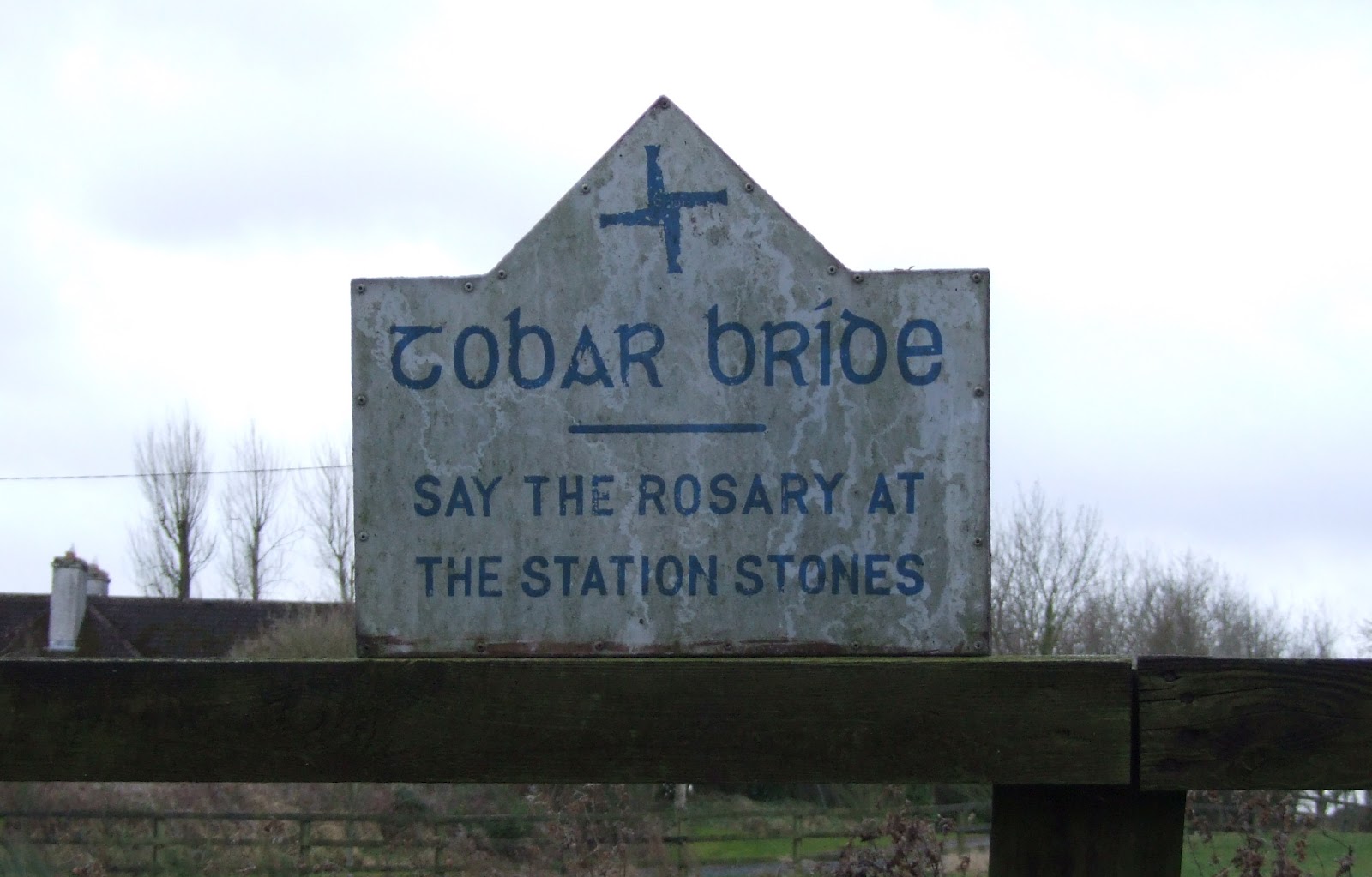
circular and deep well, surmounted by a stone cross. Pilgrims
traditionally say prayers at each of the tiny stone ‘stations’
leading up to the well (the stones are said to mark the course
of the underground river).
A collection of items left at the shrine during the pattern
The site is maintained by the Brigidine Sisters and they have
done a terrific job. The statue of Saint Brigid by sculptor
Annette McCormack dominates the site a little more than
it should, but otherwise this is a fine area, peaceful and
reflective. The stillness of the water in the well and the sound
of the bubbling water below as it passes under the arch erected
over two ancient stones makes for a rather beautiful place. A
pattern is observed here every 1st February and many events
take place in the churches and in the town of Kildare around
this date. Events are usually posted on the towns website.

This well is supposed to have a little fish. Lady Gregory, co-
founder with W. B. Yeats of the Abbey Theatre and renowned
folklorist, records a story of a mother whose daughter began
to lose weight just before she reached puberty. The child very
quickly became seriously ill and her mother fretted greatly and
prayed most fervently. She decided in desperation, that she
would find somewhere a place that would bring healing to her
daughter. She endeavoured to bring her ailing child to Saint
Brigid’s well and as she prayed over the face of the wells waters
she saw a little fish and knew in that instant that her prayers
had been answered. The child took some of the waters and was
healed.
Rags tied to the tree above the well
The idea of a fish in a well as a sign of God’s presence or as a
visitation of God is rather peculiar to Irish Christianity of that
early period. Of course, the fish was the principle Christian
symbol in the early period of Christianity - a much more
dominant symbol than the cross, so it is hardly surprising that
in early Irish Christian tales of the presence of God or of visit-
ations from God that the visions are of fish and not of a cross.
Later – although not much later it must be said – the cross
becomes the dominant symbol of Christianity throughout Ire-
land and when saints have visitations of God it is sometimes
accompanied by visions of a cross. Today at the well you will
certainly see many crosses; perhaps if you are lucky you will
see a little fish and enjoy the healing peace of this place.
Bright, eternally good lady,
May she lead us to the eternal kingdom,
The dazzling shining sun!
the temptations of each attack.
With my saint from Leinster.
A portion of Saint Ultan’s ‘Hymn to Saint Brigit’, translated by
Stokes & Strachan in 1901.
How to find it:
From the town head out past the Roman Catholic parish
towards the National Stud, traversing the motorway. After
passing the gates to the National Stud on your left, take the
first turn to the right and the well is signposted to the left,
down the lane.