Showing posts with label Book. Show all posts

Tuesday, April 21, 2026

Review: The Torch of Brighid – Flametending for Transformation by Erin Aurelia


The Torch of Brighid – Flametending for Transformation by Erin Aurelia (2024) Moon Books

Nonfiction, Popular (Neo-Pagan) (Paperback, e-book)


The Torch of Brighid is a fascinating book, or rather, more than a book, a system, an elaborate blueprint of mythical references and mystical practices aimed at supporting and containing a deliberate and tightly focussed program of personal transformation. Aurelia gathers material together from historical sources, mostly Irish but some Scottish, mostly from texts but also from folklore, and builds her very modern practice on these foundations.


The sources she draws on range from the ogham to the The Oak of Mugna, which I confess I had never heard of before, “a joyous treasure” mentioned in the Metrical Dindshenchas. She draws on Brigidine flametending, visionary ritual and meditation, and offers a liberal salting of poetry, using all of these together to build a framework for deep transformation. Using the various symbols she finds meaningful, Aurelia matches the traditional twenty-day flame-tending cycle to the twenty féda (letters) of the ogham, focussing especially on the trees associated with these letters. 


Erin’s system is not for the faint of heart, or for folk like me who are dictated to overwhelmingly by chronic fatigue. It is intense, it is complex, and it demands a persistent commitment of time, concentration, and energy that are well beyond what I can do. I had to concentrate hard just to grasp what she was pulling together, because it is detailed and complex and I am not that well. But for someone with the ability and the desire, I can see the potential for this being a fruitful practice. If I was well, I would try it out; as it is, all I could do was read the book.


If you’ve read any of my previous reviews, you will know that I am often frustrated by authors’ failure to differentiate between their own UPG or interpretations of lore, and the traditions and texts they are drawing on. So you can imagine my delight at Aurelia’s wonderfully explicit disclaimer, with lists of what this book is not (reconstructing a past pagan practice, etc.) and what it is (presenting an inspired practice, etc.). I appreciate her willingness to find new truths in old materials without claiming that her work is an old practice newly revealed, and that she is in the main clear about where she has used traditional material and where she has followed her intuition. I found some of her insights and the practices she offers quite inspiring, such as the Mantle of Brighid exercise, which builds on grounding and energy work and is powerful and beautifully realised, as a brief excerpt will reveal:


“The Mantle of Brighid is an energy exercise designed to help you open your energy to and commune with Brighid. It works with three internal energy centers the Irish tradition calls cauldrons, and which I correlate with Brighid the Smith, Brighid the Healer, and Brighid the Poet. These energy centers are detailed in the writing called The Cauldron of Poesy, designed to promote poetic inspiration. The energy you move will not only fill you, but surround you, as Brighid’s protective and healing mantle is said to do. Use this exercise to prepare yourself for each meditation in your transformational flametending work…


“Now seat yourself comfortably, close your eyes and ground yourself with three deep breaths. In your mind’s eye, picture your internal bone structure, and the three containers within you formed by your pelvic bones, ribcage, and skull. In the first cauldron of the pelvic region, the Cauldron of Warming, envision a forge. Feel a connection in this region to the energy of the inner Earth, that roiling cauldron of liquid fire, and with your inhaling breath, draw that up into your Cauldron of Warming to light the fire of its forge. As you then exhale through pursed lips, feel and envision this forge fire igniting and intensifying. Take eight more rounds of these breaths to make nine in all, feeling this earth-fire energy grow within you as you inhale, and expand within you as you exhale…”

                                                                                                pg. 34 and 35


The difficulties for me: I find the language a little challenging – a bit more cerebral than I am used to and sometimes kind of hard work, as a result. There are some moments where she makes mistakes, such as mixing up details about Saint Brigit’s birth from the different Saint’s Lives (the Lives are contradictory and confusing). But these are nitpicks, and in general I am heartened by the extent of her research and the creative use to which she puts the material. I also appreciate that she relies on Erynn Rowan Laurie’s excellent book, Ogam: Weaving Word Wisdom, for her understanding of the ogham, as that is a solid piece of research and inspiration, itself.


In general, I would say that The Torch of Brighid would appeal to those who resonate with complex metaphor and ritual, more than those who prefer a less structured, impulse-driven style of contemplation. If you have the energy and discipline that this structure requires, the vessel Aurelia has created is a good one to hold and support your inner, transformational aspirations.

Saturday, September 20, 2025

"Brigid’s Mantle — Finding the Fiery Saint of Kildare at the Heart of Celtic Spirituality” by Nancy Fitzgerald


From the website:

Brigid’s Mantle” is for those seeking courage when their church is failing them.

The church has dismissed the concerns of women and kicked the can down the road on women’s ordination.


St. Brigid’s light has become stronger and more important than ever. An ordained a bishop and successor to the apostles of Christ, she was one of the most important leaders of the fledgling Irish church. 


This book explores the lessons Brigid has to offer women—and the entire church—today.


Image: of book cover. 

Sunday, September 07, 2025

Review: Brigid - Celtic Goddess and Matron Saint of Ireland (Oracle Deck)


Brigid - Celtic Goddess and Matron Saint of Ireland, DR. KAREN WARD (author) and BERNIE SEXTON (artist) (2023)


Introduction

I am delighted by the breadth, depth, and beauty of this deck.


As always, there are things I quibble with, and I'll mention one or two below. But in general I find much more to like in Brigid - Celtic Goddess and Matron Saint of Ireland than to quarrel with. For instance, it takes in more of Brigit's cult than usual, leaning into aspects of her that we don't normally pay attention to, and so gives us more scope for contemplation. As well, rather than ignoring incontrovertibly Catholic aspects of Brigit and paganising the bits of Saint Brigit that we want to retain, she is allowed to be celebrated equally. (For instance, in the cards which show family members of both the saint and the goddess.)


This is important not because I have a fondness for the saint, personally, although I appreciate it for that reason, too, but because it's a step towards a clearer representation of who Brigit really is. Just as we protest the Christianisation of pagan elements of our stories, we need to acknowledge the modern tendency to paganise Christian elements, and look instead at what her roots truly are.


This clarification of roots isn't completely adhered to in Brigid - CGMSI. There are elements, such as the tradition of tying rags to trees at her holy wells, which come from the saint's cult but which are also, or exclusively, attributed to the goddess. But you'll find similar mixing of attributions in nearly all of the popular material about her – it's natural that traditions will be blended together over time – and there is less of it here than generally. So, for someone like myself who values knowing where ideas come from, and who loves the saint and the goddess equally, this is an enormous plus side to this deck and booklet.


The details

There are 52 cards in the deck. This is not a tarot but an oracle deck. There are no suits, no major and minor Arcana. It is divided into sections of from 3 to 8 cards. These sections cover her symbols, attributes, gifts and legends, and so on.


Karen Ward conceived of the deck and wrote the accompanying 62 page booklet. Each card has a number, a name, and an associated aspect. For instance, card number one is "Noble Name – Divinity" and the image is of a woman with various versions of the name Brigit superimposed on her.


There is one page for each card. The top, with the name and image, contains messages for the reader: "Find out what your name means. Your leadership skills need to be nurtured. You have the gift of 'common touch' with the ability to relate to many. Begin your sacred work now." Below this is a discussion of the concept, in this case Brigit's name. It culminates in a question: "What does your name mean, who gave it to you and why? May Brigid inspire you to embrace your name with new insights and delight. There is power and a divinity there to be discovered." You can see that there are a variety of perspectives offered for each concept and you are free to choose what speaks to you, comfortably or uncomfortably, within those offerings. I have found some of the cards I've drawn to be particularly thought-provoking on subjects that I am grappling with in my own life.


The artwork by Bernie Sexton is sublime. The images alone invite contemplation and can take the reader to some very interesting places. Several strike me as being particularly beautiful and one such,"The Element of Water" (card 11), makes me wish I could talk with the artist about her inspiration for the image. Others are straightforward, such as a raised fist in a circle of Irish knot-work, against the background of a golden sun, found on number 13, "Activist." I love that such a card exists, along with Peacemaker and Earth Keeper, Powerful Vocation, Charitable Deeds, and Sunbeam Miracle… cards that take us to places so critical in these times and help us to reflect on how each topic is relevant in our own lives.


Although there is a suggested layout for readings, I've simply been pulling individual cards and sitting with their image and message for days or, in the case of the first one I pulled, shortly after my mother died, months. (That card was number 33 – "Keening.") I have found this a rich path into meditation.


Do I agree with every interpretation or representation of Brigit in the booklet? No. For instance, the assertion that "Goddess Brigid's Fire Temple, Kildare was incorporated into Saint Brigid's monastery" (number 23, "Fire Temple"), and the underlying assumption that Saint Brigit herself was originally a druid, is well enough rebutted in the academic literature to be left out or at least couched as a hypothesis. And there is the occasional tendency to do what I myself did in places in my own book about Brigit, and mix the two strands, goddess and saint, as if they were the same story. This leads to such things as attributing the role the saint plays in protecting children – but not the goddess, in any of the lore available to us – to "her perceived inability to save her own (the goddess's) son" (pg. 43).


But the reality is, I'm not going to agree with everything in any book about Brigit, and some things, like the story of the goddess having a perpetual flame and the saint having been druid, are almost universally embraced by popular writers; there is no getting away from them. It's up to us as readers to learn as much as we can about where our information comes from [1] and to keep an open mind about everything we read. What I have to do as a reviewer is to step back and ask, "Is this a book I would give to a friend who wants to grow closer to, or know more about, Brigit? Does it have substantial value?" And in this case the answer is unquestionably, "Yes.


Note [1] Morgan Daimler's book, Pagan Portals – Brigid, is an excellent jumping off point for learning where our ideas about Brigit arise from; Christina Harrington's book, Women in a Celtic Church – Ireland 450 - 1150, gives an in-depth explanation of the origins of the goddess fire-temple story and the dearth of material supporting it.


Images: A selection of cards and the booklet from this deck. Photo by Mael Brigde.


Sunday, May 12, 2024

‘Brigit’s Living Traditions,’ Talk by Séamas Ó Cathain


Séamas Ó Cathain was invited by Woman Spirit Ireland to speak about Brigit at their symposium, Brigit of Ireland - An Icon for Today, and to launch the updated and extended second edition of his 1995 book, Festival of Brigit - Celtic Goddess and Holy Woman.* The talk was held on 28th January 2023.

Click here to read more about it and buy from the publisher, and here for his talk. 


Image: Photo of front cover of book, showing four children bundled in winter clothes, holding Brigit’s crosses and standing near a shrine.

* the original edition of the book is available on archive.org.


Thursday, December 15, 2022

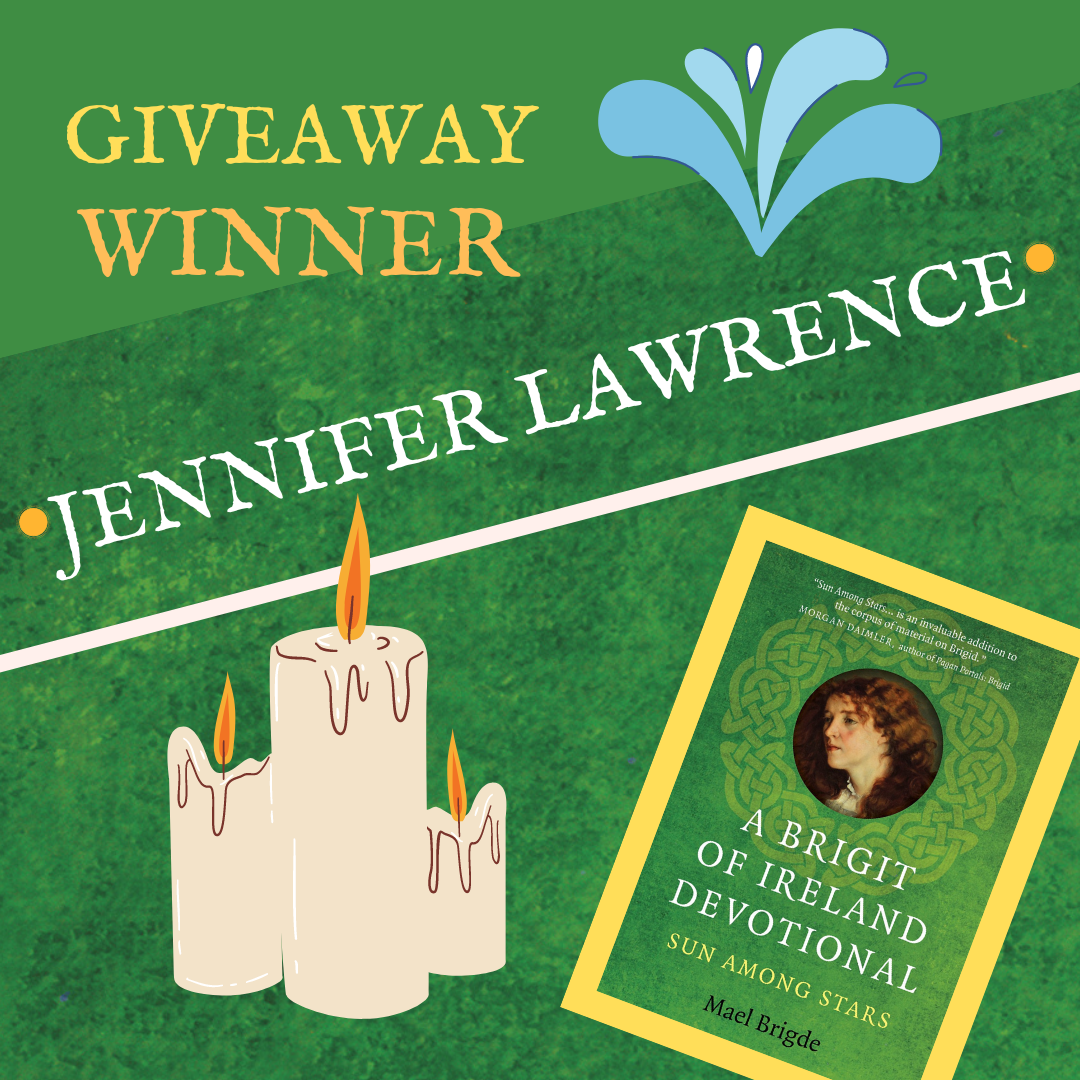
Jennifer Lawrence, Winner in Book Draw


Congratulations to Jennifer Lawrence for winning a copy of A Brigit of Ireland Devotional - Sun Among Stars!


Image: Image: green background with a gush of water, the above words, three candles, and the cover of the book. Which is also green, and has a painting of the face of a white, red-haired Irish woman, surrounded by Irish knotwork.


"Torch of Brighid: Flametending for Transformation" by Erin Aurelia - Available for Pre-Order


 My publisher, Moon Books, has a third Brigit title coming out next summer, by fellow Brigit's flame-tender, Erin Aurelia. I haven't read it yet, but it promises to be unique. The author asks (and presumably answers) the questions, "What is flametending, and how can a simple devotional practice be engaged with as a transformational spiritual path?"

Erin writes: 

"Announcing my book, The Torch of Brighid: Flametending for Transformation, by the Moon Books imprint of John Hunt Publishing, available now for preorder, to be released in June 2023! Learn more about it, read advance praise, and find out where to preorder here."


Image: Cover of Torch of Brighid by Erin Aurelia shows a red cloak worn by a white person with slender arms and hands. The person is holding a kerosene hand lantern.

Monday, September 12, 2022

It's Back in Print! Alice Curtayne's Saint Brigid of Ireland


One of my favourite books about Saint Brigit has come back into print after many years, Saint Brigid of Ireland by Alice Curtayne. Cluny Media of Rhode Island is a recent Catholic publisher focussed on reprinting books which are no longer available. In homage to SBI's reprinting, I will repost here my review of the book. (To read the original post with the other reviews included, click here.)


St. Brigid of Ireland, Alice Curtayne, 1954, Sheed and Ward, New York. 162 pp.


 Already in her girlhood the lines of an exceptionally strong character are emerging. Her freedom won, the first use she made of it was to succour her mother, whose health was poor, but who was still engaged in the heavy labours of quern and churn.”

pg 28

Unfortunately long out of print and therefore pricey, you can try bookfinder.com for a second hand copy. Beware of mould. The one I ordered from Ireland was horrific to breathe next to. Try to get it from the library if you can, perhaps on interlibrary loan.

This passionate and beautifully written book took me by surprise. I read it over twenty-five years ago, at a time when I was interested in Brigit the saint only as a lens through which to glimpse the goddess, and the book had little to offer me then. It altered in my mind into a quaint and archaic piece of Catholic introspection, confused with Lady Gregory's “Brigit, the Mary of the Gael”1. I’m happy to have returned to it at a time when I can appreciate it.

Curtayne, a native of Brigit`s Kildare, writes from the perspective of a devoted Irish Catholic. Grounded in Church and Irish history and the stories of Celtic saints, she is aware of the significant role Brigit plays in Ireland: “She stands in the first shaft of light that illuminates our history, literature, topography, art and architecture ... Her contemporaries re-named the landmarks, recast the whole topography of the island, in order that she should be remembered (pg 4-5).” 

She touches on the limits and privileges of free women, then settles into the dark burden of the bond slave2, ending with a dramatic ushering in of St Brigit: “She stood isolated, without prototype, without peer (pg 9).” This reads at first like faith-driven hyperbole, and certainly faith plays a large part in her view of Brigit, but as the book unfolds she argues her case from a variety of materials, and the picture she paints is intriguing, filled with nuance and unexpected detail.

Curtayne clearly and extensively locates Brigit on the historical stage of her time. She explores the political climate of turbulence tempered with unity that then existed, particularly in the region of Ireland where she lived, outlining the struggle for territorial dominance between Leinster and the southern Ui Neill, the contention over the position of High King, and the backlash against a punitive tax levied on Leinster. “In striving to evoke the atmosphere of the fifth century, the reader must hear the clash of arms as the perpetual undertone to all other sounds (pg 16).” Some of her details may be arguable in light of modern research; nevertheless, situating her so clearly in her environment makes this an excellent introduction to and contemplation of Brigit and the world she emerged from.

She offers a glimpse of the lives of early Irish nuns, and knits together Patrick’s picture of Irish religious women with Brigit’s Lives as well as historical and mythic texts. She discusses how Brigit’s community might have looked, how building might have proceeded, what her chariot would have been like and how it would be to travel in it. She examines the Lives to learn of the character of the woman they depict, and finds much that I miss when reading the tales—her physical strength, for instance, as one who works hard in the dairy. The image of robust health and physical power that Curtayne envisions, so different from the assumption of beauty as slim elegance, gives us a homespun Irishwoman with acuity of mind and the confidence of an aristocrat. There is of course a taste of the good Catholic girl so familiar from Saints’ tales. But she is so much more than that here.

When she tells a tale from the Lives, Curtayne couches it in the background of the age: in discussing the ale references tittered at by moderns, she describes the role of ale, made fresh and weak and used as a common daily beverage, not a special drink to make men wobbly. In telling of her refusal of marriage, she lets us know clearly the privileged life—to a poet, that nobleman of the Celtic world—that Brigit was passing up. She ties together disparate bits of information—Brigit born a slave, daughter of a tribal leader: in attempting to wed her to a poet, he has in fact offered her the highest possible social position, and throughout her life she behaves as a woman who retains the power and self-assurance of her father’s class.

In telling Brigit’s stories this way, introducing ideas from ancient Ireland, such as regarding class or attitudes toward lepers, contrasting them with attitudes current in Biblical or modern times (the 1950s), and then personalizing the story, she gives often told and sometimes stilted stories new life. She reconnects them to a world and time other than our own and then imagines a human within them—how Brigit might have felt and why she reacted as she did. Finally, she will hint at, or carefully unfold, the symbolism or spiritual lesson she perceives there. 

In approaching the material as if Brigit was a real and historical figure, and in dramatizing to great effect, she expands our understanding not only of the story and symbol of Brigit, but her place in the story of Ireland. Unique in my reading about Brigit is the revelation of her here as a source of pride and unity for a country whose people had for centuries been oppressed and despised. This message, which comes scattered in various forms throughout the book, is an important reminder. Brigit may be internationally loved and venerated now, but this is a new version of her, added to and subtracted from without our necessarily noticing. Placing her back into this setting is important both for our understanding of Brigit and for our honouring of her origins and the people who introduced us to her.

Curtayne's belief in God doesn't lead her to swallow everything that “pious hagiographers (pg 19)” have written. She seeks rational understanding while at the same time turning over the spiritual lessons found in Brigit's Lives. But she does accept that miracles happen. “The stories (of her generosity) ring true, because for the most part they are at once extraordinary and trivial. If a later biographer were minded to invent miracles for Brigid, he would use rather more imagination and tell of something more impressive than a little food conveyed furtively to a dog (pg 21).” 

At times she struggles to make peace between her rigorous intellect and her faith. She says Patrick, having lived earlier than St Brigit, could not have known her. But in the Book of Armagh it is claimed otherwise. She accomodates this by saying that because of Brigit’s friendship with intimates of Patrick, it “may be taken as essentially true (pg 45).”

A little stretch of the truth is permitted elsewhere, too. “Not the faintest breath of scandal ever touched the double monastery founded by Brigid and Conlaeth (pg 63).” Now, it states clearly in the Liber Hymnorum that “She blessed the pregnant nun, she was whole without poison, without illness”. Perhaps this was some neighbouring nun, not of Kildare ... 3  Or perhaps this was not a scandal in Brigit’s day—it certainly doesn’t read like one in the tale.

Curtayne grounds Brigit to some extent in the mythology of her people. In telling the tale where Brigit gives away her father’s sword, she refers to the heroic sword given by a fairy queen which grew so long it touched the heavens like the curve of a rainbow. And she links Brigit directly to those heroes of old. “This strange creature, in whose veins flowed the blood of Conn of the Hundred Battles ... (pg 26)” This Brigit, though unapologetically Christian, becomes more truly Celtic and Pagan than many versions of the modern, reimagined goddess.

But she stops short of linking St Brigit directly to the goddess whose name she shares. While not denying the connection, she brushes it aside, refering in passing to “fearfully dull books” that suggest St Brigit was not a real woman, but only a product of the goddess (pg 109). 

In so many ways, the Brigit in Curtayne’s book takes on life and character, and in doing so, allows the reader to connect more fully with her meaning in his or her life. To Curtayne, Brigit is not merely a symbol. Her miracles, some though not all, are real. Her envisioning of Brigit’s life surpasses even Kondratiev’s4 imaginings, and is founded on a broad knowledge of the Lives, her times, the Celts, the Bible, and the history of the Church.

We are given Brigit’s presence in Ireland and her effect on it, the building of communities, the hosting of intellectual circles surpassing anything in England or on the Continent of that time. A careful comparison between Celtic Christianity and the Christianity of St Francis5, insight into St Brigit’s reaction to the violence around her, with its parallels to the Troubles yet to come in Ireland, her examination of difficult spiritual truths6—Curtayne approaches her topic from a dizzying multitude of angles. In a rare moment of she writes: “But not to incur a charge of bathos, it would be better, perhaps, not to mention in the same breath with the Brigidine circle Madame Récamier’s salon, or the “intellectual afternoons” of Hannah More and George Eliot (pg 69).” 

A rich offering indeed.


Purchase here.


Sunday, January 23, 2022

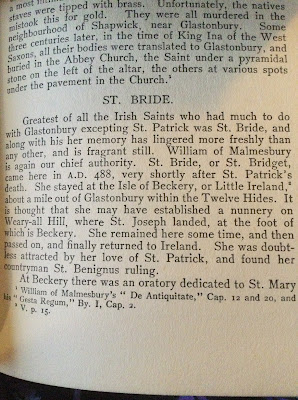
Brigit at Glastonbury, According to the Rev. Lionel Smithett Lewis, M. A.


 A dear friend of mine, once the owner of a secondhand bookstore where many a joyful hour was spent, is getting rid of her library as she prepares to move into assisted living. She gave me first crack, and I found this little gem of the Glastonbury Saint Brigit mythos.

The full title is Glastonbury “The Mother of Saints” – Her Saints A.D. 37–1539. It was published at Christmas, 1925, of which 1000 copies were printed. This is from the second edition, Christmas, 1927, of which 2000 copies were printed. The author, Rev. Lionel Smithett Lewis, M. A., was the vicar of Glastonbury.

Below you will find photographic images of the cover and pages pertinent to Saint Brigit, here called Saint Bride. Now, do remember to take every detail of this with a large cellar of salt. Click on the images to see a larger size.


Wednesday, January 05, 2022

What I'm reading coming up to Imbolc...


There are so many sources for immersing ourselves in Brigit as we come up to her festival, but what is my first choice?

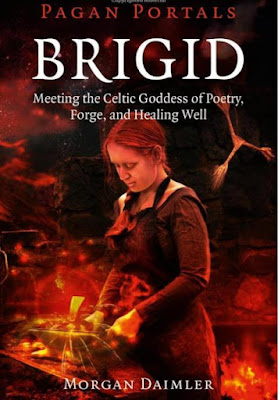
Pagan Portals - Brigid by Morgan Daimler. It is the best source for getting a clear understanding of the goddess. (There are other great sources for the saint.)


My second choice is the sadly out of print Rites of Brigid, Goddess and Saint by Seán Ó Duinn OSB.


And how did I not know there was an Irish language version of that book, Gnas Na Feile Bride? Perhaps still less available than the English.


Nevertheless, I will be dipping in to this one, as well, as the month goes on.


Wednesday, September 22, 2021

Book: The Brigidine Sisters in Ireland...


Look what landed in my mailbox yesterday.


The Brigidine Sisters in Ireland, America, Australia and New Zealand, 1807–1922, by Ann Powers (Four Courts Press, 2018) fresh from the Ballyroan Library. Well, not quite fresh. I bought it on eBay.


From the publisher's site:


The history of the Brigidines, formally known as the Sisters of St Brigid, provides a detailed and fascinating account of the congregation and its mission to the rural communities of Ireland, America, Australia and New Zealand. It compares the religious order to similar female congregations, and throws new light on Bishop Daniel Delany of Kildare and Leighlin who founded the Brigidines in 1807. His motto – strength and gentleness – became the hallmark of Brigidine practice and service.


The book highlights the lives, courage and spirit of adventure of many sisters, the hardships they endured, hidden from the public eye, and their significant achievements in education. It contributes not only to a greater understanding of the religious life but also is an appreciation of the role and adaptability of female religious in the nineteenth and twentieth centuries. It also contains a prosopography of around 700 nuns (1807–1922).


Ann Power holds a PhD in history from Trinity College Dublin, and a BA and an MA from Carlow College, St Patrick’s.


Image: unclear photo of book titled as above, with blurry humans seated on benches among trees.


Thursday, September 09, 2021

Upcoming Anthology: Brigid's Light - Tending the Ancestral Flame of the Beloved Celtic Goddess


Art by Stuart Littlejohn

An interesting new project is coming to light, an anthology of Brigit writings taken from outside her traditional homelands. It is the brainchild of Cairelle Crow and Laura Louella of the Sanctuary of Brigid.

It's an unusual idea, which began with the intention of exploring Brigit in the lives of the "Celtic" diaspora, and has evolved to include those with no ethnic or cultural connection to Brigit, but who have met and loved her through others. I am pleased to report that I have two poems in it, having caught wind of the submissions call just before the closing date. I haven't seen the manuscript, nor do I know whose work is included, but I am looking forward to exploring this offering when the time comes.

Brigid's Light: Tending the Ancestral Flame of the Beloved Celtic Goddess by Cairelle Crow (Editor), Laura Louella (Editor), and Judika Illes (Foreword). Release date: 1 March 2022. Pre-Order: here

Stories, spells, rituals, and recipes celebrating the worldwide influence of this beloved Celtic goddess, with contributions from Amy Blackthorn, Laura Tempest Zakroff, Courtney Weber, and many others


This anthology celebrates Brigid, an ancient and mysterious Celtic spirit who ranks among today’s most popular modern goddesses. Venerated in many forms including as a saint and a goddess, Brigid has traveled the globe alongside the Celtic diaspora. Once a goddess with a narrow territory, she is now an internationally beloved presence. While acknowledging her origins, this book also explores Brigid from the perspective of those outside her original Celtic homeland.

Editors Cairelle Crow and Laura Louella have gathered art, poetry, stories, spells, rituals, recipes, and traditions as an homage to the worldwide influence of Brigid’s magic and lore, especially among the descendants of immigrants to the Americas. In compiling these individual works, Cairelle and Laura have given voice to those traveling ancestors by showcasing a rich and beautiful heritage manifested through embodiments of devotion by their descendants, as well as others touched by Brigid.


Sunday, August 29, 2021

Many Voices - Book Launch & Celebration of Brigit


What a beautiful event that was. I am very happy that I took a leaf from Geraldine Moorkens Byrne's book and turned my launch into a community celebration. I briefly introduced the launch, then read four short poems before sitting back to watch and listen as friends from Ireland, Wales, Scotland, Italy, and the United States read and sang from their hearts to and about Brigit. It was very moving. A joyful and precious time.

The launch was held on Zoom (with ticketing help from the wonderful Ticket Tailor) and livestreamed to Facebook Live. I am happy to say that we can watch it (or rewatch it!) any time on Facebook at Brigit's Portal (my Page) or on YouTube.


Image: Mael Brigde, a white woman in a red dress, wearing black earphones, smiles as she speaks to her computer.

Monday, August 16, 2021

Book Giveaway! A Brigit of Ireland Devotional by Mael Brigde


COMPETITION!

WIN an Advance Reading Copy of A Brigit of Ireland Devotional - Sun Among Stars by Mael Brigde.

The winning name will be DRAWN on 27 August 2021.

To Enter:

*SIGN UP for my (occasional) newsletter here. (Look for "Contact.")

*SHARE this Giveaway with a friend.

*COMMENT below this post telling how you first heard of Brigit, and from whom.

-OR on Facebook

*LIKE my Facebook page, Brigit's Portal - Classes, Gatherings, Poetry, Tools

*SHARE the competition post to your Facebook homepage (and anywhere else you like!)

*COMMENT below the competition post on Brigit's Portal telling how you first heard of Brigit, and from whom.


Tuesday, July 27, 2021

Who IS this Woman, and What are her Poems About?


Looking for something else, I stumbled across a tiny image of a book with a title that looked very much like it referred to a goddess/saint I know. I put the title of the book by Isabel Blanco Ollero into DuckDuckGo's browser window and got a translation:

BRIGID - O EL FUEGO DE LA TRANSFORMACIÓN works out to:

BRIGID - OR THE FIRE OF TRANSFORMATION.

Now, I know I'm on to something.

But I can’t read it, or even find an article in English to tell me about her. Who will read and tell us what she says?

We live in hope!

***********

UPDATE

One reader says:

 It's a book of poetry, apparently there are four poems. I can't find any of the actual text without buying it and there doesn't appear to be an online copy.

I have found what appears to be an illuminating article, thouh' of course I am going on the strength of the odd word I can guess.

 "BRIGID O EL FUEGO DE LA TRANSFORMACIÓN, DE ISABEL BLANCO OLLERO" by MANU LÓPEZ MARAÑÓN.


Wednesday, April 14, 2021

Mael Brigde Book Video


Surprise greeted me on my Facebook feed today.

Rachel Patterson (The Kitchen Witch) made a little book trailer for me. And here she be:

Mael Brigde Book Video


As I keep repeating, the sound track is a bit thin, but the film itself has great punch.

Thanks, Rachel!


Sunday, June 23, 2019

Gratitude Oblation: Brigit Classes for Friends


I am nearly finished my manuscript, Sun Among Stars - Poems and Prayers to Brigit of Ireland.

It's been a long, looong process, interrupted repeatedly by ill health and life challenges. I can barely believe I will soon be taking the next step toward offering it to the world.

In gratitude for this long and nourishing devotion, I'd like to foster our community in another way.

At present, I have three classes available through the Mystery School of the Goddess: Discovering Brigit and its sister course, Stepping Into Brigit, and the poetry intensive, Journey with Brigit, Goddess of Poetry.

To date people have taken the courses as individuals. I would like to offer them to you to take with friends, cill, or grove members. If you gather four people to take one or more class, one of you will not be charged. This way you can make a gift to one or settle amounts between yourselves in a way that supports your community. (Oh--and if anyone at all takes Discovering Brigit and then Stepping Into Brigit, there is a discount if you sign up through the first course.)

Blessings of Brigit on all. Thank you for your immense support. 


Click here to find Mael Brigde's Classes.


Image: from Mother House of the Goddess, Journey Into Brigit, Goddess of Poetry.

Wednesday, March 27, 2019

French Language Edition of Brigid by Morgan Daimler


Wonderful to see that Morgan Daimler's excellent book on Brigid is now available in a French language edition! Click here to order.

"Cet ouvrage est une introduction élémentaire au culte de la déesse Brigid, qui se concentre sur son histoire et son mythe, ainsi que sur sa dévotion et son culte modernes. Se focalisant principalement sur la déesse irlandaise, le livre inclue également une discussion sur ses apparitions dans le reste du monde celte, en particulier en Écosse. Ses différentes apparitions dans la mythologie sont mises en relation avec la transformation de la déesse païenne en une sainte catholique. Les méthodes modernes permettant aux néopaïens de se connecter et d'honorer cette déesse populaire incluent des méditations et des offrandes, ainsi que des anecdotes personnelles tirées des expériences de l'auteure.

"Qui était Brigid chez les païens préchrétiens ? Qui est-elle et que représente-t-elle aujourd'hui pour les païens modernes ? Comment tisser les liens entre l'ancienne et la nouvelle déesse païenne ? Pour trouver la réponse à ces questions, découvrez les mythes de Brigid chez les païens irlandais, les histoires de Bride en Écosse et la façon dont les gens honorent aujourd'hui cette divinité puissante et si importante..."


12,00 €