"Brigit's Sparkling Flame" contains Brigit-related news, views, and links. "Stone on the Belly" offers poems, prayers, and so on as Brigit moves me.
I am the founder of the Brigit flame-tending group, Daughters of the Flame. I teach several online classes on Brigit, and on Brigit and poetry, at the Mystery School of the Goddess. My book, A Brigit of Ireland Devotional - Sun Among Stars, will be released on 1 September 2021.
I'm
excited. Two separate books on The Good God, An Dagda, father of the goddesses
Brigit, are now available. In my time of devotion to Brigit I have come to know her parent somewhat and fallen in love with him. I am thrilled to have these two opportunities to know him more.
Until
now, those interested in The Dagda have had to scrape together their information from
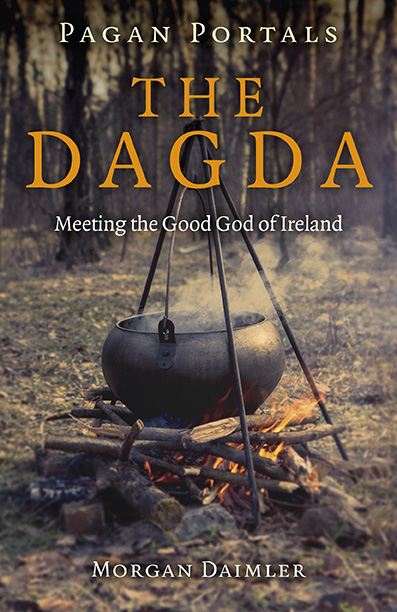
widely dispersed sources. In late October Morgan Daimler's Pagan Portals
book, The Dagda, was released. A slim volume, like all Pagan Portals titles,
it is the first book entirely devoted to this important Irish god. I haven't
read it yet, but it sits on the table awaiting my attention. I've read
several of Morgan's books and have never been disappointed.
Minutes
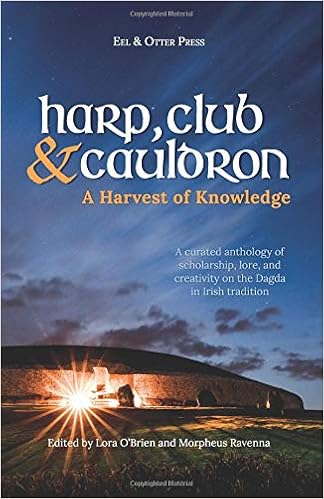
ago, Morpheus Ravenna and Lora O'Brien launched their anthology Harp,
Club, and Cauldron - A Harvest of Knowledge. Many respected (and beloved)
writers and artists have contributed to the book: Isolde Carmody and Chris
Thompson from Story Archaeology, Anthony Murphy, author of Mythical
Ireland: New Light on the Ancient Past, Segomâros Widugeni, author
of Ancient Fire: An Introduction to Gaulish Celtic Polytheism, Valerie
Herron, the artist responsible for the delightful works in Ravenna's book on
the The Morrigan, The Book of the Great Queen, Morgan Daimler herself, and many others. (I have a poem in there, myself, speaking
with Brigit about her father.) Having had a glimpse of the ebook, I am more than ever looking forward to having the book
in my hands, .
Now
is a great time to have the profile of the Dagda raised. A god of many
abilities, protector of his people and linked to the health and balance of his
land, he is a powerful ally in a world filled with disharmony and fear. His
cauldron of plenty, his harp that can bring sorrow, laughter, or sleep to those
who listen, his club which kills with one end and restores to life with the
other, his great appetites and his ability to do what needs to be done under
any circumstances--An Dagda's influence needs to be felt now more than ever.
It
may take a few hours for the anthology to become available--the button is
pushed, but Amazon sometimes takes a while to catch up. So if you get a
"not currently available" note, fear not. It's on the way.
For
those of you who have grown interested in or close with An Dagda, you
might also want to join the Facebook group The Dagda's Hearth. I'll see you
there, perhaps?
Original Fund-Raising Video for Harp, Club, and Cauldron:
This talisman honors Brigid, Irish and Scottish Goddess of poetry,
healing, smithcraft, fire, and many other bright things. She also called Brig,
Brigit, Brid, and is closely related to the Gallo-Brittonic divinities
Brigantia and Brigindona.
The name Brigid is thought to derive from the root *brig signifying
high or exalted, and is sometimes translated Exalted One. We see this same root
in place-names referring to raised hillforts. In Irish and Scottish folklore,
Brigid is linked to Saint Brigid and many believe the saint to be a survival of
the pre-Christian pagan Goddess. She is often spoken of as a triad, the Three
Brigits. She is said to be a midwife and is called upon to bless births of
children and animals, to help protect the herds and the milk supply, and for
healing. Milk and milk products have a special association with healing and
purification in Celtic thought, and She is connected to both. She is associated
with craftsmanship, especially blacksmithing, and is seen by many as the
embodiment of the fire that heats the forge. She is worshiped at holy wells
throughout Ireland, where the upwelling and flowing of waters are also
expressions of the deep well of wisdom and its flowing out in the form of
inspiration and poetry. Thus, She is also the Lady of poets and poetic
inspiration.
The front of this talisman shows Brigid in triple form, the flames of
poetic inspiration rising above each of the three faces. She carries a spear
and a vessel of milk, reflecting Her role in Celtic warrior culture, as the
Goddess who receives the returning warrior bands from their winter raiding,
purifying them with milk or butter to wash the warrior’s mark from them and
bring them peacefully back into the fold of settled society. Her stance and
position within the archway echoes images of Brigantia from Britain. The words
here say Duine úallach / Brigit búadach: “Proud lady / Victorious Brigid”.
The back of the talisman displays a triple St. Brigid’s Cross, a folk
charm traditionally woven of straw or reeds in honor of the saint and the
Goddess. Between its three arms, Her implements are displayed: hammer and anvil
as Lady of the Forge; cauldron and flame as Lady of Healing; and harp as Lady
of Poetry. These are framed by poetic lines adapted from the Carmina Gadelica:
Lasair dhealrach oir / Muime chorr dée / Bride nighinn Daghda; “Radiant flame
of gold / Noble foster-mother of Gods / Bride daughter of the Dagda”. (The
original lines in the Carmina Gadelica reference Christian ideas associated
with St. Brigid; this has been adapted to a more Pagan form).
You may notice a resemblance between the back design of this talisman,
and Ian Corrigan’s beautiful Brigid sigil. I respect Ian’s work and certainly
wouldn’t copy – this turns out to be one of those divinely inspired
synchronicities, as we’ve both arrived at this design independently. You can
check out Ian’s books on Brigid and other creations here.
Talisman is etched in 18-gauge copper, in your choice of 1.5″ diameter
medallion, or 2″ allowing for much finer detail. Comes strung on a simple
natural leather cord.
Our copper talismans are hand etched in small runs with careful
attention. Talismans are individually hand-detailed, so each pendant is
slightly different and unique. The artist, Morpheus, personally consecrates all
the talismans on her altar.