Showing posts with label Reviews. Show all posts

Monday, August 11, 2025

Quicky Picture Book Overview


I wrote this on Facebook in response to someone who asked if anyone knew of any books that bring Brigit or Irish Pagan practices into inner child work. At first I could think of nothing, but then it occurred to me that she might get something out of picture books.


I mentioned that I had reviewed some children’s books in A Long Sip at the Well (Brigit book reviews) a number of years ago, and that I have several more on hand awaiting reviews. So I said I would look at those:


Okay. There are too many here for me to properly review them for you, but I will say that whereas the ones to do with the saint usually just take a piece of her lore and make it into a story that would appeal to children (they hope!) — stretching or adapting things in a minor way to suit their purposes, many — most? — Pagan books impose the image of a goddess onto what are traditional Christian stories, rather than creating stories out of the goddess materials from the old Irish literature. They often have outright wrong info, or state as fact things that are theories that are vigorously contested — so I urge you to take everything with a grain of salt and simply see if the story as it is written in the book at hand has anything to offer your inner child.


Having said that, I particularly like:


Brigid and the Butter by Pamela Love. It is very Catholic, and is a teaching tale in the way St. B’s vitae were. It is about generosity and is for younger children.


Saint Brigid the Fearless by Ann Carroll. Also Catholic and a teeny bit teachy, it covers a lot of different stories from her vitae, including the one in the Love book. But it is lively and kind of funny.


My favourite Catholic one from this batch is Saint Brigid and the Cows by Eva K. Betz. It touches on many of her stories, but it also looks at how things were for Brigit, and her feelings.


Of less interest (to me) is The Story of Saint Brigid by Caitriona Clarke. It doesn't try to tell a story, but simply gives certain details of her life, so it is less easy to relate to as a child (inner or outer).


I have only three pagan ones.


Imbolc - Brigid's Feast by Maria Finchenko is a fun read for young children that plays with language and has great pictures. It takes folklore from the saint's cult and pretends it was all about the goddess, which I have trouble with, but what the heck.


The most original, and my favourite of the Pagan books, is Brigid and Her Cloak - an Imbolc Tale, by unknown persons. (I got in touch with them: they refuse to say who wrote and illustrated it. I worry that the illustrations could be AI, but I have no idea how to find out. They are lovely, so I hope they're not.) This one has the goddess walking through a village where people are doing traditional St. Brigit's night activities, and reflecting on what is around her. 


The last is My Name is Brigid by Isca Johnson. This one has illustrations by the late Barbara O'Meara, and I can see the appeal in them for adults, but they seem inappropriate for children. Too murky and indistinct, with no faces — harder, I would think, for a child to be drawn in by than any of the others. I was also shocked that the author, speaking for Brigit, said she had never had children. True of the saint, but absolutely not true of the goddess. Anyway, as feared, I am getting into my pet peeves, and I was trying to stay away from that.


All of these books, and the others I reviewed in A Long Sip at the Well, have lots of good things about them, despite the bits that get up my nose. Perhaps let your imagination wander through one or three of them. (Or one of those in Long Sip.) I would say, for your purposes, the Betz and the anonymous Pagan book might be the easiest doors in. Or the wonderful Brigid’s Cloak — An Ancient Irish Story by Bryce Milligan, which I review in Sip.

Blessings on your explorations. 


Images: Covers of the three books mentioned in the last paragraph.

Tuesday, November 24, 2020

Book Review: Pagan Portals – The Dagda: Meeting the Good God of Ireland by Morgan Daimler


Pagan Portals – The Dagda: Meeting the Good God of Ireland
Morgan Daimler (2018)

 It’s strange to feel so excited to read a book that has actually been waiting in my bedside cabinet for nearly two years. But that’s how it is. And now that I have now finally read The Dagda, I can’t stop raving about it. It is a jewel on my bookshelf.


 Pagan Portals – The Dagda is far from the first book I’ve read by Morgan Daimler, nor will it be the last. They have become one of my favourite authors for a few simple reasons: their research is meticulous, they draw together the important myths, gleaned from early and modern texts – they even taught themself how to read old Irish because they wanted more than the translations they had on hand were offering. Daimler has a wonderful way of looking at things from a new angle, and this book continues in that tradition.


 I was looking forward to this book in particular because I was drawn to The Dagda, personally. He drew me initially by his own personality and his actions in the tales, particularly of his building single-handed a fort for Bres, and carving out twelve plains in a one day. But more important was his being father to the sisters Brigit. Because Brigit is so important to me, I wanted to cultivate an acquaintance, at least, with someone who helped shape these sisters as they grew.1


 The Pagan Portals series is devoted to short books up to around a hundred pages long that are meant to introduce the key elements of a deity or topic. In this case the book is nearly eighty pages, and they have divided the material up well. In chapter one, “Who is The Dagda?” they begin by giving his names and the epithets that describe him, and address how a sense of his nature can be drawn from them. This necessarily takes us into the myths themselves, so although they don’t tell them exhaustively, they reveal enough that we can understand why he might be called Eochaid Ollathair, and that “The Dagda” means “The Good God.” But what does that mean? Does it mean he’s a nice guy? Well, no. It means he is good at all things. So just the definition of this one name, and he has many, tells us something important about him. This initial chapter grounds us not only in his names, but in how he’s been described physically in the tales, and gives a glimpse of his relationships with others. (This is a complicated kettle of fish as he has many lovers, many children, and his children, like himself, have run into real difficulties because of some of those lovers).


 One thing that Morgan always does which I greatly appreciate, is they provide useful end notes to each chapter, and provide a good bibliography. I can see where they’re getting their information from; I don’t have to just trust them. I can then decide whether I agree with their take on things, and that is important to me, especially in something so essential as the nature of the deities.


 The second chapter is “The Dagda in Mythology.” Here they explore where The Dagda figures most prominently in the different texts. As they work through these, his personality and what he may represent to the devotee become more and more clearly defined, leading to an overall sense of what we know of him. This chapter also has an interesting reassessment of the Samhain sex tryst between The Dagda and The Morrigan.

Tuesday, February 28, 2017

Review: Pagan Portals—Irish Paganism: Reconstructing Irish Polytheism by Morgan Daimler


An excellent primer on Celtic Reconstructionism and the deities and beliefs of ancient Ireland.

 (Also mentioned, Daimler, Morgan, Tales of the Tuatha Dé Danann; Daimler, Morgan, Treasures of the Tuatha Dé Danann; Laurie, Erynn Rowan, Ogam: Weaving Word Wisdom; and NicDhàna, Laurie, Vermeers and Lambert ní Dhoireann, The CR FAQ — An Introduction to Celtic Reconstructionist Paganism.)

So why is this book on a Brigit blog? Because, and I truly do believe this, whatever our background or spiritual leanings, the more we understand about the world Brigit emerged from and the world which embraces her now, the deeper our connection with her will become. 


Pagan Portals—Irish Paganism: Reconstructing Irish Polytheism is another short book by Morgan Daimler that gets straight to the point—a clear, comprehensive manual that dusts away cobwebs and guides the reader in helpful directions. The other such by her that I have reviewed (favourably) was Pagan Portals— Brigid: Meeting the Celtic Goddess of Poetry, Forge, and Healing Well.

By its nature, the present book cannot be as precisely tuned as the Brigit book; its topic is much vaster and its page count similar. Not difficult. Daimler still manages to identify key topics and dispatch them creditably. There are times when I wished for more detail—also not difficult. She footnotes beautifully so that the reader can consult elsewhere for that fleshing out. To attempt to put all the rich detail possible into this book would have defeated its purpose. For clarity on what is a deep and rambling topic, with dozens of possible interpretations of the materials, Daimler’s choice of a smooth outline and spare prose is perfect.

Irish Paganism: Reconstructing Irish Polytheism contains quick, nicely referenced notes on what Celtic Reconstructionism is and isn’t, basic beliefs, deities, spirits, holy days, an Irish Polytheistic approach to ritual, magic and mysticism, and so on.

I read it, without planning to, at the same time as Daimler’s pair of palm-sized bilingual (Irish and English) booklets, Treasures of the Tuatha  Dé Danann and Tales of the Tuatha  Dé Danann. She has selected key passages from Irish myths and translated them here. I found reading these booklets in tandem with  Irish Paganism: Reconstructing Irish Polytheism helped illuminate the character of some of the deities, as well as the sense of story and Otherworld from an Old Irish point of view.

A nice follow-up would be Erynn Rowan Laurie’s Ogam: Weaving Word Wisdom, which goes into greater detail on many of the above elements, including what CR is, its ethics, and approach to ritual, as well as homing in on texts and traditions that illuminate the various letters of the ogam alphabet. This yields a practical tool for the type of spirituality Daimler offers us here in broad strokes. Daimler herself gives a list of readings to turn to next, including the CR: FAQ, which I would agree is an important book for getting a grasp on what CR encompasses and aspires to.

Not every aspect of the book worked for me. Most particularly, I wish Moon Books would get a good copy editor and not let errors slip by (though I admit there are not many, and the layout can’t be faulted). Recalling that a book like this is ideal for beginners, a glossary with new words and terms, or the word listed with the page where it is defined, would be a good compromise in a short book where there is no index, and would be easy enough to add to the pronunciation page. There are times, too, when ancient and modern, Pagan and Christian are subtly blurred, such that they don’t completely reflect reality and can cause confusion.

As one who doesn’t do a lot that would be termed magical, myself, I found Daimler’s description of the place of magic in the daily life of our ancestors and the nuts and bolts of how Irish spells might be constructed quite illuminating. And finally, her discussion of cultural appropriation, with a rare and valuable explanation of what the term exactly means and when it is and isn’t a bad or good thing, was extremely valuable to me. Clearly, though this book would make a great introduction to someone newly interested in Irish Polytheism or Celtic Reconstructionism generally, it has gems on offer, too, for those who have been involved in the movement for some time.

I look forward to reading my next book by Morgan!

Wednesday, November 23, 2016

Review by Morgan Daimler of Stepping Into Brigit (A Course by Mael Brigde)


I was delighted to discover this review on my Facebook feed today. Morgan Daimler (Pagan Portals: Brigid, among others) reviews the second of my online Brigit courses. (The first is Discovering Brigit. If you do that one, at the end you will find a coupon for Stepping Into Brigit which essentially reimburses $13 of the $15 you spent to take DB.)

This review is from Living LiminallyReflections on Reconstructionist Polytheism, devotion to the Déithe and an-déithe, and living Paganism in a modern world

Top of Form

Bottom of Form
TUESDAY, NOVEMBER 22, 2016
  Many people are familiar with my dedication to the Morrigan but what may not be as widely known is my love of Brighid. It is, by its nature, a different sort of love, but it is just as much a presence in my life in its own way. So when I was asked to help Beta test* a new course 'Stepping Into Brigit' designed for people interested in Brighid to learn about and connect to her I jumped at the chance.


The course is set up as an 11 module course, with each module containing multiple lessons, and is meant to be done - ideally - over a month. With roughly 38 overall lessons to complete (course surveys excluded) one would need to either decide to do one or more lessons a day or set aside time every few days to do a full module in order to finish in a month. What I liked about the set up though is the learning is self paced, so that you can choose to it at whatever speed you like and in whatever fashion works best for you. I took the 'chunky' approach myself and did a full module at a go because that was what worked best with my schedule, although other people may find a slower spacing better.


Each lesson is fairly thorough but also brief. At some points I felt perhaps a bit too brief, but the idea was to take time with each one and contemplate it, write down thoughts and reflections on the material, and really process it, rather than rushing through to get to the next one. They often included outside recommended reading or references to follow up, such as the Story Archaeology's entry on discussing her which should take some time to do. With that in mind the size of each lesson is pretty good, and it really was designed to encourage engagement from the student. I also like the use of mixed media throughout the course which used text, images, videos, and audio clips.

The material looks at Brighid in a holistic manner including both the pagan Goddess as well as the Christian saint, and while I didn't feel the same engagement with the material relating to the saint that reflects more of my own bias than any flaw in the course. It certainly was the most well-rounded view I think I've seen and I can't fault it's fairness in giving an equal voice to all sides. the material is generally presented without any favoring of one opinion over another and with clear citation of sources, allowing a student to draw their own conclusions for the most part about the very complex subject of Brighid pagan roots and Christian history.

Speaking of sources, I really did like the way the course offered a lot of quotes directly from source material. I think often this is the best way to let a student contemplate the original material without the filter of an author's opinion. I also like the amount of poetry included and the way that allowed me, as a student, to experience the material without overthinking it and to appreciate the beauty of the ideas presented. I also liked the option of entering feedback after each lesson, to share personal experiences or thoughts. I did feel there was a lack of more directed exercises beyond the journaling being encouraged, but I acknowledge that not all students want to feel like they have written homework to complete. The overall feel of the course was contemplative and engaging without being tedious or excessively 'school-like' in its feel, which I think will have a wide appeal to modern adult spiritual seekers.

There are many people out there interested in Brighid and many seeking classes or courses online to help them better connect to spiritual things of interest. For those looking to learn about and connect to Brighid I think this course would be a good option, if you find that online courses are generally a good option for you. As with any such course it requires a person to be self-motivated to do the lessons, and to incorporate the material in a practical manner. However for someone who has the desire to truly make use of what this course is offering I think a great deal of valuable knowledge can be gained here.


*to be clear - I was asked to Beta test the course by its creator, but this review is being offered by me freely and without any compensation. As far as I am aware I was asked to help test the course in part because of the book I had written on Brighid and my knowledge of Her, and in the interest of transparency my book Pagan Portals Brigid is recommended reading for this course. However I would not and will not endorse nor recommend anything I do not genuinely see value in and my opinions offered here are honest; had I not seen value in the course on its own merits I would simply not have reviewed it. 
___________________________________________________

ABOUT Morgan
My name is Morgan Daimler. I have been a witch since 1991, an Irish reconstructionist since about 1994, and heathen since 2006; I also practice seidhr. I love studying other paths and other ways of doing things and I enjoy discussing religion, philosophy and spirituality with people from diverse paths. I am a Druid in the CR Druid group the Order of the White Oak, as well as a member of ADF. I try to stay active in the pagan community and am always interested in hearing about how other people are doing things. I have had my poetry and prose published in different places including eight anthologies, Circle magazine, as well as Witches and Pagans magazine. I am the author of the book By Land, Sea, and Sky, the children's book a Child's Eye View of the Fairy Faith which is published through Spero Publishing, and through Moon Books: Where the Hawthorn Grows, Fairy Witchcraft, Pagan Portals: the Morrigan, Pagan Portals: Irish Paganism, and the forthcoming Pagan Portals: Brigid. I also have a self published urban fantasy/paranormal romance series, Between the Worlds.


Wednesday, October 05, 2016

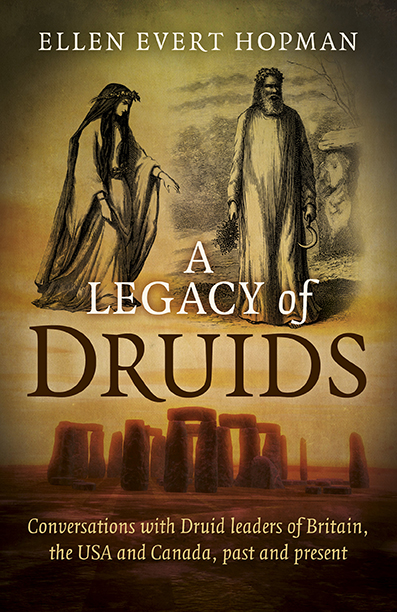
Review: Legacy of Druids - Conversations with Druid leaders of Britain, the USA and Canada, past and present by Ellen Evert Hopman


Review of Legacy ofDruids: Conversations with Druid leaders of Britain, the USA and Canada, pastand present by Ellen Evert Hopman (2016) Moon Books.

  • Paperback £14.99 || $25.95Apr 29, 2016
    978-1-78535-135-8

  • e-book £6.99 || $9.99Apr 29, 2016
    978-1-78535-136-5


Full disclosure: I was, to my amazement then and now, interviewed for this book. That is not why I like it, though I confess it is why I wanted to read it in the first place.

Why Review Legacy of Druids on Brigit’s Sparkling Flame?
I wouldn’t normally review a book like this on BSF as it isn’t actually about Brigit. However, there are two reasons to:

1) it contains an early interview of me (September 3, 1996) which discusses my own spiritual path, and of course that involves the origin of the Daughters of the Flame in 1993 and its workings till 1996 (pp 29-39).

2) More generally, it is fascinating from a historical perspective for Neo-Pagans generally, particularly but not exclusively those who identify as Druids or follow a Celtic-based path. Many Brigidines of course are in that number.

Friday, July 15, 2016

Book Review: Pagan Portals - Brigid by Morgan Daimler


Daimler, Morgan. Pagan Portals—Brigid: Meeting the Celtic Goddess of Poetry, Forge, and Healing Well, Moon Book (2016). 112 pages.


  • Paperback £4.99 || $9.95Mar 25, 2016
    978-1-78535-320-8
  • e-book £2.99 || $3.99Mar 25, 2016
    978-1-78535-321-5

AVAILABLE ONLINE FROM: Amazon US, Amazon UK, Hive, Indiebound.

__________________________________________________________________________

An excellent primer, and the best available for getting a a handle on the sources, ancient and modern, for our understanding of Brigit. I can't recommend it highly enough.

Morgan Daimler is the author of a number of books and shorter works of poetry, fiction, and nonfiction, and is gaining a reputation for clearly written, well researched, and extremely useful handbooks such as this one on Brigit.

Brigit is the spiritual being to whom I have devoted decades of my life, in study and devotion and in supporting others in their journeys on Brigit’s path. I discovered in Pagan Portals—Brigid, to my joy, a book that wastes no words—it is a slim volume indeed—but packs into those pages more clear and illusion-lifting information than I have ever seen set out about Brigit.

The reason is this: Daimler has gone straight to the medieval texts, finding references to Brigit and explaining them lucidly—indeed, clarifying for the reader which text treats her in which way, rather than allowing them to blur together in our minds; she tackles the early geography of goddesses-who-may-be-Brigit; she takes the complex blend of ancient, folk, and modern conceptions of Brigit and sorts them deftly out so the reader can see where commonly heard assertions come from and make up her own mind about where to follow and where not.

Daimler explores animal and plant associations and symbols commonly associated with Brigit, such as triplicity, touches on her holidays, prayers, chants, and charms, and looks at the rise of  modern Brigidine myths and flame-tending, as well as providing hints for honouring Brigit today and supplying a diverse resource list and bibliography.

She ends each chapter with a short essay on her personal connection to Brigit, thus grounding the theory in personal practice. Indeed, although emphasis is put on making assertions supported by solid academic material and distinguishing these from our personal beliefs, she is careful to point out that she does not believe that “the religious framework we use to connect to the Gods matters as much as the effort to honor the old Gods itself. I think we can all do this respectfully and with an appreciation for history without the need for any particular religion. Whether we are Reconstructionists, Wiccans, or Celtic pagans all that really matter is that we are approaching our faith with sincerity and a genuine intention.” I would add that this book would be useful to anyone interested in Brigit, goddess or saint, be they NeoPagan, Christian, or secular scholar, for the information is so well laid out that any further studies or devotions would only be enhanced by the reading of this book.

____________________________________________________________________________


From the publisher's website:

Pagan Portals - Brigid is a basic introduction to the Goddess Brigid focusing on her history and myth as well as her modern devotion and worship. Primarily looking at the Irish Goddess but including a discussion of her Pan-Celtic appearances, particularly in Scotland. Her different appearances in mythology are discussed along with the conflation of the pagan Goddess with Catholic saint. Modern methods for neopagans to connect to and honor this popular Goddess include offerings and meditation, and personal anecdotes from the author's experiences are included as well.

Who was Brigid to the pre-Christian pagans? Who is she today to neopagans? How do we re-weave the threads of the old pagan Goddess and the new? Learn about Brigid's myths among the pagan Irish, the stories of Bride in Scotland, and the way that people today are finding and honoring this powerful and important deity to find the answer.

Thursday, July 31, 2014

Brigit Reviews (Series Six): Nonfiction, Academic/Popular Academic


Finally! The last installment of my promised book reviews. A pleasure it was to acquaint myself with the breadth of writing available on Brigit. I'll pin links to the reviews on the Pages tab (below the title banner of this blog) in order to make them more accessible to later readers, and will also make the whole lot available by request as a pdf. In the meantime you can find the previous reviews and introductory material at these links:


Brigit Reviews (Series Six):
Nonfiction, Academic/Popular Academic

By “academic/popular” I mean books written in a scholarly style but accessible (sometimes with a real effort) to a general audience. They are footnoted, backed up citations, and so on, and so the thinking in them can be more or less traced and verified. These I can only observe as a reader, not criticize as an expert.

The Serpent and the Goddess: Women, Religion, and Power in Celtic Ireland, Mary Condren (1989)

“Fire and the Arts” (etc) in Pagan Past and Christian Present in Early Irish

            Literature, Kim McCone (1990)

The Festival of Brigit, Séamas Ó Catháin (1995)

Celtic Goddesses: Warriors, Virgins and Mothers, Miranda Green (1996)

“Imbolc: A New Interpretation”, Phillip A. Bernhardt-House (pp 57-76) in Cosmos 18 (2002)

The Rites of Brigid, Goddess and Saint, Seán Ó Duinn (2005)

Landscape with Two Saints: How Genovefa of Paris and Brigit of Kildare Built Christianity in Barbarian Europe, Lisa M. Bitel (2009)

“Queering the Flame: Brigit, Flamekeeping, and Gender in Celtic Reconstructionist Pagan Communities”, by Erynn Rowan Laurie in The Well of Five Streams: Essays on Celtic Paganism (Immanion Press, projected release 2015) 17 pp.


Introduction

There are some delicious writings in here, with lots of obscure references and nimble interpretations; a cornucopia of ideas to mull over in building an understanding of Brigit. Two recommended sources which give abundant info on the world in which St Brigit lived are Early Medieval Ireland 400-1200 by Dáibhí Ó Crónín (1995) (not reviewed here) and Bitel’s Landscape with Two Saints: How Genovefa of Paris and Brigit of Kildare Built Christianity in Barbarian Europe. Placing her in the context of her world allows for a much deeper look into her Lives and mythos, helping us to notice where our assumptions are modern and inappropriate, and allowing us to develop a more balanced perspective.

Though the earliest of these investigations, Condren’s The Serpent and the Goddess is less about Brigit as it is the Christian church in Ireland and its treatment of women. I don’t recommend it for developing an understanding of Brigit.
In The Festival of Brigit, Ó Catháin explores the festival of Imbolc and searches far afield for evidence linking Brigit to, for example, the bear cult and horned deities. Fascinating reading, carefully explored and documented.

McCone’s Pagan Past and Christian Present contains important insights into sacred kingship, the sovereignty goddess, and the three major divisions of Celtic society and convincingly suggests their reflection in Brigit’s various personae.

Green examines the place of women and female deities in Celtic society, and focusses on a number of female-related themes and specific goddesses in Celtic Goddesses: Warriors, Virgins and Mothers. Brigit is looked at in the chapter on the transition from paganism to Christianity.

Bernhardt-House offers a detailed and unique examination of the meaning of the word Imbolc and its possible links to the wolf in ancient times in “Imbolc: A New Interpretation”.

In The Rites of Brigid, Ó Duinn examines a variety of Brigit-related folk customs. He compares in detail the perpetual fires of the Vestal Virgins and Brigit, and describes other sacred and perpetual flames in medieval Ireland.Very useful.

Bitel looks at some important Lives of St Brigit in Landscape with Two Saints, comparing that by Cogitosus of Kildare with those of later writers of Armagh, and putting them into the political context of their times. She examines the legacy of Brigit, and the changing role of women in Ireland.

A rather different perspective is offered in Laurie’s “Queering the Flame: Brigit, Flamekeeping, and Gender in Celtic Reconstructionist Pagan Communities”. This piece, which could have fit well into the Nonfiction, Popular (NeoPagan) section, I place here because of Laurie’s exacting standards of research and presentation. (Footnotes and citations and quotes, oh my!)

You may notice trouble linking to footnotes through their symbols. No worries. Just scroll to the end of the post and they are there.

Read More!

Friday, May 04, 2012

Another Brigit Novel!


To my surprise and delight I stumbled the other day across an unknown (to me) novel involving the goddess Brigit. Written by English author Sarah Baylis, it is a Young Adult offering that pre-dates all the saintly novels by several years. I have added my review of this book to the previous novel posting, so please wander back there and have a look.


Saturday, February 25, 2012

Brigit Reviews (Series One): Picture Books


Picture books:
St. Brigid’s Cloak, Reg Keating. Illustrated by Heather McKay. (1997)
Brigid’s Cloak: An Ancient Irish Story, Bryce Milligan. (2002)
The Life of Saint Brigid, Abbess of Kildare, Jane Meyer. (2009)

First off: we have here three good, saint-oriented Brigidine picture books. Now we need some goddess-oriented ones.

It isn’t surprising we have three saintly versions and none focussed on the goddess aspects of Brigit. Among other things, there is an abundance of saintly stories and the goddess lore for Brigit is thin on the ground. Nevertheless, without it we have only half the story. I would like to see a picture book that addresses the triple Brigit, maybe even one that tackles both sides, Pagan and Christian, in a positive and simple way. There’s your gauntlet, writerly and painterly folk. (And when you do it, please send me a copy to review!)

The present books are quite different from each other in terms of both artwork and writing, but they do have a number of things in common. Interestingly, from among the many, many stories related to Brigit, stories of her cloak, in one form or another, figure in all three books. When you consider the pithiness necessary in a picture book, the brevity of the text which allows only a few aspects to be explored, it is perhaps surprising that the cloak figures in all three, though admittedly the cloak stories are among the most well known in her vitae. The cloak is a main focus in the first two, and more or less a footnote in the latest, by Jane Meyer.

St. Brigid’s Cloak, Reg Keating. Illustrated by Heather McKay. Tarantula Books, Dublin, Ireland (1997)

The first, St. Brigid’s Cloak by Reg Keating, is the smallest, shortest, and least elaborate in every way. Heather McKay's illustrations have a humorous, energetic style with simple, bold lines and Adobe Illustrator-type colour-pattern infills. The style is well-suited to Keating’s direct, simple, playful text and the underlying humour of the story.

The focus is narrow—after quickly giving us an idea of Brigit’s early life and desire to serve God, Keating tells a medieval tale of Brigit’s miraculous cloak. In this story, Brigit tricks a stingy king into giving her ample valuable land to build her monastery on by asking for merely as much as her cloak would cover, only to have the cloak grow enormously once on the ground.

This book is not written to entice children to holiness. It simply tells a fine and funny traditional story about someone who happens to be a saint and rather holy herself. It certainly doesn’t try to persuade against living a holy or moral life, and she is indeed presented as someone who works hard to do good, but that’s not the point. If anything, Brigit’s independence and cleverness are the important thing here.

By contrast, the two later books are more self-consciously Christian, and much more developed.

Brigid’s Cloak: An Ancient Irish Story, Bryce Milligan. Illustrated by Helen Cann. Eerdmans Books For Young Readers, USA and UK (2002)

Brigid’s Cloak: An Ancient Irish Story, by Bryce Milligan, is a beautifully illustrated, textured book aimed at somewhat older children than Keating’s audience. In it we go beyond the bare facts of Brigit’s life to hear the wild winds of fifteen centuries ago, to huddle in a cold hut outside her father’s hill fort, to hear the stars singing and see a Druid in the forest, come to prophesy about Brigit’s life.

Brigit’s magically noted birth is followed in time by her vision (as in Norah Kelly's play based on the Scottish folk tale1) of being in Palestine. There she plays the role of the daughter of the innkeeper who shelters Joseph and Mary, and helps Mary with Jesus’s birth. The story of her cloak, in this case given by the Druid, is not the one where she tricks the King of Leinster into giving her lands, but the one where she lends her now shabby cloak to Mary, who is shivering as she lies in labour, and who returns it beautifully renewed. The story is centered on Christ’s birth, though inspired by Brigit’s devotion and generosity.

Milligan’s writing is subtle and often beautiful, and his tale touches on many evocative details that inspire a sense of wonder. There is an attempt at verisimilitude in the drawings of ancient Irish and Palestinian dwellings and dress, and the book closes with a page devoted to historical information about Brigit and her cloak. Helen Cann’s paintings are delicious, with subtle shades of colour that match the subtlety of the writing, and with energy, balance, and magic.

The Life of Saint Brigid, Abbess of Kildare, Jane Meyer. Illustrated by Zachary Lynch. Conciliar Press, Ben Lomond, California, USA (2009)

The Life of Saint Brigid, Abbess of Kildare, by Jane Meyer, is perhaps the most joyfully religious of the three books. Published by Conciliar Press Ministries and written and illustrated by members of the Orthodox Church, it is intended to share the story of Brigit’s generosity and devotion to others and to God, and to inspire similar love and compassion in the children who read it.

Meyer ranges farther in her treatment of Brigit than the previous two authors, telling more about her young life, including her penchant for miracles associated with milk and butter and including a prayer she uttered to God to bless her pantry, which led to such abundance. She then follows Brigit through her life, touching on a few brief, important moments, such as her father’s attempt to sell her to the King who would one day inadvertently supply the land for her first monastery, her refusal to marry (somewhat dodging, though alluding to, the self-mutilation that convinced her family to let her off the matrimonial hook), her peripatetic ways and the resulting monasteries she founded across Ireland. She ends the book with an “Irish Rune of Hospitality”, a brief prayer that we may follow Brigit’s example, and the “Kontakion of Saint Brigid”: a prayer about and to Saint Brigit.

Zachary Lynch’s rough and ready iconographic illustrations are perfectly suited to the text. A playfully reimagined cow from a medieval Irish manuscript, Celtic knotwork gone mad with colour, Brigit with a hint of Theotokas in her face—there is much to delight the mind and eye in these pages.

My only complaint about this last book is the Celtic typeface used for the main text. If, as an adult who has been reading for many years, I have occasional difficulty making out a letter and therefore a word, I can only suppose that a young reader might find such a typeface one more obstacle on the rocky road to reading. But since with picture books of this complexity you generally have an adult reading to a child, perhaps it isn’t that much of a problem.

Okay now, Pagani. Get out your pens and paints and come up with some equally impressive Pagan counterparts to these three books. Ready, set—go!

1 A version of this folk tale is found in the the Carmina Gadelica, a collection of stories, prayers, etc collected by Alexander Carmichael in the Scottish Highlands between 1855 and 1910.

The Reviews, At Last!


A Grace On This Work


clear eye and thankful heart

calm pen and loving speech

bless this work Brigit

make of it a gift

self to self

neighbour to neighbour

friend to friend

across each boundary

of your fresh and speckled earth


I come at last to publish the first of my Brigit book reviews with a sense of gratitude and peace. There have been many obstacles along the path, yet I think that the work has benefited from, rather than been harmed by, these sometimes transformational delays. Today I am just returned from a week-long retreat for people living with cancer1, and I am deeply and joyfully aware of the blessings of this life. One of the greatest blessings for me has been the opportunity to know and draw close to Brigit and her stories and traditions, to find guidance in the wealth of meaning that arises from her, and to share my love of her with the many people who celebrate her in their many different ways. I have gained something from every one, even those I strongly disagreed with, even ones who are long drifted from my life.


I have certain standards I apply to works about Brigit which not everyone shares. I prefer works that rely on verifiable stories and traditions, and, where they branch off from these into new understandings and associations, are clear and up front about it. I’m not opposed to the evolution of her cult—this is a far different world from that which gave birth to her—but I am opposed to muddying the milk. As authors, teachers, or spiritual leaders I believe we owe it to others to be frank about what we simply believe about Brigit as opposed to what we know and can verify. If we offer no clue as to which is which, we rob others of the opportunity to find for themselves who Brigit is to them, the unique understanding that emerges out of her profound mix of old traditions and tales.


NeoPagans can be particularly guilty in this, but so can Christians. We want so much for her to be for everyone what she is for us, we do a little bending here and there—“surely if the facts were known they would prove that the saint was originally a priestess of the goddess Brigit, so I will just say that she was.” But there is no evidence at all for this, and personally I don’t believe it. Or “surely she is a historical figure completely separate from Pagan goddesses and their goings on, and would never have, say, caused a foetus to disappear from a woman’s womb. That would be abortion! That story can’t be true.” Well, whether it is true or not, it is a legitimate part of Brigidine lore, and we have to take an honest look at what that means.


Like the authors of the works being reviewed, I have my cherished beliefs, and my feathers get ruffled now and then. My endeavour has been to present each work as fairly as I can, whether I “approve” of it or not, to allow you to know whether this would be the right work for you or whether you might prefer to start with another one. I am not always entirely successful in smoothing my feathers. It is a delicate balance, though, between respecting and valuing—as I very much do—every author and her or his efforts to bring Brigit to the world, and blunting my perceptions of how this work fails its audience through, for instance, misleading or inadequate scholarship. And if my grumpiness shows through from time to time I do apologize and ask your forgiveness.


It struck me, as I read through these books, that they are all written by members of my Brigidine community. The authors are academics, NeoPagans, Christians; they are thinkers, artists, enthusiasts. They would not all get along, or approve of the interpretation or treatment of Brigit employed by another, but some common thing draws each of us to this ancient figure and touches us deeply. Whether our primary intention is to understand her role in the recent or distant past, to shape her modern visage (which is what we are doing, whether it is our intention or not), to draw meaning or comfort, or simply to remain agape in her presence, we are joined to each other through her and through our regard, even love, for her.


This, I think, would please the Brigit I have come to know. In honour of her I encourage us to recall always that essential elements of this complex goddess and saint are healing, reconciliation, creation, and hospitality. May we find ways to induce those elements in our perceptions of and communications with each other.


Besides filling many of the holes in my understanding of Brigit and Brigidines, there have been surprises. I’ve liked books I’d expected not to, and been disappointed by some I thought I’d enjoy. This latter has been difficult to come to terms with, which is one reason I moved slowly on the project.


I’ve delayed posting anything until all the works were read and reviews written. They can be read individually, but if you have the time and muscle for it, I suggest reading them collectively. Themes touched on lightly in one may be developed in another, and the group presents a vast picture of Brigit, past and present, all valuable in its own way.


The astute observer will notice that the review list has changed as new material has come to my attention and certain other works have been removed for various reasons. I have kept the names of a couple of items on the list that I have yet to review; I hope to get and review them later.


To quote Lisa Bitel, “To journey through the scholarly literature on the saint-goddess is as wild a pilgrimage as surfing the web for Brigit-sites.2” The stories of Brigit, goddess and saint, are there to be discovered, and able students like Lisa Bitel, Kim McCone, and Erynn Laurie, among others, have vast offerings of background material and interpretation that are of benefit to us as we attempt to gain a sense of who she has been over time, and in shaping who she can be to us today. Poets like Ann Egan, Christian and NeoPagan writers such as Rita Minehan, Alexei Kondratiev, and Amber Kay can begin to evoke a vision of her and nurture our relationship to her as the seeds of our understanding grow.


The Brigidine movement is growing, and it is diverse. May we honour the spirit and the essence of Brigit, goddess and saint, with diligence and in good faith, in our writings, our prayer, and our ritual.


Now, to the first set of reviews. For more background on why I am reviewing these books, please see the earlier post Brigit Book Reviews (1): Introduction and see also Brigit Book Reviews (2): List of Books to be Reviewed. For those who would rather read the entire document as one, feel free to contact me by commenting on this blog and I will email you a pdf when all of the sections have been posted. (Depending on surgery dates this may take more or less time.) Or if some soul knows how I can post a pdf to the blog, tell me, and I will do that.


Happy reading, and Brigit’s blessings on you.

Mael Brigde


1 See the Callanish Society of Vancouver, Canada for more information on these amazing retreats. http://www.callanish.org/

2 “St. Brigit of Ireland: From Virgin Saint to Fertility Goddess”, Lisa Bitel. Presented at Fordham University, February, 2001

Saturday, January 14, 2012

Pussy Cat, Pussy Cat, Where Have You Been?


"On Reading" by André Kertész. Esztergom Hungary 1915


I want to explain why Brigit's Sparkling Flame has been so quiet recently. I have indeed been working on it, but rather than doing my usual little posts I have been ploughing through approximately twenty-five books and articles about Brigit, reviewing them at greater or lesser length, and preparing the reviews for the blog. This was a much bigger job than expected, in part because I kept expanding the list (it has since contracted a little as I had to rein myself in a tad), and in part because of Life.

I have in fact finished the reading and am at the stage of final drafts and organization of sections, to go on when that is completed to adding links, images, etc. Portions of some of the reviews will also go on LibraryThing.com and Amazon.

Problem is, I am not well. Various commitments to bring me to a healthy state are now taking most of my time, and there is no energy left for finishing the project at the moment. So once again there is a delay, but I am determined to get it done as soon as I can, and perhaps in the meantime I ought to go back to posting the odd little bit of interest to lovers of Brigit, such as the previous piece about the Daughters of Bride.

My apologies, and blessings of Brigit on you all.

Mael