Thursday, April 16, 2026
A look through Trinity's digital collections: an artistic history of St. Brigid
Sunday, September 07, 2025
Review: Brigid - Celtic Goddess and Matron Saint of Ireland (Oracle Deck)
Brigid - Celtic Goddess and Matron Saint of Ireland, DR. KAREN WARD (author) and BERNIE SEXTON (artist) (2023)
Introduction
I am delighted by the breadth, depth, and beauty of this deck.
As always, there are things I quibble with, and I'll mention one or two below. But in general I find much more to like in Brigid - Celtic Goddess and Matron Saint of Ireland than to quarrel with. For instance, it takes in more of Brigit's cult than usual, leaning into aspects of her that we don't normally pay attention to, and so gives us more scope for contemplation. As well, rather than ignoring incontrovertibly Catholic aspects of Brigit and paganising the bits of Saint Brigit that we want to retain, she is allowed to be celebrated equally. (For instance, in the cards which show family members of both the saint and the goddess.)
This is important not because I have a fondness for the saint, personally, although I appreciate it for that reason, too, but because it's a step towards a clearer representation of who Brigit really is. Just as we protest the Christianisation of pagan elements of our stories, we need to acknowledge the modern tendency to paganise Christian elements, and look instead at what her roots truly are.
This clarification of roots isn't completely adhered to in Brigid - CGMSI. There are elements, such as the tradition of tying rags to trees at her holy wells, which come from the saint's cult but which are also, or exclusively, attributed to the goddess. But you'll find similar mixing of attributions in nearly all of the popular material about her – it's natural that traditions will be blended together over time – and there is less of it here than generally. So, for someone like myself who values knowing where ideas come from, and who loves the saint and the goddess equally, this is an enormous plus side to this deck and booklet.
The details
There are 52 cards in the deck. This is not a tarot but an oracle deck. There are no suits, no major and minor Arcana. It is divided into sections of from 3 to 8 cards. These sections cover her symbols, attributes, gifts and legends, and so on.
Karen Ward conceived of the deck and wrote the accompanying 62 page booklet. Each card has a number, a name, and an associated aspect. For instance, card number one is "Noble Name – Divinity" and the image is of a woman with various versions of the name Brigit superimposed on her.
There is one page for each card. The top, with the name and image, contains messages for the reader: "Find out what your name means. Your leadership skills need to be nurtured. You have the gift of 'common touch' with the ability to relate to many. Begin your sacred work now." Below this is a discussion of the concept, in this case Brigit's name. It culminates in a question: "What does your name mean, who gave it to you and why? May Brigid inspire you to embrace your name with new insights and delight. There is power and a divinity there to be discovered." You can see that there are a variety of perspectives offered for each concept and you are free to choose what speaks to you, comfortably or uncomfortably, within those offerings. I have found some of the cards I've drawn to be particularly thought-provoking on subjects that I am grappling with in my own life.
The artwork by Bernie Sexton is sublime. The images alone invite contemplation and can take the reader to some very interesting places. Several strike me as being particularly beautiful and one such,"The Element of Water" (card 11), makes me wish I could talk with the artist about her inspiration for the image. Others are straightforward, such as a raised fist in a circle of Irish knot-work, against the background of a golden sun, found on number 13, "Activist." I love that such a card exists, along with Peacemaker and Earth Keeper, Powerful Vocation, Charitable Deeds, and Sunbeam Miracle… cards that take us to places so critical in these times and help us to reflect on how each topic is relevant in our own lives.
Although there is a suggested layout for readings, I've simply been pulling individual cards and sitting with their image and message for days or, in the case of the first one I pulled, shortly after my mother died, months. (That card was number 33 – "Keening.") I have found this a rich path into meditation.
Do I agree with every interpretation or representation of Brigit in the booklet? No. For instance, the assertion that "Goddess Brigid's Fire Temple, Kildare was incorporated into Saint Brigid's monastery" (number 23, "Fire Temple"), and the underlying assumption that Saint Brigit herself was originally a druid, is well enough rebutted in the academic literature to be left out or at least couched as a hypothesis. And there is the occasional tendency to do what I myself did in places in my own book about Brigit, and mix the two strands, goddess and saint, as if they were the same story. This leads to such things as attributing the role the saint plays in protecting children – but not the goddess, in any of the lore available to us – to "her perceived inability to save her own (the goddess's) son" (pg. 43).
But the reality is, I'm not going to agree with everything in any book about Brigit, and some things, like the story of the goddess having a perpetual flame and the saint having been druid, are almost universally embraced by popular writers; there is no getting away from them. It's up to us as readers to learn as much as we can about where our information comes from [1] and to keep an open mind about everything we read. What I have to do as a reviewer is to step back and ask, "Is this a book I would give to a friend who wants to grow closer to, or know more about, Brigit? Does it have substantial value?" And in this case the answer is unquestionably, "Yes.”
Note [1]: Morgan Daimler's book, Pagan Portals – Brigid, is an excellent jumping off point for learning where our ideas about Brigit arise from; Christina Harrington's book, Women in a Celtic Church – Ireland 450 - 1150, gives an in-depth explanation of the origins of the goddess fire-temple story and the dearth of material supporting it.
Images: A selection of cards and the booklet from this deck. Photo by Mael Brigde.
Thursday, February 17, 2022
Rowan Lewgalon Art
There is an artist who loves to paint Brigit. I have only seen a few of her offerings, but I have loved what I’ve seen and I look forward to seeing many more. Here are two examples, and this is her new Instagram profile: @rowan_lewgalon_art
Sunday, August 08, 2021
Alan Wells (Máel Loga): Brighid Art
All Images by Alan Wells.
Thursday, July 01, 2021
Saint Brigit Statue
I was not looking for this, but I've stumbled across a site that sells this Saint Brigit statue in the U.K. (I'm sure they will send them overseas, too.) They are sometimes a little hard to find, so I am passing this on to you.
I have one of these and she has graced my altar for several years now. I have great affection for her. They are hand-painted (in Italy), so not everyone is the same. I chose one with a slightly wonky eye (because), but some of them are "perfect," as in this photo. They are 20 cm in height.
The store is called Holy Art, and you can find this figurine here.
Thursday, February 11, 2021
Pandemic Saint
I am blown away by this updating of Deirdriu's Saint Bridgit painting. She is the perfect symbol, the perfect saint, for our COVID-19 time.
If you would like to see the painting without the mask, click here.
Image: "My new St. Bridgit!" by Deirdriu Ní Cheocháin (Deirdre Keohane)
Tuesday, February 11, 2020
Artist Valerie Herron Blogs About Her Brigit Painting
Some months ago, artist Valerie Herron released onto the world a stunning image of Brigit and her mythos. (See my post "Brigit in Her Complexity and Beauty - Art by Valerie Herron" from 18 June 2019.)
Since that time she has had questions a-plenty on the different symbols, so at last she has produced a digital fiesta for those inquiring minds who want to know.
Aptly entitled Brigid, you may find the full post in her new blog ARS NYCTICORAX the art blog of Valerie Herron, by clicking on this link.
Image: "Scroll," from the work "Brigid" © by Valerie Herron.
Tuesday, February 04, 2020
Kildare Cathedral Lit Up with Images of Brigit
What a stunning display of Brigidine art!
Find them on Facebook:
Herstory Ireland!
Images: Thank you to Melody Dickson on Facebook for sharing Into Kildare's post of @miss_susanboyle's photographs.
Tuesday, June 18, 2019
Brigit in Her Complexity and Beauty - Art by Valerie Herron
Valerie Herron just released into the world an awe-inspiring image of Brigit, one which encompasses so much it makes my heart swell. It moves me in a way no other Brigit art, however wonderful, has ever done. It is huge, what Valerie has expressed here.
Here is what she says about it on her Instagram post:
Brigid: Goddess of the flame of inspiration. Patron Saint of Ireland, the blacksmiths and the poets. She is the resplendent fire in the head of writers, painters, and luminaries. The living embodiment of the creative flow. This piece is about my relationship with creativity and creation.
Valerie is a Seattle based illustrator of the "mythological, the macabre, and the absurd." I encourage you to plumb the depths of her offerings.
Where to find Valerie and her art:
Webpage: Mystic Media: The Art of Valerie Herron
Etsy: Mystic Media: The Art of Valerie Herron
Instagram: Valerie Herron Art
Facebook: Valerie Herron
Image: Brigit by Valerie Herron (2019).
Wednesday, March 27, 2019
Bride of Iona, by artist Greg Tricker
Follow this link to watch the lovely short film in which Greg Tricker shows his handmade book, Bride of Iona.
Monday, November 26, 2018
Saint Brigid Art at Trinity Stores
Trinity Stores is having a sale on its products, and these include seven separate images of Saint Brigid by different artists, including Brother Robert Lentz (Saint Brigid and Saint Darlughdacha), and Brother Mickey McGrath. The images are available on a variety of products, from notecards to votive candles to mugs and t-shirts and of course framed prints.
Saint Brigid at Trinity Stores
Saturday, August 06, 2016
Art: Lorenzo Lotto, The Legend of St. Brigid
From the Web Museum at Christian Iconography Info, Lorenzo Lotto's mural, The Legend of St. Brigid:
1523-24
Fresco
Suardi Chapel, Trescore, Italy
The episodes in the right panel are most likely drawn from some specific text. In the Suardi Chapel frescoes Lotto tends to follow his written source faithfully.8 However, I have yet to find a Life that corresponds to the scenes shown. In the foreground of the street scene, the saint takes a glass pitcher of milk from someone at a window. At her feet, two poor men have taken the pitcher, which is now empty (and perhaps broken – it is hard to tell from the photograph).
I take exception to the last statement, that Cogitosus is suppressing and demythologizing earlier stories. The evidence points toward Cogitosus's vita being the earliest, and as various authors have argued, much is added in later tales for a variety of reasons: each author from Cogitosus onward has had reasons for portraying Saint Brigit in the way they have chosen. (See Lisa Bitel, Landscape with Two Saints and Isolde Carmody and Chris Thompson "Revisiting Mythical Women 05: The Search for Brigid", for example.)
Christian Iconography Info, by the way, is quite a neat website. It endeavours to help viewers of Christian art unpack what is going on. Attend:
Read the stories that the paintings refer to.
Find out the "why" behind traditional elements in paintings of scriptural events.
Use this search engine.... {HINT: You'll have to go to their actual page to use their search engine.}
Example: if you're curious about a picture of a saint shown with a tower, just enter "tower" into the search field (without the quotation marks). You'll learn she is St. Barbara, and you can read about her, view similar images, and follow a link to the medieval legend about her.
.....or learn how artists have portrayed specific saints, topics, or scriptural events by clicking on any one of these links:
A
Aaron Abel Abraham Acisclus and Victoria ... {Have a look! There are saints galore.}
Monday, March 30, 2015
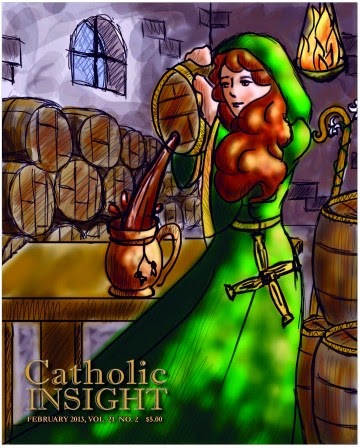
Cover Art: St Brigit and Her Ale by Anna Pierlot
The cover art here is from the February 2013 issue of Catholic Insight, depicting St Brigit pouring ale from a barrel into a pitcher, with a straw cross swinging from her belt. The artist, Anna Pierlot, is a student at Campion College in NSW, Australia.
She says, about her painting,
"This piece depicts St. Brigid, patron of Ireland (along with St. Patrick). She is often shown holding a reed cross, a crozier of the sort used by abbots, along with some source of fire or light. Fire is a central image connected with St. Brigid; nuns at her monastery are said to have kept burning a sacred eternal flame. She is said to have had the power to multiply such things as butter, bacon, and milk; she is shown here brewing beer."
Saturday, January 24, 2015
Create a Brigid Prayer Painting in Mixed Media Collage
Lady of the Radiant Flame: Create a Brigid Prayer Painting in Mixed Media Collage
For every act of creation is an act of magic.
How it works:
We will cover:
- Beginning with intention and ceremony.
- Learning about Brigid, and how you resonate with Her.
- Gathering imagery and text. (Some of each will be provided.)
- Working out a composition.
- Choosing a color scheme.
- Creating a background with papers, paint, and stencils.
- Adhering collage elements.
- Adding visual and symbolic interest with stamps, pastels, paint, ink, fabric, ephemera, and natural elements.
- Telling the story of your prayer painting.
- Practicing visio divino with your prayer painting.
You will need these materials (click here for list).
Sunday, August 31, 2014
Icon by Lewis Williams
ST. BRIGID OF IRELAND (B. 451 – D.527AD)
Most revered of all of Ireland’s early female saints, Brigid was born of pagan\Christian parentage, and raised in the fosterage (early Irish practice of youth education) of a druid. She converted to Christianity at age 17. Noted for her prayerfulness, compassion, humility, and generosity, she founded the earliest known Celtic double monastery, housing both men (renowned for a school of art in illuminated manuscripts) and women (expert in wool industry and weaving of cloth).
She professed a profound belief in “anam cara,” or soul friends, unique persons God offers us as companions on our pilgrim road. This extended to the idea that love and intimacy were essential to a sound marriage, also quite unique for her time.
Exceptional in another aspect, St Mel of Ardagh, inebriated by her virtues or by ‘spirits’, ordained her a bishop and she was respected as such. A perpetual fire was kept in her honor from her time till extinguished by King Henry VIII’s order in 1540 of the Dissolution of Monasteries. Recently it has been rekindled.
In this icon she is noted for her beauty, holding the crosier (based on the famous Lismore crosier), symbolic of a Bishops staff and shepherds of men. Her clothing is the fine wool work of her sisters. She also holds a ‘Brigid Cross,’ an ancient solar symbol traditionally made to welcome Spring (Feb.1, in Ireland). Dawn barely touches the sky over her right shoulder, a time when the veil between worlds is very thin, and her perpetual fire burns through the night.
Also known as ‘Brigid of Kildare’ (“Kildare”= church of the oak) and ‘Bride’ (“bright or exalted one”).
Her feast day is February 1.
Saturday, May 24, 2014
Brigid’s Blessing by Joanna Powell Colbert
Thanks to Becky of the Daughters of the Flame for this one.
From the SageWoman blog