Showing posts with label Book Review. Show all posts

Wednesday, August 06, 2025

Pagan Portals - Brigid: Meeting The Celtic Goddess Of Poetry, Forge, And Healing Well by Morgan Daimler


Do you love Brigit? (Brigid, Bridget, Brig…) Are you her devotee? Or just kind of curious?

READ THIS BOOK! (And if you’ve already read it — read it again. Every time I do I find important bits I either missed or had forgotten.)

Morgan Daimler has done such an amazing job of gathering together and delving into the sources for our many ideas about her. This is an absolutely pivotal text. Please consider (and consider taking on board) what Morgan has to say on so many controversial points. But even if you don’t want your most dear beliefs about Brigit challenged at all (and Brig knows I don’t agree with *everything* Morgan suggests), revel in what you will learn here. Such a tiny book, yet it carries enormous weight.


Image: book cover with woman smith striking an anvil. Lots of red and orange and yellow and fire!

Sunday, December 29, 2024

REVIEW “Singing the Dawn - Rebirth of the Sacred Feminine” by Anne Kathleen McLaughlin


   I have enjoyed this book. It is a sort of fantasy but it isn’t a genre novel. In fact, it is religious fiction that embraces much of Irish myth but is at its heart modern goddess spirituality. A tag the author uses in a post about the book explains what I mean here: "Brigid as Face of Sacred Feminine.”   Singing the Dawn envisions a place beyond the ninth wave — a place unseen by others — where for twelve centuries women have tended, alone or in a community of hermits scattered across seven islands, the memory and rites of the sacred feminine as represented in Brigit. The protagonist is a disillusioned Catholic nun from Ontario, Canada who had hoped to open up the understanding of God within her community to embrace the female as well as the male. When an opportunity to visit a mysterious island becomes available to her, through a note found hidden in the wall of a stone shrine to Saint Dymphna in Ireland, she finds herself joining this secret order of women.    


Part of the book, as she spends time with each of the solitary members over the course of several months, reads a little like an immram: a form of mediaeval Irish tale that sees the protagonist travelling from island to island off the west coast of Ireland — truly, travelling in the Otherworld — and meeting wonders there.   


Because this is meant to be a contemplative tale, it does not rip along plot wise, but wends quietly. This makes it a good book to pick up and read a few pages and then put down again for another time, although it also lends itself to a good long read.   


I tend to like my portrayals of Irish myths, legend, and history to be as close to what I understand to be correct as possible, so there are moments in the book where I grind my teeth a little. On the other hand, I know that there are many Irish people who perceive them in the ways that are written here, so I can’t grind too hard. (It was in Ireland that I was first shown the book by someone deeply devoted to Brigit, who strongly encouraged me to read it.) I do appreciate that the author, who is herself a Grey nun and is Canadian, as am I, does bring Irish myths into the story and uses them as teaching tales. She doesn’t just draw up a beehive hut and a nun and then make it all up from there. (Occasionally, one of the characters will tell a tale from another context, or one created by the author for her purposes.)   


Does the book succeed as a spiritual tool? I think this would depend on the reader entirely. I did find that I was drawn a number of times to think about my own spiritual life when reflecting on what I had just read, and I did have a few moments of new insight, which is far more than I normally would in reading a novel. I appreciate that. And as someone with an urge toward shared contemplative life, I enjoyed imagining this group of women, each on her own small island beyond the ninth wave, held together by their love for their community and a desire to nurture the Sacred Feminine Presence and continue her devotions until the world was ready to embrace Her.   


The author classifies this book as Celtic Christianity, but it is easy to see it as something that has moved beyond that religion into goddess spirituality entirely, as God doesn’t show up much at all. I can see it appealing to a diverse if not an enormous audience. Its specialty of divine womanhood is one that the main masses of readers are not likely to be interested in, and its sedate pace would put off a reader who is only there to be entertained. But for the right person, it can be an uplifting and thoughtful journey.         


Image: of book resting on quilt. Behind it, also on the bed, is an open laptop with a fullscreen image of a tea candle burning.    


Thursday, October 26, 2023

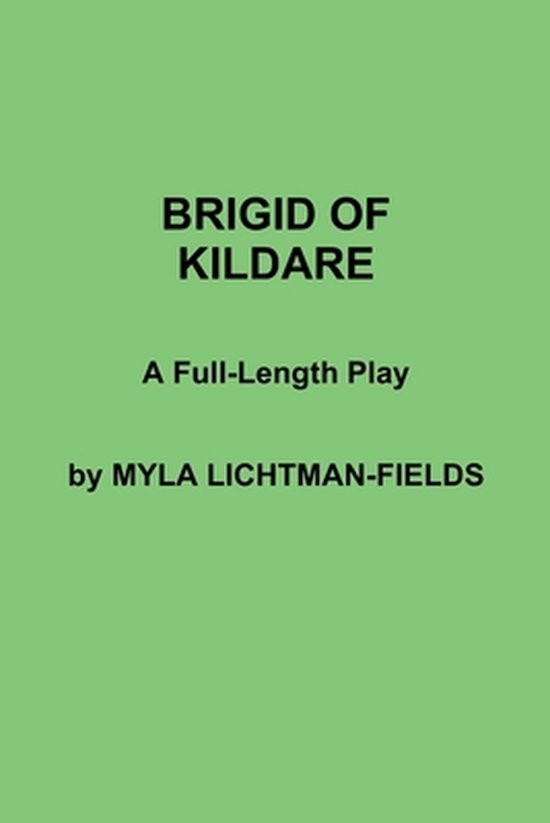
Review: "Brigid of Kildare - A Full-Length Play” by Myla Lichtman-Fields


Review Myla Lichtman-Fields Brigid of Kildare - A Full-Length Play (2014)


This review has two parts, one covering the booklet containing the original script, and one of the radio performance, which differs from the original in important ways.


The booklet (original script):


Lichtman-Fields’s play is that rare beast among Brigidine fiction, a piece that, while written for one side of the religious divide or the other, in this case Christian, honours and respects and even celebrates to some degree the other religion, pre-Christian Irish paganism, or Druidism as she envisions it. A most welcome approach!


Lichtman-Fields has done a good job of looking through the lives of Saint Brigit and picking out important moments, then fleshing them out with dialogue and character.


BRIGID: Kildare’ll mark an important link between our Druid traditions and our new world. Here, my Sisters will keep a fire burning day and night to honor those who came before and to help light the way for those who come after us.


 pg. 60


This is pure Lichtman-Fields. There is nothing in the early Brigit literature about linking the two worlds.[1] But it is a lovely offering of a long-withheld olive branch between the two paths.


Make no mistake, though, this play will appeal in the main to Christians, particularly Catholics, who enjoy and appreciate the old genre of religious inspiration and education, hagiography – writings of saints’ lives which model the values, beliefs, and understanding of the world that are expected of a great Christian. 


Monday, September 12, 2022

It's Back in Print! Alice Curtayne's Saint Brigid of Ireland


One of my favourite books about Saint Brigit has come back into print after many years, Saint Brigid of Ireland by Alice Curtayne. Cluny Media of Rhode Island is a recent Catholic publisher focussed on reprinting books which are no longer available. In homage to SBI's reprinting, I will repost here my review of the book. (To read the original post with the other reviews included, click here.)


St. Brigid of Ireland, Alice Curtayne, 1954, Sheed and Ward, New York. 162 pp.


 Already in her girlhood the lines of an exceptionally strong character are emerging. Her freedom won, the first use she made of it was to succour her mother, whose health was poor, but who was still engaged in the heavy labours of quern and churn.”

pg 28

Unfortunately long out of print and therefore pricey, you can try bookfinder.com for a second hand copy. Beware of mould. The one I ordered from Ireland was horrific to breathe next to. Try to get it from the library if you can, perhaps on interlibrary loan.

This passionate and beautifully written book took me by surprise. I read it over twenty-five years ago, at a time when I was interested in Brigit the saint only as a lens through which to glimpse the goddess, and the book had little to offer me then. It altered in my mind into a quaint and archaic piece of Catholic introspection, confused with Lady Gregory's “Brigit, the Mary of the Gael”1. I’m happy to have returned to it at a time when I can appreciate it.

Curtayne, a native of Brigit`s Kildare, writes from the perspective of a devoted Irish Catholic. Grounded in Church and Irish history and the stories of Celtic saints, she is aware of the significant role Brigit plays in Ireland: “She stands in the first shaft of light that illuminates our history, literature, topography, art and architecture ... Her contemporaries re-named the landmarks, recast the whole topography of the island, in order that she should be remembered (pg 4-5).” 

She touches on the limits and privileges of free women, then settles into the dark burden of the bond slave2, ending with a dramatic ushering in of St Brigit: “She stood isolated, without prototype, without peer (pg 9).” This reads at first like faith-driven hyperbole, and certainly faith plays a large part in her view of Brigit, but as the book unfolds she argues her case from a variety of materials, and the picture she paints is intriguing, filled with nuance and unexpected detail.

Curtayne clearly and extensively locates Brigit on the historical stage of her time. She explores the political climate of turbulence tempered with unity that then existed, particularly in the region of Ireland where she lived, outlining the struggle for territorial dominance between Leinster and the southern Ui Neill, the contention over the position of High King, and the backlash against a punitive tax levied on Leinster. “In striving to evoke the atmosphere of the fifth century, the reader must hear the clash of arms as the perpetual undertone to all other sounds (pg 16).” Some of her details may be arguable in light of modern research; nevertheless, situating her so clearly in her environment makes this an excellent introduction to and contemplation of Brigit and the world she emerged from.

She offers a glimpse of the lives of early Irish nuns, and knits together Patrick’s picture of Irish religious women with Brigit’s Lives as well as historical and mythic texts. She discusses how Brigit’s community might have looked, how building might have proceeded, what her chariot would have been like and how it would be to travel in it. She examines the Lives to learn of the character of the woman they depict, and finds much that I miss when reading the tales—her physical strength, for instance, as one who works hard in the dairy. The image of robust health and physical power that Curtayne envisions, so different from the assumption of beauty as slim elegance, gives us a homespun Irishwoman with acuity of mind and the confidence of an aristocrat. There is of course a taste of the good Catholic girl so familiar from Saints’ tales. But she is so much more than that here.

When she tells a tale from the Lives, Curtayne couches it in the background of the age: in discussing the ale references tittered at by moderns, she describes the role of ale, made fresh and weak and used as a common daily beverage, not a special drink to make men wobbly. In telling of her refusal of marriage, she lets us know clearly the privileged life—to a poet, that nobleman of the Celtic world—that Brigit was passing up. She ties together disparate bits of information—Brigit born a slave, daughter of a tribal leader: in attempting to wed her to a poet, he has in fact offered her the highest possible social position, and throughout her life she behaves as a woman who retains the power and self-assurance of her father’s class.

In telling Brigit’s stories this way, introducing ideas from ancient Ireland, such as regarding class or attitudes toward lepers, contrasting them with attitudes current in Biblical or modern times (the 1950s), and then personalizing the story, she gives often told and sometimes stilted stories new life. She reconnects them to a world and time other than our own and then imagines a human within them—how Brigit might have felt and why she reacted as she did. Finally, she will hint at, or carefully unfold, the symbolism or spiritual lesson she perceives there. 

In approaching the material as if Brigit was a real and historical figure, and in dramatizing to great effect, she expands our understanding not only of the story and symbol of Brigit, but her place in the story of Ireland. Unique in my reading about Brigit is the revelation of her here as a source of pride and unity for a country whose people had for centuries been oppressed and despised. This message, which comes scattered in various forms throughout the book, is an important reminder. Brigit may be internationally loved and venerated now, but this is a new version of her, added to and subtracted from without our necessarily noticing. Placing her back into this setting is important both for our understanding of Brigit and for our honouring of her origins and the people who introduced us to her.

Curtayne's belief in God doesn't lead her to swallow everything that “pious hagiographers (pg 19)” have written. She seeks rational understanding while at the same time turning over the spiritual lessons found in Brigit's Lives. But she does accept that miracles happen. “The stories (of her generosity) ring true, because for the most part they are at once extraordinary and trivial. If a later biographer were minded to invent miracles for Brigid, he would use rather more imagination and tell of something more impressive than a little food conveyed furtively to a dog (pg 21).” 

At times she struggles to make peace between her rigorous intellect and her faith. She says Patrick, having lived earlier than St Brigit, could not have known her. But in the Book of Armagh it is claimed otherwise. She accomodates this by saying that because of Brigit’s friendship with intimates of Patrick, it “may be taken as essentially true (pg 45).”

A little stretch of the truth is permitted elsewhere, too. “Not the faintest breath of scandal ever touched the double monastery founded by Brigid and Conlaeth (pg 63).” Now, it states clearly in the Liber Hymnorum that “She blessed the pregnant nun, she was whole without poison, without illness”. Perhaps this was some neighbouring nun, not of Kildare ... 3  Or perhaps this was not a scandal in Brigit’s day—it certainly doesn’t read like one in the tale.

Curtayne grounds Brigit to some extent in the mythology of her people. In telling the tale where Brigit gives away her father’s sword, she refers to the heroic sword given by a fairy queen which grew so long it touched the heavens like the curve of a rainbow. And she links Brigit directly to those heroes of old. “This strange creature, in whose veins flowed the blood of Conn of the Hundred Battles ... (pg 26)” This Brigit, though unapologetically Christian, becomes more truly Celtic and Pagan than many versions of the modern, reimagined goddess.

But she stops short of linking St Brigit directly to the goddess whose name she shares. While not denying the connection, she brushes it aside, refering in passing to “fearfully dull books” that suggest St Brigit was not a real woman, but only a product of the goddess (pg 109). 

In so many ways, the Brigit in Curtayne’s book takes on life and character, and in doing so, allows the reader to connect more fully with her meaning in his or her life. To Curtayne, Brigit is not merely a symbol. Her miracles, some though not all, are real. Her envisioning of Brigit’s life surpasses even Kondratiev’s4 imaginings, and is founded on a broad knowledge of the Lives, her times, the Celts, the Bible, and the history of the Church.

We are given Brigit’s presence in Ireland and her effect on it, the building of communities, the hosting of intellectual circles surpassing anything in England or on the Continent of that time. A careful comparison between Celtic Christianity and the Christianity of St Francis5, insight into St Brigit’s reaction to the violence around her, with its parallels to the Troubles yet to come in Ireland, her examination of difficult spiritual truths6—Curtayne approaches her topic from a dizzying multitude of angles. In a rare moment of she writes: “But not to incur a charge of bathos, it would be better, perhaps, not to mention in the same breath with the Brigidine circle Madame Récamier’s salon, or the “intellectual afternoons” of Hannah More and George Eliot (pg 69).” 

A rich offering indeed.


Purchase here.


Thursday, October 07, 2021

Book Review: Becoming Brigid by Lisa Shafer


Becoming Brigid by Lisa Shafer (2013)


Confession: covers matter to me. They are the first thing about a book that catches my attention, either by their wonderfulness, their horribleness, or their unnoticeableness. They tell me the genre, often, what sort of publisher is handling them (don’t assume I gravitate to the ones from big publishers, because I don’t), and, if I’m lucky, something of the subject of the book. They are my first opportunity to assess whether I might be interested enough to stay a moment and find out a little more.


Given all that, I approached this book, which I found by chance online, cautiously. The cover appeared homemade, which usually means the book is self-published. I know that many self-published books are awesome, but a whole lot of them are not. So, I approach, but with slightly lowered expectations.


To my delight, the blurb told me that this was a novel not just about a girl and a fellow, but also a missing goddess named Brigid. Yes!! There are not enough novels about Brigit, from where I sit, and I am always looking for ones I will love. With Becoming Brigid I was looking at one that moved out of the more serious territory of the others I have read* and into a fond sub-genre, paranormal fantasy. I ordered it, and soon it arrived.


My first impressions were good. The writing was professional and engaging, the genre familiar and comfortable (North American Y.A. urban fantasy), and I quickly got a sense of the main character and her cheeky, adventurous spirit. Her father is a ghost hunter who never finds anything, but she, it seems, sees ghosts. And one, at least, sees her.


And we’re off.


The long and the short of it is, I really like this book. The plot is appealing and carried me along, with enough surprises that I was pleased but not so many I was exhausted. The main and secondary characters are convincing and interesting (I really like Pepper’s sidekick, though I wish her female friends had featured more in the book). The dialogue, and in fact the writing overall, is excellent. The story’s main setting (Utah) remains tangible in my memory, though I have hazier recollection of other settings. And the author’s humour shines through on a number of occasions, giving me some good, unexpected laughs, which I appreciate in a book that is not attempting to be funny on every page. I was absolutely in my reading element to have added to all of that the intrigue of my real life favourite goddess playing a major part here.


Did I have criticisms flickering in my brain at any points as I read along? Of course. I always do – even when I am the person who did the writing.


There were a couple of moments where a person of size was referred to in a humourously pejorative way, which really bothers me. (I felt somewhat better when I discovered that the author herself is heavy. Not that it makes it great, but it is likely internalised oppression rather than skinny-person prejudice. I can live with that.)


I did feel uncomfortable with the sexual vibe between a teenager and a grown man, even though it is never acted on beyond a brief kiss. Why could he not have been a teenager, too? On the other hand, handled as it is, it’s saying to girls, “You can say no even to a guy you really like; there is no hurry or even any need to act on those feelings,” without shaming the protagonist’s sexual sensations and desires. That is pretty cool, if you ask me, and a whole lot different than the messages in the books I read as a teen.


In fact, there is a whole lot of girl power happening in this story, a lot of rejection of controlling males, and the protagonist finding her way through her fears and self-perceptions: but not in a heavy handed, info dump kind of way. Really well done.


For those among us who are attached to certain stories about the goddess Brigit, I will say that the backstory here is not from the Irish tales and traditions. It is based instead on a much more recent tale of Brigit and Lugh in Scotland, along with what my limited understanding believes is a Wiccan or similar Neo-Pagan perspective. Brigit’s triple goddess nature is said by one character to be linked to the maiden-mother-crone modality, which in origin, in fact, it is not. This is again a modern framework superimposed on an ancient goddess.


But you know what? That’s okay. If we aren’t coming to this novel to learn mythology or history, but to enjoy fictional magic, a character’s growing self-awareness, and plain good writing, then there is no need to worry about those things. And you know how much time I do spend worrying about them, in my free time.


Now, I may have to seek out Lisa Shafer’s other books, starting with the first, Confessions of an Average Half-Vampire.


Enjoy.


* You can read my reviews of them on my blog, Brigit’s Sparkling Flame: http://brigitssparklingflame.blogspot.com/p/brigit-book-reviews.html