Showing posts with label Morgan Daimler. Show all posts

Wednesday, August 06, 2025

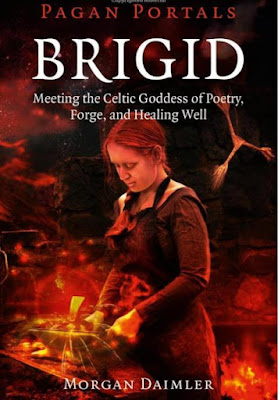
Pagan Portals - Brigid: Meeting The Celtic Goddess Of Poetry, Forge, And Healing Well by Morgan Daimler


Do you love Brigit? (Brigid, Bridget, Brig…) Are you her devotee? Or just kind of curious?

READ THIS BOOK! (And if you’ve already read it — read it again. Every time I do I find important bits I either missed or had forgotten.)

Morgan Daimler has done such an amazing job of gathering together and delving into the sources for our many ideas about her. This is an absolutely pivotal text. Please consider (and consider taking on board) what Morgan has to say on so many controversial points. But even if you don’t want your most dear beliefs about Brigit challenged at all (and Brig knows I don’t agree with *everything* Morgan suggests), revel in what you will learn here. Such a tiny book, yet it carries enormous weight.


Image: book cover with woman smith striking an anvil. Lots of red and orange and yellow and fire!

Monday, March 17, 2025

Ten Titles (and Thirteen Books) for Brigit


I am revising my online course, Discovering Brigit, and wanted to update the brief book list included there. These books are the ones I would point people to first, for a variety of reasons. Recall that I have a slew of unread and therefore unreviewed Brigit books, which I hope to get to over the next year and a bit. But for now, I’d like to share this with you.

Only one, Ó Duinn’s Rites of Brigid, is out of print, but you should be able to get that on interlibrary loan.


Top Ten Books for Starting Out with Brigit (Also Awesome for Oldtimers)


Bitel, Lisa M. Landscape with Two Saints: How Genovefa of Paris and Brigit of Kildare Built Christianity in Barbarian Europe (2009). (Nonfiction.)


Brigde, Mael. A Brigit of Ireland Devotional - Sun Among Stars (2021). (Poetry and essays.)


Clann Bhríde. Book of Hours - For Daily and Seasonal Practice (2013).


Curtayne, Alice. Saint Brigid of Ireland (1954). Reissued (2022). (Nonfiction.) 


Daimler, Morgan. Pagan Portals Brigid: Meeting the Celtic Goddess of Poetry, Forge, and Healing Well(2016). (Nonfiction.)


Freeman, Philip. Two Lives of Saint Brigid (2024).


Minehan, Rita CSB. Rekindling the Flame: a Pilgrimage in the Footsteps of Brigid of Kildare (1999). Revised (2022). (Nonfiction.)


Mole, Chris, et al. Brigantia Vol. 1 (2021) and 2 (2024). (Graphic novels.)


Ó Duinn, Séan OSB. Rites of Brigid - Goddess and Saint (2004). (Nonfiction.) 


Phillips, M.A. Rituals of Rock Bay Series:  (Fiction.)

Book 1: River Magic (2020); Book 2: Hearth Magic (2021);

Book 3: Forest Magic (2021);


Image: "book lot on table" by Tom Hermans on Unsplash.

Thursday, December 15, 2022

Class Giveaway! Discovering Brigit - Goddess & Saint (with Mael Brigde)


Win free enrollment in Discovering Brigit - Goddess & Saint with Mael Brigde. Enrollment gives a discount on the following course, Stepping Into Brigit, but Discovering Brigit can be taken as a stand-alone, and will appeal to long-time devotees as well as those new to Brigit.


TO ENTER

*METHOD ONE*

* Like my Facebook page, Brigit's Portal - Classes, Gatherings, Poetry, Tools.

* Share this post.

* Comment below the competition post on Brigit's Portal with one thing that drew you to Brigit, Goddess and Saint.


*METHOD TWO*

* Subscribe to this blog.

* Share the contents of this post & the image above on social media.

* Comment below with one thing that drew you to Brigit, Goddess and Saint.


The winning name will be drawn on 15 January 2023.

Good luck!


ENDORSEMENTS

"I can’t imagine reading this poetry and remaining untouched. I can’t imagine allowing this book to lie, languishing and ignored, at the back of the shelf. I can’t imagine allowing this book to pass you by."

from the foreword by Orlagh Costello, founder of Brigid's Forge.

“Sun Among Stars…is at once contemplative and deeply personal, educational and reflecting the evolution in understanding and belief that we all go through over time. For this alone it is an invaluable addition to the corpus of material on Brigid… Let the goddess or the saint or simply Brigid speak to you through the author’s words as you step into a deeper understanding…”

Morgan Daimler author of Pagan Portals: Brigid - Meeting The Celtic Goddess Of Poetry, Forge, And Healing Well

"It is a unique challenge to bridge the ancient past with the modern, and the Christian with the Pagan, but Mael Brigde does so with ease and grace. She tells the story of Brigid through remarkable poetry that is as much prayer as it is verse. This gorgeous text could be used as a guidebook for a Brigid devotee through different holidays and times of life. A must have for all lovers of Brigid."

Courtney Weber, author of Brigid: History, Mystery, and Magick of the Celtic Goddess


WEBSITE: https://bit.ly/MaelBrigde


IMAGE: a graphic design consisting of the words Class Giveaway going around a photo of a red-haired woman (pictured from the upper arms to above the knee-line. She is wearing a green dress and holding a candle lantern. The image rests on a photo of hawthorn leaves against a background of blue sky.

Tuesday, November 15, 2022

Book Giveaway: A Brigit of Ireland Devotional - Sun Among Stars by Mael Brigde


Win a copy of A Brigit of Ireland Devotional - Sun Among Stars by Mael Brigde. (Yes, me! Why do I feel so shy about this?)


TO ENTER

*METHOD ONE*

* Like my Facebook page, Brigit's Portal - Classes, Gatherings, Poetry, Tools.

* Share this post.

* Comment below the competition post on Brigit's Portal with one thing that drew you to Brigit, Goddess and Saint.


*METHOD TWO*

* Subscribe to this blog.

* Share the contents of this post & the image above on social media.

* Comment below with one thing that drew you to Brigit, Goddess and Saint.


The winning name will be drawn on 15 December 2022.

Good luck!


ENDORSEMENTS

"I can’t imagine reading this poetry and remaining untouched. I can’t imagine allowing this book to lie, languishing and ignored, at the back of the shelf. I can’t imagine allowing this book to pass you by."

from the foreword by Orlagh Costello, founder of Brigid's Forge.

“Sun Among Stars…is at once contemplative and deeply personal, educational and reflecting the evolution in understanding and belief that we all go through over time. For this alone it is an invaluable addition to the corpus of material on Brigid… Let the goddess or the saint or simply Brigid speak to you through the author’s words as you step into a deeper understanding…”

Morgan Daimler author of Pagan Portals: Brigid - Meeting The Celtic Goddess Of Poetry, Forge, And Healing Well

"It is a unique challenge to bridge the ancient past with the modern, and the Christian with the Pagan, but Mael Brigde does so with ease and grace. She tells the story of Brigid through remarkable poetry that is as much prayer as it is verse. This gorgeous text could be used as a guidebook for a Brigid devotee through different holidays and times of life. A must have for all lovers of Brigid."

Courtney Weber, author of Brigid: History, Mystery, and Magick of the Celtic Goddess


WEBSITE: https://bit.ly/MaelBrigde


IMAGE: a graphic design consisting of the words Book Giveaway going around a photo of the copy of a green book, A Brigit of Ireland Devotional - Sun Among Stars. The face of a red-haired woman (painting) looks out from a circle of Irish knotwork. The book rests on a photo of hawthorn leaves against a background of blue sky.

Monday, October 24, 2022


 Just a reminder to those who read books about Brigit that I have a whole slew of reviews of Brigit books which you can find on my this blog, Brigit's Sparkling Flame and at Academia.edu.
I have a store of new books to review over the next year or two, and these come out one at a time on the blog. (A few have already been added, such as Morgan Daimler's Pagan Portals: The Dagda - Meeting the Good God of Ireland.) When I am done reviewing them all I will update the paper, or perhaps just do a Volume Two.
This marks the first time there have been so many books about her that I am picking and chosing which to review, rather than going for every one I can find. If you have some obscure title I might miss and think I should review it, please let me know. Review copies of your own books are welcome, and that includes your poetry book! I confess that I am omitting a couple of books I would like to review because of costs.

Meanwhile…
Happy reading!


Image: "Libreria ambulante Santiago de Chile" by L'odyssée Belle on Unsplash.

Wednesday, January 05, 2022

What I'm reading coming up to Imbolc...


There are so many sources for immersing ourselves in Brigit as we come up to her festival, but what is my first choice?

Pagan Portals - Brigid by Morgan Daimler. It is the best source for getting a clear understanding of the goddess. (There are other great sources for the saint.)


My second choice is the sadly out of print Rites of Brigid, Goddess and Saint by Seán Ó Duinn OSB.


And how did I not know there was an Irish language version of that book, Gnas Na Feile Bride? Perhaps still less available than the English.


Nevertheless, I will be dipping in to this one, as well, as the month goes on.


Wednesday, November 10, 2021

Saturday, June 05, 2021

MoonCon 21 "Brigit Panel"


So this just happened! I really enjoyed our #Brigit Panel. And that swirling white streak beneath Erin Aurelia and I is actually Morgan Daimler, manifesting in our shared realm.
If you want to watch the rest of the Con, you can find the sessions on Facebook and YouTube :
Our Brigit panel (available on video):

OR


Image: Screenshot, 5 June 2021, MoonCon 21 by Mael Brigde.


Tuesday, November 24, 2020

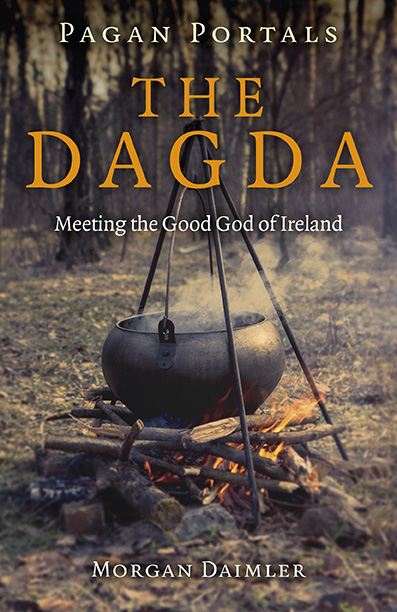
Book Review: Pagan Portals – The Dagda: Meeting the Good God of Ireland by Morgan Daimler


Pagan Portals – The Dagda: Meeting the Good God of Ireland
Morgan Daimler (2018)

 It’s strange to feel so excited to read a book that has actually been waiting in my bedside cabinet for nearly two years. But that’s how it is. And now that I have now finally read The Dagda, I can’t stop raving about it. It is a jewel on my bookshelf.


 Pagan Portals – The Dagda is far from the first book I’ve read by Morgan Daimler, nor will it be the last. They have become one of my favourite authors for a few simple reasons: their research is meticulous, they draw together the important myths, gleaned from early and modern texts – they even taught themself how to read old Irish because they wanted more than the translations they had on hand were offering. Daimler has a wonderful way of looking at things from a new angle, and this book continues in that tradition.


 I was looking forward to this book in particular because I was drawn to The Dagda, personally. He drew me initially by his own personality and his actions in the tales, particularly of his building single-handed a fort for Bres, and carving out twelve plains in a one day. But more important was his being father to the sisters Brigit. Because Brigit is so important to me, I wanted to cultivate an acquaintance, at least, with someone who helped shape these sisters as they grew.1


 The Pagan Portals series is devoted to short books up to around a hundred pages long that are meant to introduce the key elements of a deity or topic. In this case the book is nearly eighty pages, and they have divided the material up well. In chapter one, “Who is The Dagda?” they begin by giving his names and the epithets that describe him, and address how a sense of his nature can be drawn from them. This necessarily takes us into the myths themselves, so although they don’t tell them exhaustively, they reveal enough that we can understand why he might be called Eochaid Ollathair, and that “The Dagda” means “The Good God.” But what does that mean? Does it mean he’s a nice guy? Well, no. It means he is good at all things. So just the definition of this one name, and he has many, tells us something important about him. This initial chapter grounds us not only in his names, but in how he’s been described physically in the tales, and gives a glimpse of his relationships with others. (This is a complicated kettle of fish as he has many lovers, many children, and his children, like himself, have run into real difficulties because of some of those lovers).


 One thing that Morgan always does which I greatly appreciate, is they provide useful end notes to each chapter, and provide a good bibliography. I can see where they’re getting their information from; I don’t have to just trust them. I can then decide whether I agree with their take on things, and that is important to me, especially in something so essential as the nature of the deities.


 The second chapter is “The Dagda in Mythology.” Here they explore where The Dagda figures most prominently in the different texts. As they work through these, his personality and what he may represent to the devotee become more and more clearly defined, leading to an overall sense of what we know of him. This chapter also has an interesting reassessment of the Samhain sex tryst between The Dagda and The Morrigan.

Wednesday, March 27, 2019

French Language Edition of Brigid by Morgan Daimler


Wonderful to see that Morgan Daimler's excellent book on Brigid is now available in a French language edition! Click here to order.

"Cet ouvrage est une introduction élémentaire au culte de la déesse Brigid, qui se concentre sur son histoire et son mythe, ainsi que sur sa dévotion et son culte modernes. Se focalisant principalement sur la déesse irlandaise, le livre inclue également une discussion sur ses apparitions dans le reste du monde celte, en particulier en Écosse. Ses différentes apparitions dans la mythologie sont mises en relation avec la transformation de la déesse païenne en une sainte catholique. Les méthodes modernes permettant aux néopaïens de se connecter et d'honorer cette déesse populaire incluent des méditations et des offrandes, ainsi que des anecdotes personnelles tirées des expériences de l'auteure.

"Qui était Brigid chez les païens préchrétiens ? Qui est-elle et que représente-t-elle aujourd'hui pour les païens modernes ? Comment tisser les liens entre l'ancienne et la nouvelle déesse païenne ? Pour trouver la réponse à ces questions, découvrez les mythes de Brigid chez les païens irlandais, les histoires de Bride en Écosse et la façon dont les gens honorent aujourd'hui cette divinité puissante et si importante..."


12,00 € 

Friday, February 08, 2019

Review: Pagan Portals—Gods and Goddesses of Ireland by Morgan Daimler


Daimler, Morgan. Pagan Portals—Gods and Goddesses of Ireland: A Guide to Irish Deities (2016).


Once again I come away from reading one of Morgan Daimler’s books with a sense of excitement and the urge to wave it in front of all sorts of people saying, “You want this book!” Why, in this case?

If you have ever plunged into Irish mythological texts, or even modern writings about the Irish deities, you will have quickly discovered that there are a LOT of names in there, all baffling if you are unused to Irish spellings, or are unaware that there are multiple forms and spellings for every name, not to mention the plethora of different persons associated with each god or goddess. In one story he is married to so-and-so, in another he is cavorting with someone else; here she is a sympathetic character, there she is a trickster or a dupe. How do you keep them all straight? And how begin to build a sense of each deity in his or her own right and complexity? How winnow through opinion and fact, misinformation and changing perceptions over time? How, on top of all of this, do you honour those you are drawn to?

There are a number of excellent tomes that cover Irish deities and myths in depth. Their worth is undeniable. But if you want to narrow down your focus you would be hard pressed to find a source that maps things out as clearly and beautifully as Pagan Portals—Gods and Goddesses of Ireland.

The Pagan Portals series is a brilliant idea. Each book is short—in this case less than ninety pages—and serves as an introduction to its subject that offers enough information to set you clearly on your path without overwhelming you with detail. It is possible to read one quickly enough to retain a good sense of the general scope of the book, to leave you feeling less rather than more confused.

In this case, Daimler’s purpose is to offer sound scholarly information about the deities in an easily accessible style to assist those interested in following an Irish Pagan path. This book could be of use both to newcomers to Irish Neo-Paganism and to those who have been immersed for some while.

She tackles her topic by dividing the book into three main sections covering the gods of the Tuatha Dé Danann, the goddesses of the Tuatha Dé Danann, and Irish deities of different or uncertain origins. Instead of limiting herself to the handful of deities we encounter again and again, Daimler includes a number who are much more obscure. She somehow strikes a balance between giving a satisfying survey of their names, relationships, attributes, associations, and elements of their stories, and holding back enough detail that the reader doesn’t end up becoming lost in the thickets.[1] (It must be very hard to stop herself at times—she is well versed in her topic and has many fascinating gems at her disposal.) She is concise and clear without oversimplifying, frequently giving conflicting points of view and allowing the reader to follow up on them if desired rather than simply offering her own favourite theory and omitting all controversy. As well as those of Celtic scholars, she offers perspectives of Irish Neo-Pagan practitioners, and ends each entry with suggestions for how we might honour a given deity in our own lives.

In addition to the individual entries, which range from less than half a page for a deity like Neit, about whom little is known, to over four pages for Macha, Daimler offers excellent advice on how to build a relationship with the deities—not a prescription of rituals and offerings, but an approach to learning and relating that is as wise as it is clear (and again, succinct). A bibliography and recommended reading list are given at the end of the book.

I had not originally thought to include this review in Brigit’s Sparkling Flame. I changed my mind for the simple reason that Brigit is not an isolated goddess, but a part of a rich tapestry of deities from a complex culture, and having a clearer sense, even just a beginning sense, of some of the other gods and goddesses can only strengthen our understanding of and relationship to her. I can think of no better book to wave before Brigidines for this purpose than Pagan Portals—Gods and Goddesses of Ireland.


[1] One detail I find especially interesting which is not often included is the particular geographic area a deity is linked to, where that is known.


Saturday, December 01, 2018

An Dagda's First Books Have Launched!


Pagan Portals - the Dagda 


I'm excited. Two separate books on The Good God, An Dagda, father of the goddesses Brigit, are now available. In my time of devotion to Brigit I have come to know her parent somewhat and fallen in love with him. I am thrilled to have these two opportunities to know him more.

Until now, those interested in The Dagda have had to scrape together their information from widely dispersed sources. In late October Morgan Daimler's Pagan Portals book, The Dagda, was released. A slim volume, like all Pagan Portals titles, it is the first book entirely devoted to this important Irish god. I haven't read it yet, but it sits on the table awaiting my attention. I've read several of Morgan's books and have never been disappointed. 

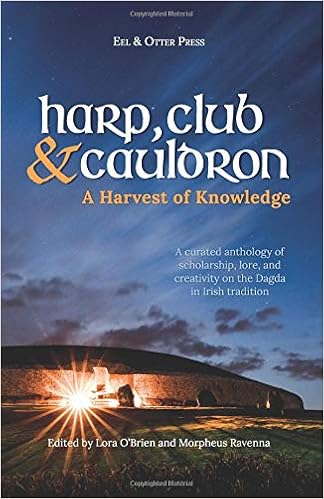
Minutes ago, Morpheus Ravenna and Lora O'Brien launched their anthology Harp, Club, and Cauldron - A Harvest of Knowledge. Many respected (and beloved) writers and artists have contributed to the book: Isolde Carmody and Chris Thompson from Story Archaeology, Anthony Murphy, author of Mythical Ireland: New Light on the Ancient Past, Segomâros Widugeni, author of Ancient Fire: An Introduction to Gaulish Celtic Polytheism, Valerie Herron, the artist responsible for the delightful works in Ravenna's book on the The Morrigan, The Book of the Great Queen, Morgan Daimler herself, and many others. (I have a poem in there, myself, speaking with Brigit about her father.) Having had a glimpse of the ebook, I am more than ever looking forward to having the book in my hands, .

Now is a great time to have the profile of the Dagda raised. A god of many abilities, protector of his people and linked to the health and balance of his land, he is a powerful ally in a world filled with disharmony and fear. His cauldron of plenty, his harp that can bring sorrow, laughter, or sleep to those who listen, his club which kills with one end and restores to life with the other, his great appetites and his ability to do what needs to be done under any circumstances--An Dagda's influence needs to be felt now more than ever.

It may take a few hours for the anthology to become available--the button is pushed, but Amazon sometimes takes a while to catch up. So if you get a "not currently available" note, fear not. It's on the way.

For those of you who have grown interested in or close with An Dagda, you might also want to join the Facebook group The Dagda's Hearth. I'll see you there, perhaps?


Original Fund-Raising Video for Harp, Club, and Cauldron:

Tuesday, February 28, 2017

Review: Pagan Portals—Irish Paganism: Reconstructing Irish Polytheism by Morgan Daimler


An excellent primer on Celtic Reconstructionism and the deities and beliefs of ancient Ireland.

 (Also mentioned, Daimler, Morgan, Tales of the Tuatha Dé Danann; Daimler, Morgan, Treasures of the Tuatha Dé Danann; Laurie, Erynn Rowan, Ogam: Weaving Word Wisdom; and NicDhàna, Laurie, Vermeers and Lambert ní Dhoireann, The CR FAQ — An Introduction to Celtic Reconstructionist Paganism.)

So why is this book on a Brigit blog? Because, and I truly do believe this, whatever our background or spiritual leanings, the more we understand about the world Brigit emerged from and the world which embraces her now, the deeper our connection with her will become. 


Pagan Portals—Irish Paganism: Reconstructing Irish Polytheism is another short book by Morgan Daimler that gets straight to the point—a clear, comprehensive manual that dusts away cobwebs and guides the reader in helpful directions. The other such by her that I have reviewed (favourably) was Pagan Portals— Brigid: Meeting the Celtic Goddess of Poetry, Forge, and Healing Well.

By its nature, the present book cannot be as precisely tuned as the Brigit book; its topic is much vaster and its page count similar. Not difficult. Daimler still manages to identify key topics and dispatch them creditably. There are times when I wished for more detail—also not difficult. She footnotes beautifully so that the reader can consult elsewhere for that fleshing out. To attempt to put all the rich detail possible into this book would have defeated its purpose. For clarity on what is a deep and rambling topic, with dozens of possible interpretations of the materials, Daimler’s choice of a smooth outline and spare prose is perfect.

Irish Paganism: Reconstructing Irish Polytheism contains quick, nicely referenced notes on what Celtic Reconstructionism is and isn’t, basic beliefs, deities, spirits, holy days, an Irish Polytheistic approach to ritual, magic and mysticism, and so on.

I read it, without planning to, at the same time as Daimler’s pair of palm-sized bilingual (Irish and English) booklets, Treasures of the Tuatha  Dé Danann and Tales of the Tuatha  Dé Danann. She has selected key passages from Irish myths and translated them here. I found reading these booklets in tandem with  Irish Paganism: Reconstructing Irish Polytheism helped illuminate the character of some of the deities, as well as the sense of story and Otherworld from an Old Irish point of view.

A nice follow-up would be Erynn Rowan Laurie’s Ogam: Weaving Word Wisdom, which goes into greater detail on many of the above elements, including what CR is, its ethics, and approach to ritual, as well as homing in on texts and traditions that illuminate the various letters of the ogam alphabet. This yields a practical tool for the type of spirituality Daimler offers us here in broad strokes. Daimler herself gives a list of readings to turn to next, including the CR: FAQ, which I would agree is an important book for getting a grasp on what CR encompasses and aspires to.

Not every aspect of the book worked for me. Most particularly, I wish Moon Books would get a good copy editor and not let errors slip by (though I admit there are not many, and the layout can’t be faulted). Recalling that a book like this is ideal for beginners, a glossary with new words and terms, or the word listed with the page where it is defined, would be a good compromise in a short book where there is no index, and would be easy enough to add to the pronunciation page. There are times, too, when ancient and modern, Pagan and Christian are subtly blurred, such that they don’t completely reflect reality and can cause confusion.

As one who doesn’t do a lot that would be termed magical, myself, I found Daimler’s description of the place of magic in the daily life of our ancestors and the nuts and bolts of how Irish spells might be constructed quite illuminating. And finally, her discussion of cultural appropriation, with a rare and valuable explanation of what the term exactly means and when it is and isn’t a bad or good thing, was extremely valuable to me. Clearly, though this book would make a great introduction to someone newly interested in Irish Polytheism or Celtic Reconstructionism generally, it has gems on offer, too, for those who have been involved in the movement for some time.

I look forward to reading my next book by Morgan!

Wednesday, November 23, 2016

Review by Morgan Daimler of Stepping Into Brigit (A Course by Mael Brigde)


I was delighted to discover this review on my Facebook feed today. Morgan Daimler (Pagan Portals: Brigid, among others) reviews the second of my online Brigit courses. (The first is Discovering Brigit. If you do that one, at the end you will find a coupon for Stepping Into Brigit which essentially reimburses $13 of the $15 you spent to take DB.)

This review is from Living LiminallyReflections on Reconstructionist Polytheism, devotion to the Déithe and an-déithe, and living Paganism in a modern world

Top of Form

Bottom of Form
TUESDAY, NOVEMBER 22, 2016
  Many people are familiar with my dedication to the Morrigan but what may not be as widely known is my love of Brighid. It is, by its nature, a different sort of love, but it is just as much a presence in my life in its own way. So when I was asked to help Beta test* a new course 'Stepping Into Brigit' designed for people interested in Brighid to learn about and connect to her I jumped at the chance.


The course is set up as an 11 module course, with each module containing multiple lessons, and is meant to be done - ideally - over a month. With roughly 38 overall lessons to complete (course surveys excluded) one would need to either decide to do one or more lessons a day or set aside time every few days to do a full module in order to finish in a month. What I liked about the set up though is the learning is self paced, so that you can choose to it at whatever speed you like and in whatever fashion works best for you. I took the 'chunky' approach myself and did a full module at a go because that was what worked best with my schedule, although other people may find a slower spacing better.


Each lesson is fairly thorough but also brief. At some points I felt perhaps a bit too brief, but the idea was to take time with each one and contemplate it, write down thoughts and reflections on the material, and really process it, rather than rushing through to get to the next one. They often included outside recommended reading or references to follow up, such as the Story Archaeology's entry on discussing her which should take some time to do. With that in mind the size of each lesson is pretty good, and it really was designed to encourage engagement from the student. I also like the use of mixed media throughout the course which used text, images, videos, and audio clips.

The material looks at Brighid in a holistic manner including both the pagan Goddess as well as the Christian saint, and while I didn't feel the same engagement with the material relating to the saint that reflects more of my own bias than any flaw in the course. It certainly was the most well-rounded view I think I've seen and I can't fault it's fairness in giving an equal voice to all sides. the material is generally presented without any favoring of one opinion over another and with clear citation of sources, allowing a student to draw their own conclusions for the most part about the very complex subject of Brighid pagan roots and Christian history.

Speaking of sources, I really did like the way the course offered a lot of quotes directly from source material. I think often this is the best way to let a student contemplate the original material without the filter of an author's opinion. I also like the amount of poetry included and the way that allowed me, as a student, to experience the material without overthinking it and to appreciate the beauty of the ideas presented. I also liked the option of entering feedback after each lesson, to share personal experiences or thoughts. I did feel there was a lack of more directed exercises beyond the journaling being encouraged, but I acknowledge that not all students want to feel like they have written homework to complete. The overall feel of the course was contemplative and engaging without being tedious or excessively 'school-like' in its feel, which I think will have a wide appeal to modern adult spiritual seekers.

There are many people out there interested in Brighid and many seeking classes or courses online to help them better connect to spiritual things of interest. For those looking to learn about and connect to Brighid I think this course would be a good option, if you find that online courses are generally a good option for you. As with any such course it requires a person to be self-motivated to do the lessons, and to incorporate the material in a practical manner. However for someone who has the desire to truly make use of what this course is offering I think a great deal of valuable knowledge can be gained here.


*to be clear - I was asked to Beta test the course by its creator, but this review is being offered by me freely and without any compensation. As far as I am aware I was asked to help test the course in part because of the book I had written on Brighid and my knowledge of Her, and in the interest of transparency my book Pagan Portals Brigid is recommended reading for this course. However I would not and will not endorse nor recommend anything I do not genuinely see value in and my opinions offered here are honest; had I not seen value in the course on its own merits I would simply not have reviewed it. 
___________________________________________________

ABOUT Morgan
My name is Morgan Daimler. I have been a witch since 1991, an Irish reconstructionist since about 1994, and heathen since 2006; I also practice seidhr. I love studying other paths and other ways of doing things and I enjoy discussing religion, philosophy and spirituality with people from diverse paths. I am a Druid in the CR Druid group the Order of the White Oak, as well as a member of ADF. I try to stay active in the pagan community and am always interested in hearing about how other people are doing things. I have had my poetry and prose published in different places including eight anthologies, Circle magazine, as well as Witches and Pagans magazine. I am the author of the book By Land, Sea, and Sky, the children's book a Child's Eye View of the Fairy Faith which is published through Spero Publishing, and through Moon Books: Where the Hawthorn Grows, Fairy Witchcraft, Pagan Portals: the Morrigan, Pagan Portals: Irish Paganism, and the forthcoming Pagan Portals: Brigid. I also have a self published urban fantasy/paranormal romance series, Between the Worlds.


Friday, July 15, 2016

Book Review: Pagan Portals - Brigid by Morgan Daimler


Daimler, Morgan. Pagan Portals—Brigid: Meeting the Celtic Goddess of Poetry, Forge, and Healing Well, Moon Book (2016). 112 pages.


  • Paperback £4.99 || $9.95Mar 25, 2016
    978-1-78535-320-8
  • e-book £2.99 || $3.99Mar 25, 2016
    978-1-78535-321-5

AVAILABLE ONLINE FROM: Amazon US, Amazon UK, Hive, Indiebound.

__________________________________________________________________________

An excellent primer, and the best available for getting a a handle on the sources, ancient and modern, for our understanding of Brigit. I can't recommend it highly enough.

Morgan Daimler is the author of a number of books and shorter works of poetry, fiction, and nonfiction, and is gaining a reputation for clearly written, well researched, and extremely useful handbooks such as this one on Brigit.

Brigit is the spiritual being to whom I have devoted decades of my life, in study and devotion and in supporting others in their journeys on Brigit’s path. I discovered in Pagan Portals—Brigid, to my joy, a book that wastes no words—it is a slim volume indeed—but packs into those pages more clear and illusion-lifting information than I have ever seen set out about Brigit.

The reason is this: Daimler has gone straight to the medieval texts, finding references to Brigit and explaining them lucidly—indeed, clarifying for the reader which text treats her in which way, rather than allowing them to blur together in our minds; she tackles the early geography of goddesses-who-may-be-Brigit; she takes the complex blend of ancient, folk, and modern conceptions of Brigit and sorts them deftly out so the reader can see where commonly heard assertions come from and make up her own mind about where to follow and where not.

Daimler explores animal and plant associations and symbols commonly associated with Brigit, such as triplicity, touches on her holidays, prayers, chants, and charms, and looks at the rise of  modern Brigidine myths and flame-tending, as well as providing hints for honouring Brigit today and supplying a diverse resource list and bibliography.

She ends each chapter with a short essay on her personal connection to Brigit, thus grounding the theory in personal practice. Indeed, although emphasis is put on making assertions supported by solid academic material and distinguishing these from our personal beliefs, she is careful to point out that she does not believe that “the religious framework we use to connect to the Gods matters as much as the effort to honor the old Gods itself. I think we can all do this respectfully and with an appreciation for history without the need for any particular religion. Whether we are Reconstructionists, Wiccans, or Celtic pagans all that really matter is that we are approaching our faith with sincerity and a genuine intention.” I would add that this book would be useful to anyone interested in Brigit, goddess or saint, be they NeoPagan, Christian, or secular scholar, for the information is so well laid out that any further studies or devotions would only be enhanced by the reading of this book.

____________________________________________________________________________


From the publisher's website:

Pagan Portals - Brigid is a basic introduction to the Goddess Brigid focusing on her history and myth as well as her modern devotion and worship. Primarily looking at the Irish Goddess but including a discussion of her Pan-Celtic appearances, particularly in Scotland. Her different appearances in mythology are discussed along with the conflation of the pagan Goddess with Catholic saint. Modern methods for neopagans to connect to and honor this popular Goddess include offerings and meditation, and personal anecdotes from the author's experiences are included as well.

Who was Brigid to the pre-Christian pagans? Who is she today to neopagans? How do we re-weave the threads of the old pagan Goddess and the new? Learn about Brigid's myths among the pagan Irish, the stories of Bride in Scotland, and the way that people today are finding and honoring this powerful and important deity to find the answer.

Sunday, February 14, 2016

Book: "Pagan Portals - Brigid: Meeting the Celtic Goddess of Poetry, Forge, and Healing Well" by Morgan Daimler


This is an EXCELLENT book.

I have read it cover to cover, and have seen nothing else that comes close to it in clearly and briefly presenting the facts and confusions around the goddess Brigit. (Not the saint. Different book.)

I can't recommend it highly enough.


From the publisher's website:

Pagan Portals - Brigid is a basic introduction to the Goddess Brigid focusing on her history and myth as well as her modern devotion and worship. Primarily looking at the Irish Goddess but including a discussion of her Pan-Celtic appearances, particularly in Scotland. Her different appearances in mythology are discussed along with the conflation of the pagan Goddess with Catholic saint. Modern methods for neopagans to connect to and honor this popular Goddess include offerings and meditation, and personal anecdotes from the author's experiences are included as well.

Who was Brigid to the pre-Christian pagans? Who is she today to neopagans? How do we re-weave the threads of the old pagan Goddess and the new? Learn about Brigid's myths among the pagan Irish, the stories of Bride in Scotland, and the way that people today are finding and honoring this powerful and important deity to find the answer.


Morgan Daimler is an Irish Reconstructionist with Heathen tendencies who has been a polytheist since the early ’90′s. Morgan is a Druid in the Order of the White Oak and witch who follows a path inspired by the Irish Fairy Faith. A wandering cleric of Odin and dedicant of Macha, Morgan teaches classes on Irish myth and magical practices, fairies, and related subjects around the northeastern United States and has appeared as a guest on the podshows, the New Normal and Raven Radio. Morgan has been published in multiple anthologies as well as in Circle magazine, Witches and Pagans magazine, and the CR journal Air n-Aithesc. Besides the titles available through Moon Books Morgan has self-published By Land, Sea, and Sky, a book of Irish language translations called The Treasure of the Tuatha De Danann, and an urban fantasy/paranormal romance series called Between the Worlds and through Spero publishing a children's book called A Child's Eye View of the Fairy Faith. Connecticut, USA.

Tuesday, February 11, 2014

Brigit Reviews (Series Five): Nonfiction, Popular (Neo-Pagan)


This post follows rather belatedly on the earlier reviews of children's Picture Books, etc. When I have completed the Sixth and final series (Academic/Popular Academic) I'll pin them all to the Pages tab below the title banner, in order to make them more accessible to later readers. In the meantime you can find the previous reviews and introductory material at these links:

Brigit Book Reviews (1): Introduction


Brigit Reviews (Series Five): Nonfiction, Neo-Pagan

Candlemas: Feast of Flames, Amber K and Azrael Arynn K (2001) Llewellyn Publications
“The Well of Her Memory” in Red-Haired Girl from the Bog, Patricia Monaghan (2003) New World Library
‘‘Imbolc—Brigit”, Alexei Kondratiev,  in Devoted to You, Judy Harrow (2003) Citadel Press
Brighid’s Healing: Ireland’s Celtic Medicine Traditions, Gina McGarry (2005) Green Magic
Ogam: Weaving Word Wisdom, Erynn Rowan Laurie (2007) Megalithica Books
Brigid: Goddess, Druidess and Saint, Brian Wright (2009) The History Press
Brighid and Me: Experiences with the Goddess, Hollee Swann, ed. (2010) copyright Helen Roberts Hollee Swann
Brigit: Sun of Womanhood, ed. Patricia Monaghan and Michael McDermott (2013) Goddess Ink
Pagan Portals—Brigid: Meeting the Celtic Goddess of Poetry, Forge, and Healing Well, Daimler, Morgan (2016) Moon Books

Introduction

We have a mixed bag in this category, some excellent, some I don’t recommend at all, and some I recommend with certain reservations. A few of these reservations crop up repeatedly, in particular the failure of authors to cite their sources and the mixing of fact with guesswork—their own or that gleaned from other writers.

A useful guideline for dealing with one sub-category of the latter problem can be found in the concept of UPG. (See below. ) It is a variation on a basic principle of nonfiction writing: only present as fact what can be established as such. Represent your own ideas and those of “the popular mind” as what they are. This does not make them less important. Insight and innovation nourish our growing appreciation of and connection to Brigit in the modern world. Delineating between our own ideas and defensible traditions simply allows each individual to draw their own conclusions, in possession of as much clear, and clearly sourced, information as possible.

The Ks’ book, Candlemas, suffers from a lack of citations—there are some but not many and they aren’t all useful—making it frequently impossible to check their statements. It also suffers in offering unproven assumptions as fact, particularly annoying when they are in doubt or disproven elsewhere. Despite this it is a lovely jumping off point for thinking about Brigit and the festival, with lots of warmth, imagination, and ideas for celebration, Neo-Pagan-style.

Monaghan’s essay, “The Well of Her Memory”, offers a well written and interesting personal perspective on Brigit and her modern celebration in Kildare. A couple of her statements, again not cited, are dubious, however, and I would verify elsewhere any new ideas you find here that you want to embrace.

Kondratiev, too, at times presents imagination as fact in ‘‘Imbolc—Brigit”. Yet he does have a good background in Celtic studies and it is a pleasure to imagine along with him. He offers numerous ways to celebrate a Neo-Pagan Imbolc, as well. Worth the read.

I can’t speak to McGarry’s herbal information, which may be solid, but, despite her obvious goodwill, as a book about Brigit or Celtic tradition Brighid’s Healing: Ireland’s Celtic Medicine Traditions is very unreliable. Nor does it have much obvious to offer around actual Irish herbal traditions. Not recommended.

Laurie has done an excellent job in Ogam: Weaving Word Wisdom. This book is not specifically about Brigit, but she appears frequently in its pages, placed to an unusual degree in the context of the Celtic mindset from which she emerged, and the Neo-Pagan landscape in which she now finds herself. It is well-footnoted and carefully distinguishes Laurie’s own ideas from tradition, offering modern innovations and explaining how they adhere to or differ from what is known of the beliefs and values of the Celts.

Despite some interesting photos and tidbits, I can’t recommend Wright’s Brigid: Goddess, Druidess and Saint. Instead of distinguishing his hypotheses from known facts, he puts forward his own imagined history, unsupported by evidence, quite forcibly as reality, thereby giving a very misleading picture of things.

Swann has put together a nice little pamphlet of personal essays by various Neo-Pagans on their relationship to Brigit in Brighid and Me: Experiences with the Goddess. I like it, and was pleased to be asked to write an essay for it, so I leave it to you to decide if I am biased.

I’m going to cheat and not actually review Monaghan and McDermott’s Brigit: Sun of Womanhood. It was published after the writing of the other reviews here, which have been long delayed in publication due to health issues in my life. Rather than delay yet longer as I read and review Sun of Womanhood  I will say only that it exists, and that it is a collection of largely Neo-Pagan writings, though there are offerings from Christians as well.


Daimler’s Pagan Portals: Brigit is a short (112 pg.) and very focussed look at the goddess Brigit. If you can afford only one book about Brigit, this is it.


Useful Terms:

When discussing books written by authors of a spiritual bent, the terms UPG, SPG, and CG can come in very handy.

UPG (Unsubstantiated Personal Gnosis): Information gained through meditation, intuition, visions, etc., which cannot be substantiated by lore or research but is usable in the individual’s practice. Labelling as UPG helps prevent misunderstandings about verifiable sources and preserves intellectual honesty. “UPG” specifically indicates beliefs arrived at via mystical means, not ideas or intellectual conclusions reached from academic research.

SPG (Shared Personal Gnosis) — A mystical vision and belief shared by a number of people.

CG (Confirmed Gnosis) — Substantiating evidence for UPG or SPG may later be found in the lore, rendering it CPG (Confirmed Personal Gnosis). These instances are highly valued, and have served to bolster individual and community faith in the Deities, spirits or ancestors from whom the information was received. Instances of CG are also very important in that over time they help us learn to distinguish true imbas from imagination. (Imbas is the Old Irish word for “inspiration.” In Modern Irish it is spelled iomas. )

                                                   Distilled from the CR FAQ (available online or in book form.)


Click below to read the reviews.