|
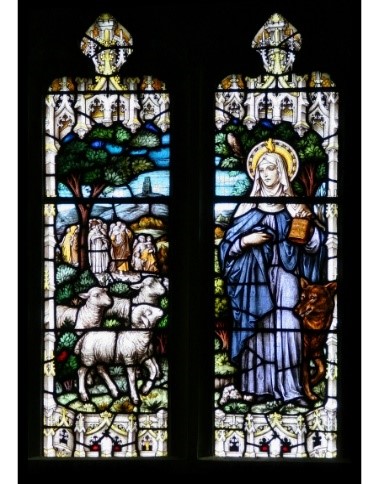
Detail of Centenary window (1908-2008)
St Bride's Roman Catholic Church, West Kilbride |
Preface
This
article has been written as a prayer and dedication to St Bride herself.
Underpinning this research has been the deeply religious and mystical poem Little Gidding by TS Eliot, one of the Four Quartets (1942).
Briefly, the poem was the result of a visit he made to the Church of St John at
Little Gidding in England, and the insights he gained from that experience. It
is my favourite poem of all time and lines kept coming back to me as I typed.
Significantly, to paraphrase part of Stanza Three, when talking of the church
building, he says that he isn’t there for mere reportage, but that:
“…You
are here to kneel
Where
prayer has been valid …”
Amen
to that. In this piece on the St Bride and St Bridget Churches this is the
fundamental truth which underscores my work.
1. Introduction
For
over ten years, I have been faithfully recording sites dedicated to St Bridget in
Scotland, where she is generally known as St Bride. In addition to features in
the landscape, towns and sea, my list includes around ninety-plus ancient (and
in the main disappeared) Pre-Reformation St Bride chapels, known as Kilbride
(in the Gàidhlig) and Kirkbride (from the Norse). I will be coming back to my
research over the next few months but thought I would start by giving some
details about the thirty current St Bride/St Bridget churches in Scotland,
which are ‘living’ and consecrated for use.
2. A Brief Explanation of the
Denominations in Scotland
Firstly,
it is important to understand the ecclesiastical system in Scotland, which
profoundly differs from the rest of the UK. Instead of just two mainstream denominations—Protestant
Reformed and Roman Catholic—in Scotland there are three. An Appendix at the end
of this article, gives more detail about the history of and differences between
the denominations, but briefly they are:
Church of Scotland. Protestant (Presbyterian). The Established Church in Scotland. Originated
1560 during the Scottish Reformation, which was led by John Knox. Completely
did away with any ‘Popish or Roman’ worship and banned Roman Catholicism. Known
as ‘The Kirk’.
Roman
Catholic Church. After the Scottish Reformation, all their
cathedrals, churches and chapels were taken over by the Presbyterians for their
own use, and Roman Catholics were forbidden to have places of worship. They met
in secret for services, but over time religious laws began to be relaxed and by
the mid-nineteenth century the Catholic church was restored. Known as ‘The Chapel’.
Scottish Episcopal Church. Protestant, but considers
itself principally Reformed Catholic.
Originated in seventeenth century by Scottish Protestants who wanted to return
to Pre-Reformation style of worship and traditions. Although having no connection
to Rome, the Scottish Episcopal Church was also forced, at times, to meet in
secret. Eventually, the Scottish Episcopal Church too was permitted to
flourish.
It
should be noted, that unlike in England, the Monarch is not, and never has
been, Head of the Church anywhere in Scotland!
3. The St Bride/St Bridget
Churches
The
thirty Bridie Churches are listed below by denomination. It is immediately evident
that all the historic Pre-Reformation church buildings dating back to the
Celtic Church and Mediaeval period, are now in the hands of the Church of
Scotland and have been since 1560. I have labelled these ‘Ancient’ in brackets
to illustrate the connections. Also, it will be clear that there are no Roman
Catholic or Scottish Episcopal Church buildings prior to 1858, as up till that
point both denominations were holding services in houses and other sundry
buildings, which continued for many years. It is interesting to note that a
number of Churches and Chapels which are dedicated to St Bride have a connection
to Clan Douglas (of Lanarkshire and beyond). St Bride is their Patron Saint.
When
the Roman Catholic Church eventually constructed church buildings, they were
very often financed by members of the congregation with some help from the
Diocese. These small communities — in part made up of Irish immigrants fleeing
to Scotland from the Potato Famine or coming to work as low-paid ‘navvies’ on
Victorian engineering projects — were immensely
poor. Their churches reflect that. They are simple buildings (some made of
wood) for the Mass and Confession, with little in the way of decoration. In my
discussions with Mael Brigde, we talked of “acknowledging the humility” of
these buildings and she is absolutely right. Just because they are not grand
does not diminish them as sacred spaces. The list of Catholic churches,
therefore, is sparse in details because for some buildings, there is very
little to write about. However, in some parts of the country, where there was
more money, wealthy benefactors were able to invest in elaborate and glorious
churches in the traditional style. What is crucial, though, is that these Irish
communities brought with them across the sea a love of St Bridget, for they
dedicated their churches to her, and it must have seemed like a small part of
home.
For
Scottish Episcopalians, St Bride’s importance has survived over the centuries,
although only two churches are dedicated to her. I could find no links between
these buildings and the Ancient churches of the Mediaeval period. St Bride is,
however, considered one of the great Celtic Saints of Scotland. The Canon’s
stalls in the Quire of St Mary’s Scottish Episcopal Cathedral in Glasgow (each
of which is dedicated to a Saint) has a St Bride Stall. When a friend of mine
was the first woman priest to be made a Canon of the Cathedral a good few years
ago, she chose the St Bride Stall as her permanent seat!
Finally,
there are two other St Bride Churches, which do not fit into the three-fold
denominations listed above. They are in a section of their own entitled
‘Other’.
3.1
Church of Scotland:
Abernethy Kirk of St Bride,
Abernethy, (Ancient), first church founded 460AD,
first stone church built 590AD, current built around 1802. St Bride is said to
have been buried here before her remains were transported to Kildare. Monastic
settlement founded nearby in sixth century (or possibly earlier) dedicated to
St Bride. By fifteenth century there are records of Priory of Abernethy, whose
counter-seal had a figure of St Bride holding a pastoral staff in her left
hand, with a nimbus around her head, and a cow at her feet on the right.
Bothwell Collegiate Church
(dedicated to St Bride), Bothwell, (Ancient), on the site of former sixth century church,
building dates back to 1398, with subsequent restoration and additions.
Partially funded by Clan Douglas. Windows by Sir Edward Burne-Jones, Gordon
Webster and Douglas Strachan. Houses the celebrated “Bothwell Embroideries” (twentieth century) one of which is The Life of St Bride.
Brydekirk Church of Scotland,
Brydekirk,
(Ancient), Current built in nineteenth century, close to remains of a Mediaeval
chapel reported to have been in use about 1100AD (some evidence it was built on
the site of a previous chapel), beside St
Bryde’s Well.
St Bride’s, Douglas Valley
Church, Douglas,
meets for worship in St Bride’s Community Centre, following amalgamation of
Parishes in Douglas Valley.
St Bride’s Ancient, Douglas, (Ancient) built fourteenth
century, now partial ruin but consecrated for use. Steeple houses earliest known
working clock in Scotland, said to have been a gift from Mary, Queen of Scots.
Founded by Clan Douglas, and is the mausoleum for some of their antecedents.
Regarding the following Isle
of Arran Churches, the Isle, (14 miles by sea from the mainland) is divided
into two Parishes: Kilmory (Church of St Mary) in the west and Kilbride (Church
of St Bride) in the east (a very happy pairing!). For such a small island (twenty
miles long and ten miles wide) it is perhaps unusual that it has three current and
living Churches dedicated to St Bride, with three Mediaeval Kilbride chapels.
Given the fact that you can see the northern coast of Ireland from its southern
shores and the proximity of the Isle with West Kilbride on the mainland, it is
my own theory — which is completely unsubstantiated! — that St Bride landed on
the Isle of Arran at some point.
St Bride’s Church, (Isle of
Arran) Brodick, built 1910 in red sandstone,
architects D & JR McMillan of Aberdeen. Square tower 53 ft high from whence
a single cast bell is rung five minutes before the service. St Bride window (1958).
 |
| Kilbride
Parish Church, Lamlash |
Kilbride Parish Church, (Isle
of Arran), Lamlash
(Ancient), known as The Auld Paroch Kirk,
ruins of Mediaeval chapel nearby, current built early 1880s.
 |
| Ruins
of Mediaeval Kilbride Chapel, Lamlash |
St Bride’s Church, (Isle of
Arran) Lochranza
(Ancient), ruins of Mediaeval chapel nearby, current built 1795, improved 1835
and 1895.
There are remains of a further
Mediaeval chapel on the south of the Isle, at
Bennan.
St Bride’s Church, Newtonmore, (Ancient), current church built
1955. Remains of sixth century chapel said to be in graveyard: “Ladh gu Cladh Brighde” (Churchyard of
Bride).
Panbride Church, Panbride, (Ancient), original church
dates from 1147, current built on the same site around 1851. The name of the
town of Panbride means Bride’s Hollow (from Gàidhlig ‘Pann’ meaning ‘hollow’)
or Bride’s Church (from corrupted Latin ‘fanum’ meaning church).
St Bride’s Church, Sanquhar, (Ancient) original church
dates from Mediaeval period demolished 1827, current built 1828 on the site. Stained
glass attributable to J T & C East Stewart 1930. Life of St Bride depicted in two-light window, 1949. St Bride’s Well close by.
St Bridget’s Hall-Church,
Stonehaven,
(Ancient), original church built 1394 near the present site by the Earl Marischal,
Sir William Keith, and dedicated to St Brede (St Bride). Current built 1888 and
converted to a multi-purpose community facility 1970. Used for worship on
Sundays.
3.2.
Roman Catholic:
Regarding the towns of East
Kilbride and West Kilbride [below], each were originally just called Kilbride. It
was not until the coming of the Railways in the nineteenth century that their
names were changed, to avoid confusion for travellers as they are forty miles
apart.
St Bride’s Church, Bothwell, original church of 1910
closed in 1940 due to damage from mine workings beneath the building. Congregation
disbanded but worship eventually continued in Miners’ Welfare Halls in 1957. Current
building completed 1973.
St Bride’s Church, Cambuslang, built 1900. Church now in
use was originally meant to be church hall. Stained glass by Gordon Webster.
Icons of St Joseph, St Bride and Christ in Glory by Petra Clare.
Our Lady and St Bride,
Cowdenbeath,
built 1921-1923, constructed by Reginald Fairlie.
St Bridget’s Church, Eaglesham, built 1858. Land provided
by 13th Earl of Eglinton. Interior comprises a roof of Californian
redwood beams, large canvas of the Deposition
of Christ from the Cross by de Surne, and a Madonna and Child statue from
Ireland. In 2010 fire destroyed part of the Sanctuary, and the Church of
Scotland gave permission for their hall to be used for worship till the
restoration was completed in 2011.
St Bride, East Kilbride, built 1963-1964. Built by
Gillespie, Kidd & Coia in a very modernist style. The 150 ft Campanile was
demolished 1966 due to deterioration of brickwork. St Bride window and St Bride
statue on exterior.
St Bride’s, Geirinis, Isle of
South Uist,
built 1966. Adjacent to the road-side shrine of St Mary, Our Lady of the Isles.
St Bridget’s Church, (Glasgow)
Baillieston,
built 1893. Beautiful little Gothic style gem! Originally worship took place in
an adapted barn. In 1880 church cum school built, followed 1893 by current
building by Pugin & Pugin (famous London based architects). Has a two-light
window depicting St Bride and St Columba, by Shona McInnes, St Bridget statue on exterior above West door.
St Brigid’s Church, (Glasgow)
Toryglen, built
1965. Church founded by Fr Patrick J Sheary, Parish Priest 1955. A letter to
his parishioners survives: “My dear
people — 25 years have come and gone since I was asked by the then archbishop
to go to Toryglen and establish the new Parish of St Brigid - Mary of the Gael”.
St Brigid’s Church, Kilbirnie, built 1862, some extensions
and developments in the twentieth century.
St Bride Church, Monifieth, built 1983. Designed by
Brocks Brothers of Leeds. Originally, worship was held in a converted cottage,
which became the hall when the new church was built. Modernist St Bride window by Gail Donovan
St Brigid’s Church, New Mains, built 1933. St Brigid statue, St Brigid Tapestry (2008) and first stained—glass window in Britain
dedicated to The Luminous Mysteries of
the Rosary. Original Chapel and School established 1871, now a Parish
centre serving the community.
St Bride’s Church, Pitlochry, built in the twentieth
century. Original church built 1949 from timber and destroyed by fire 1969. Current
designed by A B Kennedy & Sons of Pitlochry. St Bride’s Cross carved by Henry Bain from Aberfeldy in the garden.
Our Lady and St Bridget, West
Calder,
built 1877.
 |
St Bride’s
Roman Catholic Church,
West Kilbride
|
St Bride’s Church, West
Kilbride,
built 1908. St Bride is said to have landed on the shore here around 500AD and
founded chapels along the coast. Beautiful little building with St Bride statue in vestibule, beneath a
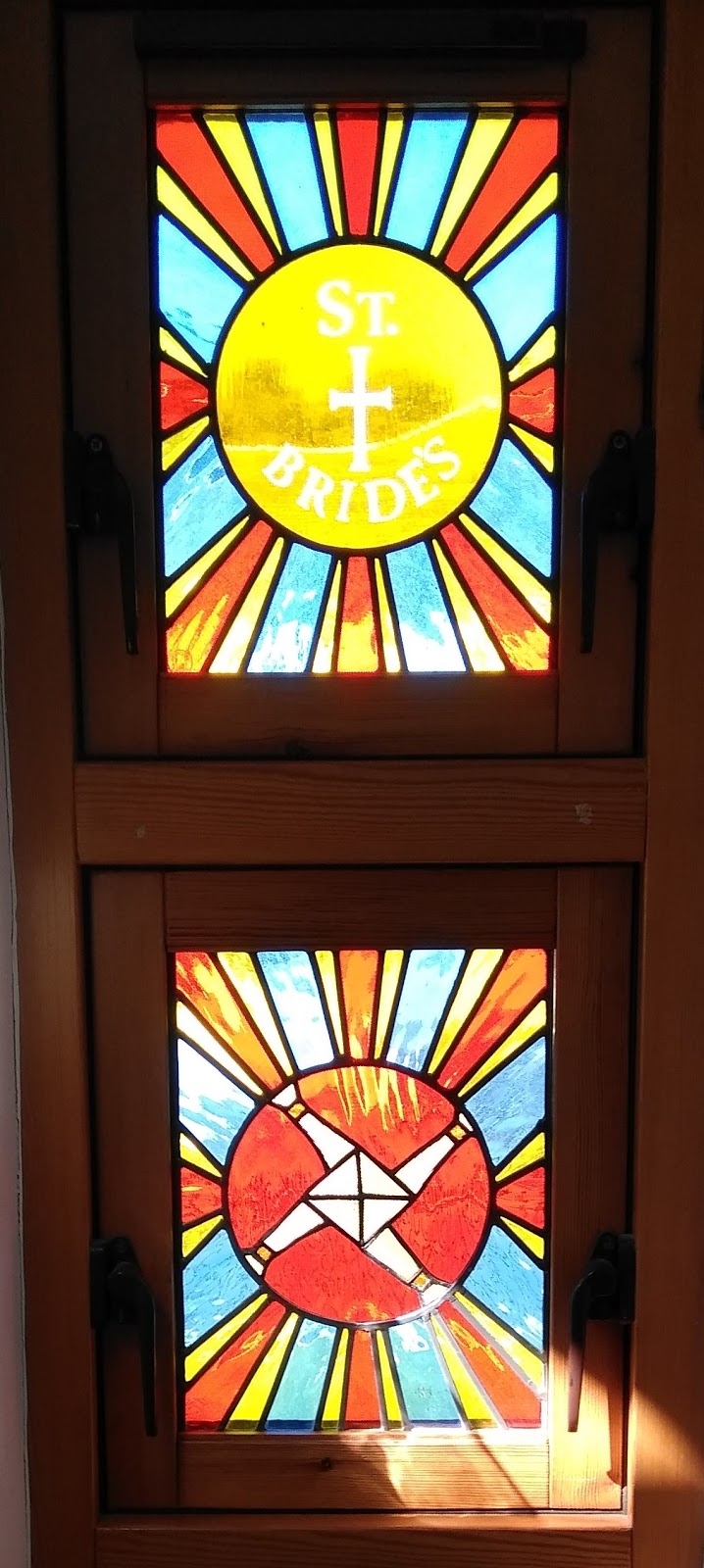
glass ceiling which pours in diffused light (see photograph at the end of this article). Modern Centenary window
in Vestibule (2008) in four lights (see
detail of two lights in the title of this
article).
3.3.
Scottish Episcopal Church (part of the wider Anglican Communion):
St Bride’s Church, (Glasgow)
Hyndland,
building completed 1915. Original wooden church of 1899 provided by Clan
Douglas, was hauled by traction engine from its location in Douglas Castle
grounds, to Hyndland (some thirty miles). Begun in 1903, building work stopped
through lack of funds and dissatisfaction with original contractors. Eventually
the Incumbent funded the building of the tower and north aisle, but the south
aisle was never built, giving the church an interesting interior. St Bride statue on exterior West Wall, St
Bride mural in crypt. The link with Clan Douglas could possibly account for
this Church being dedicated to St Bride.
 |
Church
of St Bride,
Scottish
Episcopal Church, Onich
|
Church of St Bride, Onich, built 1874. On North wall,
Chinnery-Haldane memorial windows show St
Bride, St Patrick and St Columba. East window shows Christ Coming Again in Glory, with St Bride and St Columba at his feet in welcome.
At
certain times, the Eucharist is celebrated in the Gàidhlig:
“Thoiribh
buidheachas don Tighearna oir tha e gràsmhor. Agus mairidh a thròcair gu sìorraidh.”
Litirdi Albannach, 1982
“Give
thanks to the Lord for he is gracious. And his mercy endures for ever”. Scottish Liturgy, 1982
3.4.
Others:
St Bride’s Anglican Church
(Greyfriars), Dumfries,
(Ancient), originally Church of Scotland, built 1727 as Greyfriars Church (after
the local dispersed Monastery), rebuilt 1860. Stands on site of former
Maxwell’s Castle, which had a St Bride chapel. When surplus to Church of
Scotland requirements in 2009, purchased by Revd Andrew Crosbie and functions
as an independent Anglican congregation, using both Scottish and English Prayer
Books. It was his decision to dedicate this Church to St Bride. Original Abbey
Church of the Greyfriars contained the shrine of Our Lady, Queen of the South (which gives its name to Dumfries and
the local football team), which has been restored by present Incumbent.
Kilbryde Chapel, in grounds
of Kilbryde Castle, Doune,
(Ancient), Castle now the seat of Sir James Campbell, chapel built 1750 on site
of original Kilbride Parish Church. Sir James informed me there are no
significant architectural features. Original Castle built around 1460 and
rebuilt 1870s. Chapel would originally have been a private chapel for the Castle
incumbents and local villagers. It is now available for hire for Christian
weddings, blessings etc of all denominations. Cottages in the grounds are
available for self-catering holidays.
Collect for St Brigid’s Day
1 February
Deus, qui nos
hodiérna die beátae Brigídae vírginis tuae ánnua solemnitáte laetíficas:
concéde propítious; ut ejus adjuvémur méritis, cujus castitátis irradiámur
exémplis.
O God, who dost
this day gladden us by the yearly festival of blessed Brigid Thy virgin:
mercifully grant that we may be helped by the merits of her whose example of
chastity shines upon us with such lustre.
Daily Missal, by Dom Gaspar Lefebure
OSB,
of the Abbey of St Andre, 1943
APPENDIX
A Brief History
While
the Reformation was being led by Martin Luther in Germany in the sixteenth
century, in Scotland, around the same time, opposition to the Roman Catholic
Church was being led by John Knox, who founded the Church of Scotland. His
European influences were John Calvin and Ulrich Zwingler, who advocated a
severe and austere method of reform. Principally, John Knox abolished the three-fold
order of Bishops, Priests and Deacons, which
(1)
dated back to the very earliest biblical accounts we have of the early
Christian church and
(2)
dated back to the original Celtic Church in Scotland, where there is evidence
that St Columba was a bishop.
In
their place were Ministers who were overseen by a Presbytery (the governing
body at local level). All “Romish practices” were proscribed. The Mass was
replaced by Holy Communion four times a year and new churches were built
without a central aisle to prevent genuflection. The liturgy, colours, icons,
singing, festivals, robes, candles, incense —Christmas Day itself!— all
disappeared. Their attitude to the saints was that lessons could be learned from
their lives, but any sense of veneration was prohibited, particularly where it
involved St Mary (“Mariolatry”).
There
followed a hundred years of bloody and systematic cruelty as Protestants and
Catholics waged war against each other. Eventually the Presbyterians held sway
in Scotland and became what we now call The Established Church. Roman Catholic
cathedrals, chapels and churches were taken over by Presbyteries for their own
use and it was forbidden for Catholics to have any places of worship. They held
services in secret. Any early and Mediaeval chapels of Kilbride and Kirkbride
not used by the Presbyterians, eventually fell into disrepair and the stones
were taken away and used for other buildings.
During
the seventeenth century, a group of Scottish Protestants who agreed with the
basic tenets of the Reformation but were unhappy at losing all the pre-existing
religious practices, formed the Scottish Episcopal Church. They recovered their
roots in the sacred Isle of Iona and the traditions of the Celtic Church and restored
the three-fold order of Bishops, Priests and Deacons. The Eucharist (The Mass) was
resurrected with the Scottish Liturgy, colours, icons, singing, festivals,
robes, candles, incense and Christmas Day. They honoured the saints, particularly
St Mary. However, although they did not have any links with Rome, for a time
they too were forced to hold services in secret. A key moment in their history
was consecrating Samuel Seabury of Connecticut as the first bishop of the newly
independent America, after the Church of England declined. The Scottish
Episcopal Church is known as ‘a Broad Church’, meaning that some congregations
prefer a more simple style of worship, where others go for something more
splendid, and others in between.
Eventually,
religious laws became more relaxed and there was greater freedom of worship. By
the nineteenth century, church building began in earnest for all denominations,
but particularly for Scottish Episcopalians and Roman Catholics who till then
had no churches. Additionally, the Roman Catholic Church responded to the needs
of the many Irish families who came to Scotland during the Potato Famine or
looking for work. Since the mid-twentieth century the spirit of ecumenism has
allowed for far greater interaction and dialogue, with all denominations being
respected and coming together from time to time to celebrate and worship. And
yes, in 1958 Christmas Day became a statutory holiday in Scotland!
Near
life-size statue of St Bride, vestibule of St Bride’s Roman Catholic Church,
West
Kilbride
©
Heather Upfield 18 June 2018
All
Photography by Heather Upfield, except exterior of St Bride’s Roman Catholic
Church, West Kilbride by Emily Churchill and Church of St Bride, Onich by Paul
Williment.




 Thus,
it’s entirely natural that contemporary artists like Wendy Andrew (Painting
Dreams) and Karen Cater (Hedingham Fair) would feature snowdrops in their
beautiful images of Bridie and Imbolc; and that the icon of St Bridget of
Kildare in St Gregory Orthodox Church, Silver Spring, Maryland (twentieth
century) features snowdrops at Bridie’s feet. Whether Brigid, Bride, Brighid or
Ffraed (in Wales), they and the snowdrop seem to be inextricably linked.
Thus,
it’s entirely natural that contemporary artists like Wendy Andrew (Painting
Dreams) and Karen Cater (Hedingham Fair) would feature snowdrops in their
beautiful images of Bridie and Imbolc; and that the icon of St Bridget of
Kildare in St Gregory Orthodox Church, Silver Spring, Maryland (twentieth
century) features snowdrops at Bridie’s feet. Whether Brigid, Bride, Brighid or
Ffraed (in Wales), they and the snowdrop seem to be inextricably linked.