Showing posts with label Rita Minehan. Show all posts

Monday, March 17, 2025

Ten Titles (and Thirteen Books) for Brigit


I am revising my online course, Discovering Brigit, and wanted to update the brief book list included there. These books are the ones I would point people to first, for a variety of reasons. Recall that I have a slew of unread and therefore unreviewed Brigit books, which I hope to get to over the next year and a bit. But for now, I’d like to share this with you.

Only one, Ó Duinn’s Rites of Brigid, is out of print, but you should be able to get that on interlibrary loan.


Top Ten Books for Starting Out with Brigit (Also Awesome for Oldtimers)


Bitel, Lisa M. Landscape with Two Saints: How Genovefa of Paris and Brigit of Kildare Built Christianity in Barbarian Europe (2009). (Nonfiction.)


Brigde, Mael. A Brigit of Ireland Devotional - Sun Among Stars (2021). (Poetry and essays.)


Clann Bhríde. Book of Hours - For Daily and Seasonal Practice (2013).


Curtayne, Alice. Saint Brigid of Ireland (1954). Reissued (2022). (Nonfiction.) 


Daimler, Morgan. Pagan Portals Brigid: Meeting the Celtic Goddess of Poetry, Forge, and Healing Well(2016). (Nonfiction.)


Freeman, Philip. Two Lives of Saint Brigid (2024).


Minehan, Rita CSB. Rekindling the Flame: a Pilgrimage in the Footsteps of Brigid of Kildare (1999). Revised (2022). (Nonfiction.)


Mole, Chris, et al. Brigantia Vol. 1 (2021) and 2 (2024). (Graphic novels.)


Ó Duinn, Séan OSB. Rites of Brigid - Goddess and Saint (2004). (Nonfiction.) 


Phillips, M.A. Rituals of Rock Bay Series:  (Fiction.)

Book 1: River Magic (2020); Book 2: Hearth Magic (2021);

Book 3: Forest Magic (2021);


Image: "book lot on table" by Tom Hermans on Unsplash.

Tuesday, February 27, 2024

"Brigid: A Woman, A Life, A Legacy” (a four part lecture series)


Mount St Anne’s in collaboration with Solas Bhride Centre, Kildare offer a Spring Online Course  

Brigid: A Woman, A Life, A Legacy

This 4-week online course takes place each Wednesday evening for 7pm – 9pm (Irish time)

6th March: ST BRIGID AND HER FEAST DAY IN IRISH TRADITION (Bairbre Ní Fhloinn)
Dr Bairbre Ní Fhloinn, is recently retired as Associate Professor of Irish Folklore and Ethnology at UCD. She was Director of the MA in Irish Folklore and Ethnology in UCD, a programme she established. She has written widely on many aspects of Folklore and Ethnology.

13th March: THE SPIRIT OF ST. BRIGID IN OUR CONTEMPORARY WORLD (Rita Minehan)
Sr. Rita Minehan is a Brigidine Sister and founding member of Solas Bhride Spirituality Centre in Kildare. She is the author of Rekindling the Flame, a Pilgrimage in the footsteps of Brigid of Kildare.

20th March: DECODING ST. BRIGID (Eoghan Corry)
Eoghan Corry is the lead travel commentator in Ireland, as well as being a historian, author and broadcaster. Eoghan will draw on his historical background and his travel experience to present a picture of St. Brigid as a saint and demonstrate how her influence and relevance still echoes today.

27th March: ST BRIGID: THRESHOLD WOMAN TO JUSTICE AND COMPASSION (Doris Testa)
Dr Doris Testa is a Brigidine Sister located in Melbourne, Australia. Having a fifty year background in education and social work, she has taught at first and third levels, worked in Child Protection and Community Development. She has held positions of leadership within the Brigidine Victorian Province.

Cost:  Full Course €50

To book a place, please email secretary@mountstannes.com or phone 057-8626153


Wednesday, November 09, 2022


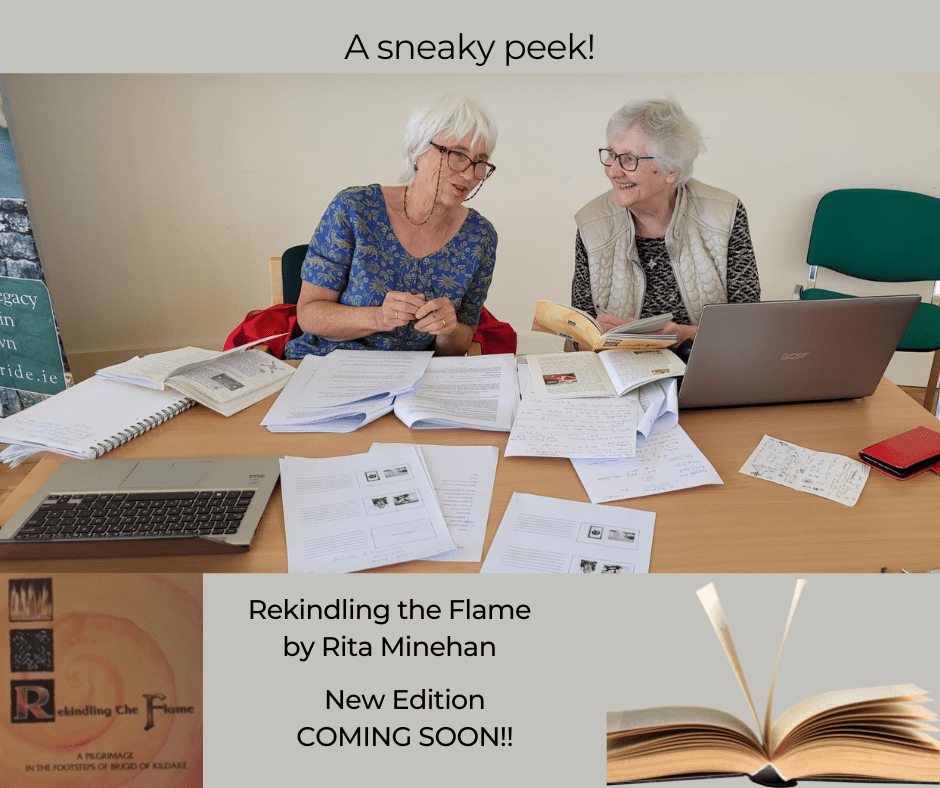
And speaking of books about Brigit! At long last, the sisters at Solas Bhríde are releasing an updated version of Sister Rita Minehan‘s book, Rekindling the Flame -  a Pilgrimage in the Footsteps of Brigid of Kildare.

From their newsletter:

Dear Friends,
The news you've been waiting on...a revised edition of 'Rekindling the Flame' is about to be published and will be available from Solas Bhríde from mid-December. The original book written by Rita Minehan csb has been hugely popular with pilgrims as it offered them a reflective guide to accompany them on their pilgrim journey in Kildare, from St Brigid's Cathedral to St Brigid's Garden and Wayside Wells. Rita's updated edition includes a history of the developments that have occurred in Kildare Town since 1999, in particular the opening of Solas Bhríde Spirituality Centre & Hermitages on Tully Road. The revised edition will appeal to those coming on pilgrimage to Solas Bhríde and Kildare Town but also to the many who have visited and wish to reflect on that journey through the story, legend, poems and meditations the book presents. The book will be officially launched on February 26th 2023, but more on that anon!!

Monday, April 16, 2012

Brigit Reviews (Series Four): Nonfiction, Popular (Saint)


Nonfiction, Popular (Saint):

Brigit, the Mary of the Gael”, from A Book of Saints and Wonders by Lady Gregory (1907) (Mention only.)
Saint Brigid of Ireland, Alice Curtayne (1954)
Saint Bride, Iain MacDonald (1992)
Power of Raven, Wisdom of Serpent, Noragh Jones (1994)
Rekindling the Flame: a Pilgrimage in the Footsteps of Brigid of Kildare, Rita Minehan CSB (1999) (Pilgrimage Guidebook; Guided Meditation)
The Life of Saint Brigid, Anna Egan Smucker (2007)

Introduction:

This is a surprisingly small sampling, but I like all of these books. If you could read only one I would recommend Curtayne. Unless of course your purpose was to hurriedly prepare for a pilgrimage to Kildare, in which case go with Rekindling the Flame. Oh, heck. They all have different aims, so any could be the one for you, depending on your needs.

Curtayne’s book, written in the early 1950s, is a detailed and broad-ranging introduction to the saint which has no time for the goddess, yet which deepens our understanding of Brigit on many levels. It is told from the perspective of a believing Catholic—ironically, a rare view in the current Brigidine literature, and therefore doubly valuable for the insight it provides. It is the first full book I read about Brigit and remains a favourite.

MacDonald’s highly portable text contains translations of a late (15th century) Life of Saint Brigit from the Book of Lismore and an unusual prayer sometimes credited to Saint Columba (among others): the 9th century “Hail Brigid”. Perfect for a quiet walk in the countryside, reflecting on the saint.

Jones looks at length and in an accessible style at the traditional roles and rituals of the Scottish countrywoman, and Brigit appears throughout.

Minehan, herself a Brigidine nun, has written a moving and informative pilgrims’ guide to the Brigidine sites of Kildare town and its environs.

Smucker has pieced together a small and lively (and beautifully illustrated) primer on Saint Brigit as told through the late (15th century) Life of Brigit from the Leabhar Breac and customs and prayers related to her.

I had hoped to include “Brigit, the Mary of the Gael”, from A Book of Saints and Wonders by Lady Gregory (1907). Unfortunately, the copy I borrowed from the Vancouver Public Library in the ‘80s appears to have been withdrawn from the collection, and I don’t have another copy near to hand. Hence only a brief mention below.

Read More!


Saturday, September 19, 2009

Catholic Ireland DOT Net: Brigit Offerings


CatholicIreland.net is, rather self-explanatorily, a site for Irish Catholics and their admirers and friends. A quick search of the site yields a small number of articles on St. Brigit. To whit:


February 1st, the feast of Imbolg in the old Celtic year, marked the beginning of spring. It was Christianised and adapted as the feast of St Brigid and many rituals still associated with the feast are best understood in the light of their pagan Celtic origins. After a Foreword on the life of Brigid as told in the Leabhar Breac, Seán Ó Duinn describes these rites and explores their relevance for today.

236 pp, Columba Press, 2005. To purchase this book online, go to www.columba.ie

On this page are the table of contents, foreword, and a large section of the first chapter of the book.


The Irish in the Middle Ages had an intriguing way of expressing devotion to the Child Jesus. And it was more than mere fancy, writes Gilbert Márkus.

This article, which first appeared in Spirituality, a publication of the Irish Dominicans, explores the idea of Brigit as the Mother of God, and extends it other Christians as well. It ends with the observation:

"Many nations and cultures, not only the Gaels, explored this imagery of the Christian disciple as the mother of God. The application of the Gaelic title már Choimded máthair to Brigit, ‘mother of the great Lord’, is not some kind of weird error or deviation. It is a natural flowering of the creative mind in love, part of that ever unfolding process of finding new ways to express the love poured into our hearts."


Brigid of Kildare is a patroness of those who have a care for the earth, for justice and equality, for peace and she is a model for a contemplative life. Brigidine sister Rita Minehan profiles her here.

"A great resurgence of interest in all aspects of our Celtic heritage is leading many individuals and groups to rediscover - and draw inspiration from - the lives of the early Irish saints. St Brigid, the patroness of Ireland, is emerging as one whose life has relevance and inspiration for us as we try to face the issues that confront our country and our world at this time. When we look at the life of Brigid and at some of these issues we can see more clearly why she continues to be relevant to us today."

The article looks at the many sides of spiritual life that St. Brigit models - carer, inspirer, etc.

For the full text of these articles, follow the links or go to http://brigitssparklingflame.blogspot.com/2004_09_01_archive.html

Sunday, September 19, 2004

A woman for our times: St Brigid of Ireland by Rita Minehan

A woman for our times: St Brigid of Ireland

Brigid of Kildare is a patroness of those who have a care for the earth, for justice and equality, for peace and she is a model for a contemplative life. Brigidine sister Rita Minehan profiles her here.

A great resurgence of interest in all aspects of our Celtic heritage is leading many individuals and groups to rediscover - and draw inspiration from - the lives of the early Irish saints. St Brigid, the patroness of Ireland, is emerging as one whose life has relevance and inspiration for us as we try to face the issues that confront our country and our world at this time. When we look at the life of Brigid and at some of these issues we can see more clearly why she continues to be relevant to us today.

Carer of the earth

The feast of St Brigid on the first of February is a celebration of the wonderful springing back of the earth from its winter sleep. It is the season when we celebrate new beginnings and new life on earth. The sod is turned. The day lengthens. Seeds are sown and sails are hoisted.

Many of the stories about Brigid tell of her milking the cows, churning the milk, making up the firkins of butter, shepherding her flocks of sheep, helping with the harvest and even brewing the ale!

Brigid, in keeping with her Celtic traditions, was wonderfully attuned to the seasons and cycles of nature. She valued the elements of nature: earth, air, fire and water.

Light the fire

Today, we are becoming more aware of the fragility of our planet. Lands are becoming barren, skies fouled, waters poisoned. Many individuals and groups concerned about the environment draw inspiration from the reverence and respect which Brigid had for the land. She is often referred to as the Saint of Agriculture.

In a new hymn, composed by Fr Liam Lawton, Brigid is invoked 'to heal our wounds and green our earth again.'

'A Life of Brigid' (Vita Brigitae), composed by Cogitosus about 650 AD, places great emphasis on Brigid's faith, her healing powers, her hospitality, her generosity, her great skill with animals, and her compassion for the poor and the oppressed. Twenty three of the thirty two chapters tell of her extraordinary concern for the poor. One of the Brigidine legends illustrates this very effectively.

Woman of compassion

One day when Brigid was on a long journey she stopped to rest by the wayside. A rich lady heard about this and brought her a beautiful basket of choice apples. No sooner had she received them than a group of very poor people came by and begged her for food. Without a moment's hesitation, Brigid gave them the choice apples. The rich lady was utterly disgusted and she complained to Brigid, 'I brought those apples for you, not for them.' Brigid's reply was: 'What is mine is theirs.'

This Brigidine legend poses a challenge to all of us in terms of our world today, where forty-five thousand people die from hunger and hunger-related diseases every day and where twenty percent of the population own and consume about eighty percent of the earth's resources.

The poverty gap continues to widen both within and between countries, as the rich grow richer and the poor grow poorer. This legend challenges us to work for a more equitable distribution of the world's resources.

Model of equality

It is generally accepted that Brigid established her abbey and church in Kildare around 480 AD, on the site now occupied by St Brigid's Cathedral. Brigid held a unique position in the Irish Church and society of her day. As Abbess, she presided over the local Church of Kildare and was leader of a double monastery for men and women.

Tradition suggests that she invited Conleth, a hermit from Old Connell near Newbridge, to assist her in Kildare. Cogitosus tells us that 'they governed their Church by means of a mutually happy alliance.'

What emerges from many of these stories and legends about Brigid is the portrait of a strong and gentle woman, a powerful leader, a good organiser, a skilful healer and a wise spiritual guide. Brigid has become - for men as well as women - a potent symbol of Christian womanhood, showing us in so many different ways the feminine face of God.

Woman of peace

There was no lack of domestic strife in the Ireland of Brigid's day, where feuds between clans were commonplace. She is often depicted as a peacemaker who intervened in disputes between rival factions and brought healing and reconciliation. Folklorists tell us that in some parts of Ireland a St Brigid's cross was often used as a token of goodwill between neighbours, indicating a desire for peace and friendship after a local quarrel.

One of the best-known stories associated with St Brigid is that of her giving away her father's precious sword to a poor man so that he could barter it for food to feed his family. Thus, a sword, a weapon of war, was transformed into a life-giving instrument.

This story offers an important lesson for our world today where every minute thirteen million pounds is being spent on weapons of war.

One wonders what links Brigid would make today between the massive expenditure on arms and the welfare of the poor people of the world?

Woman of contemplation

Brigid emerges as a woman of action in the stories, legends and poems about her. If one, however, were to seek the source from which she drew her strength and energy, one could probably find the answer in this story.

One day, Saint Brendan the Navigator stood on a cliff top and watched two whales engaging in fierce combat.

Suddenly, the smaller whale, in a human voice, cried out for help not to Brendan but to Brigid, who was not even present. The cry was answered immediately, and the combat ceased.

Brendan was puzzled as to why he had been ignored. 'Do you always think about God?' asked Brigid, when the two met. 'Yes,' replied Brendan, 'except at times when my boat is caught in a storm at sea and I have to concentrate on keeping it afloat.'

'That's the explanation,' Brigid answered. 'From the moment I first knew God I have never let him out of my mind, and I never shall.'

An old Irish poem, written in the seventh century, speaks of her contemplation of the Trinity:

Deeper than the seas,

Greater than words can express,

Three persons in one only God;

Overflowing with wonder.'

Woman of inspiration

Even today, poets, writers and artists still find inspiration in the symbols, customs and folklore surrounding Brigid.

One writer recently referred to her as 'the woman who, above all others, embodies the spirit of pre-Christian and Christian Ireland'.

In a beautiful leadlight window in Kildare College Chapel, Holden Hill, South Australia (see image) the artist depicts Brigid dancing the dance of the new life of creation, carrying the Spirit of Jesus into the twenty-first century.

Many of the values associated with Brigid are captured in this delightful poem:

Lady, from winters dark,

Star of Imbolc, rise!

Dance around our threshold,

Scattering warm laughter,

Seeds of hospitality,

Tolerance, forgiveness!

Return again to the folk;

You the spring we yearn for!

What a lovely image to carry with us into the future!

This article first appeared in The Messenger (February 2002), a publication of the Irish Jesuits. Reprinted from CatholicIreland.net.