Showing posts with label Wales. Show all posts

Friday, September 02, 2011

Mara Freeman Talks Brigit


Mara Freeman is "an author and teacher of Western Esoteric tradition, specifically the Celtic and British branches. She lives in a wooded valley in west Wales not far from the sea." She is the author of Kindling the Celtic Spirit, Harper San Francisco, 2001. In October of 2004 we linked to her Beliefnet guided meditation, Fire at the Forge.

Mara recently contacted me about two Brigit-related postings on her blog, which I would like now to share with you. I'll present here a snippet of each, and then provide a link to the full posting on her blog.

Freeing the Waters – Two Rediscovered Holy Wells of Wales


An age-old tradition links women with wells. In the ancient world

sacred springs were regarded as the entrance to the Underworld

where the spirits dwelled. Pilgrims visited them to receive oracular

utterances from the priestess who was guardian of the shrine – a

practice that was still alive not two hundred years ago in Cornwall.

A mediaeval Grail text tells us of the “Voices of the Wells,” which

were silenced when the Well Maidens were defiled by an evil king

and his followers. Because of this the Holy Grail was withdrawn

from the kingdom and its blessings no longer poured freely out

into our world. This last weekend I visited two wells in mid Wales

that were once lost but recently found again. Strangely enough, the

stories of their rediscovery all involve women....

Ffynnon Ffraid

Winding up through the Cambrian mountains in the hazy heat of early

July, I went in search of one of the few holy wells in Wales dedicated

to St Bridget. The Irish holy woman who was once the Celtic goddess

Brigit is known here as St. Ffraid (pronounced Fride), and a mediaeval

Ffynnon Ffraid had been rediscovered not long ago by a woman living

in a remote upland farm in these parts. According to tradition, when

Bridget was young her duties involved milking cows and making butter in

thehafod, the country people's summer home in the high pastures.

Brigit of the red kites,

Brigit of the moorland,

Brigit of the meadowsweet,

Brigit of the dragonflies . . .

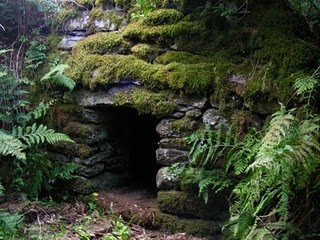
The well was entirely unique in Wales, being covered by stones in the

shape of a beehive, but was in a bad state of repair. Annwen Davies

and her mother worked for years to get funding for its restoration,

but in the end had to use their own savings to get the job done...


To read the full text of this entry, please scoot over to the original posting on Mara's blog.


And from Mara's posting

MONDAY, 15 AUGUST 2011

What the Druids Knew

Bees were considered so important to early Irish society that there
were special bee laws designed to protect them, called the 'bech
tha.' A 7th century holy woman called Gobnait, who founded a
women's community in southwest Ireland, had a close relationship
with bees and used their honey for healing illnesses and treating
wounds. She was said to be one of three sisters who had power
over fire, and is clearly a Christianised version of the triple fire-
goddess, Brighid, with whom she shares the same feast-day in
early February. When a band of thieves attempted to steal the
community cattle, Gobnait let loose a swarm of bees on the
rustlers and sent them fleeing in terror. At her shrine in Bally-
vourney, Co. Cork, a statue depicts her standing on top of a hive,
surrounded by bees.

For the full posting, please follow this link.


Thursday, April 28, 2011

Iron Age Celts Home Education

Brigit, it will come as no surprise to you, arises at least in part from Celtic culture, and some understanding of that culture is useful to those who are attracted to learning more about her. I stumbled across a site which has an interactive educational module on Celtic life, in particular Welsh, designed for youngsters. (Do we still use that word?) Not terribly young myself, I nevertheless enjoyed exploring the site.

Thanks to the BBC for this!


http://www.bbc.co.uk/wales/celts/

Sunday, March 27, 2011

St Bridget of Skenfrith, Wales


St. Bridget's Church in the village of Skenfrith in the Welsh Marches turned 800 years old in 2007.

According to Filbee, whose Flickr photos of this church are worth a look, St. Bridget's is a "13th century church with squat tower and huge buttress. The interior has a Jacobean pew, 15th century embroidery, and the tomb of the last governor of the Three Castles (Grosmont, Skenfrith, and White).

"St Bridget’s Church was founded in 1207 by Hugh de Burgh who was also responsible for building Skenfrith castle. The tower is unusual. It belongs to the period when the Welsh border was subject to sudden raids and the villagers might need to seek refuge at any time. The tower has five feet thick walls and is capped with a 'Dovecote' which in times of scarcity or danger could have housed pigeons as well as bells. The clock was installed in 1926."

He provides a link to Mark Collins' Roughwood site, with its page on St Bridget's. There are some excellent pictures here. The interior shot above comes from his page.

The UKAttraction site has this to add:

"The church, dedicated to the Irish Abbess Bridget, was built in the 13th Century in Early English and Perpendicular styles. It has a wooden dovecote-topped tower with an open wood lantern containing 6 bells. There is medieval glass in the East window, fragments of wall paintings and an ancient tomb chest with Elizabethan figures depicting the wife and eight children of John Morgan dated 1557. A rare pre-Reformation cope (a cape-like garment worn by Bishops) is preserved in a glass-fronted case."

This handy page provides links to attractions in the area of the church, places to stay, and so on.