Showing posts with label Bride. Show all posts

Sunday, January 23, 2022

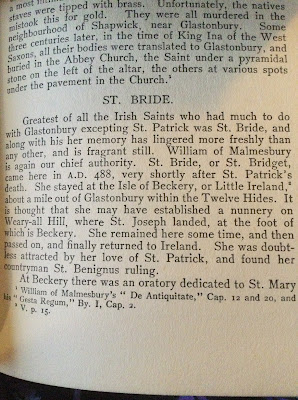
Brigit at Glastonbury, According to the Rev. Lionel Smithett Lewis, M. A.


 A dear friend of mine, once the owner of a secondhand bookstore where many a joyful hour was spent, is getting rid of her library as she prepares to move into assisted living. She gave me first crack, and I found this little gem of the Glastonbury Saint Brigit mythos.

The full title is Glastonbury “The Mother of Saints” – Her Saints A.D. 37–1539. It was published at Christmas, 1925, of which 1000 copies were printed. This is from the second edition, Christmas, 1927, of which 2000 copies were printed. The author, Rev. Lionel Smithett Lewis, M. A., was the vicar of Glastonbury.

Below you will find photographic images of the cover and pages pertinent to Saint Brigit, here called Saint Bride. Now, do remember to take every detail of this with a large cellar of salt. Click on the images to see a larger size.


Wednesday, March 27, 2019

Bride of Iona, by artist Greg Tricker


Follow this link to watch the lovely short film in which Greg Tricker shows his handmade book, Bride of Iona.


Wednesday, October 09, 2013

Goddess Bride: Art by Maggie V. Jones


I first came across the art of Warwickshire, England's  Maggie V. Jones in 2008, and was struck by its vibrancy. I see Maggie has less of an internet presence than she did then--a situation I hope changes. Here are two images she painted of Bride, lush wonders that refer to her link to bees. As this is the season for gathering honey, it is a good time to share Maggie's images.


The Celtic Goddess Bride (Brigid). Medium: Digital. Completed Imbolc 2009.
Copyright Maggie V. Jones
Two versions of this, and I personally prefer the latter. Others may beg to differ.


Maggie says of herself: 


I think I'm boringly normal, but I think my mother thinks otherwise. She's always saying, "I don't know where I got her from!" I have two dogs called Jet and Titch, and a cockatiel called Bella. They rule me. I am partial to both chocolate and lemon puff biscuits,and if I go out for a tipple it's usually a lager with a dash of blackcurrant cordial (I know Im common). My usual order at a restaurant would be a nice fish platter. One of my enduring loves is the tarot which I was introduced to when I was nine years of age (thank-you Janet). They arent just packs of cards, they are old friends. I have three kids and one grandchild. They all never cease to amaze me with all their triumphs, trials and tribulations. Life is never boring, I can tell you. Im going to be with my husband to the death, and beyond. I'm terribly posessive. My favourite thing apart from my tarot cards is my case of Derwent Inktense watercolour pencils. Bloody marvellous things!

Monday, April 16, 2012

Brigit Reviews (Series Four): Nonfiction, Popular (Saint)


Nonfiction, Popular (Saint):

Brigit, the Mary of the Gael”, from A Book of Saints and Wonders by Lady Gregory (1907) (Mention only.)
Saint Brigid of Ireland, Alice Curtayne (1954)
Saint Bride, Iain MacDonald (1992)
Power of Raven, Wisdom of Serpent, Noragh Jones (1994)
Rekindling the Flame: a Pilgrimage in the Footsteps of Brigid of Kildare, Rita Minehan CSB (1999) (Pilgrimage Guidebook; Guided Meditation)
The Life of Saint Brigid, Anna Egan Smucker (2007)

Introduction:

This is a surprisingly small sampling, but I like all of these books. If you could read only one I would recommend Curtayne. Unless of course your purpose was to hurriedly prepare for a pilgrimage to Kildare, in which case go with Rekindling the Flame. Oh, heck. They all have different aims, so any could be the one for you, depending on your needs.

Curtayne’s book, written in the early 1950s, is a detailed and broad-ranging introduction to the saint which has no time for the goddess, yet which deepens our understanding of Brigit on many levels. It is told from the perspective of a believing Catholic—ironically, a rare view in the current Brigidine literature, and therefore doubly valuable for the insight it provides. It is the first full book I read about Brigit and remains a favourite.

MacDonald’s highly portable text contains translations of a late (15th century) Life of Saint Brigit from the Book of Lismore and an unusual prayer sometimes credited to Saint Columba (among others): the 9th century “Hail Brigid”. Perfect for a quiet walk in the countryside, reflecting on the saint.

Jones looks at length and in an accessible style at the traditional roles and rituals of the Scottish countrywoman, and Brigit appears throughout.

Minehan, herself a Brigidine nun, has written a moving and informative pilgrims’ guide to the Brigidine sites of Kildare town and its environs.

Smucker has pieced together a small and lively (and beautifully illustrated) primer on Saint Brigit as told through the late (15th century) Life of Brigit from the Leabhar Breac and customs and prayers related to her.

I had hoped to include “Brigit, the Mary of the Gael”, from A Book of Saints and Wonders by Lady Gregory (1907). Unfortunately, the copy I borrowed from the Vancouver Public Library in the ‘80s appears to have been withdrawn from the collection, and I don’t have another copy near to hand. Hence only a brief mention below.

Read More!


Wednesday, April 15, 2009

The Coming of Angus and Bride


Wonder Tales from Scottish Myth and Legend by Donald Alexander Mackenzie
Illustrations by John Duncan
Frederick A Stokes Co., New York [1917]

An example here of the rewriting of Cailleach tales to include Brigit (Bride) as a part of a fabricated maiden/mother/crone mythos not found before the 1900s. according to Insa Thierling, author of Mistresses of the Land: Supernatural Females Associated with Land and Landscape in Scottish Gaelic Tradition. See previous post.


copied from:

The Internet Sacred Text Archive


Sacred Texts Legends & Sagas Celtic Index Previous Next

p. 33

CHAPTER II

The Coming of Angus and Bride

All the long winter Beira kept captive a beautiful young princess named Bride. She was jealous of Bride's beauty, and gave her ragged clothing to wear, and put her to work among the servants in the kitchen of her mountain castle, where the girl had to perform the meanest tasks. Beira scolded her continually, finding fault with everything she did, and Bride's life was made very wretched.

One day Beira gave the princess a brown fleece and said: "You must wash this fleece in the running stream until it is pure white."

Bride took the fleece and went outside the castle, and began to wash it in a pool below a waterfall. All day long she laboured at the work, but to no purpose. She found it impossible to wash the brown colour out of the wool.

When evening came on, Beira scolded the girl, and said: "You are a useless hussy. The fleece is as brown as when I gave it to you."

see the Comments section for the remainder of this story or go to the story as posted on the sacred texts website.