Friday, February 09, 2018

“Bridie and the Snowdrop: An Exploration in Flora and Stained Glass” by Heather Upfield


Heather's Snowdrops

Introduction
Some weeks ago I posted an image on Facebook of a little group of snowdrops in the garden of my house on the southwest coast of Scotland. They were in tight bud and my post hoped that they would bloom in time for the Feast Day of St Brigid (or St Bride, as she is generally known in Scotland) on 1st February. This date also coincides with the Christian celebration of Candlemas (on 2nd February) in which, according to the mythology, St Bride played a leading role, and the Midwinter Festival of Imbolc or Oimelc, with its links to the Goddess Brighid. It is a time of enormous energy, whatever your perspective and at the heart of this glorious time are snowdrops!

Thus, it’s entirely natural that contemporary artists like Wendy Andrew (Painting Dreams) and Karen Cater (Hedingham Fair) would feature snowdrops in their beautiful images of Bridie and Imbolc; and that the icon of St Bridget of Kildare in St Gregory Orthodox Church, Silver Spring, Maryland (twentieth century) features snowdrops at Bridie’s feet. Whether Brigid, Bride, Brighid or Ffraed (in Wales), they and the snowdrop seem to be inextricably linked.

It was, therefore, with interest that I read a comment from Mael Brigde herself, asking me if I knew that the snowdrop was not native to Britain and Ireland but had been imported several centuries ago, by Crusaders returning from the Middle East in the 10th century - at least 500 years after St Bride! This was news to me - I had assumed they’d been here for ever - and it set me thinking about snowdrops in general and the iconography of Bridie. It took me on a little journey, firstly into the history of the snowdrop and then into images of St Bridget/St Bride in stained glass windows and I am delighted to share what I found with you here.

Snowdrops
I went online to search, firstly, for the history of the common snowdrop in Britain (Galanthus nivalis). From Google searches, it showed there are currently around thirty-two varieties of snowdrop available and it appeared that snowdrops were not native to Britain. However, I could find no mention whatsoever of a link with the Crusades, although I found evidence that Crusaders were responsible for importing spices and hollyhocks! Mael Brigde’s information had come from BBC4 Gardener’s Question Time - a popular radio programme - and although she gave me the names of the presenters to follow up, I did not receive an answer.  Trawling through various sites, I discovered from Kew Gardens that they had first been recorded in Britain in the mid-15th century in a garden, and it is supposed that they were originally planted in gardens, eventually escaping to the wild, where they became naturalized in woodlands and glens.

By the nineteenth century they were well established and appear in Circle of the Seasons and perpetual key to the Calendar and Almanack by Thomas Ignatius M Forster (1828). In his text, he reports that the snowdrop was known as “Our Lady of February”, “Fair Maid of February” and “Purification Flower”. This clearly shows it was at one time linked to St Mary, Mother of God. Candlemas celebrated the Purification of Mary in the Temple under Jewish law. Also, a local folk name for snowdrops is “Mary’s Tapers”. I have always believed that there is a very close bond between St Mary and St Bride (which is supported in Hebridean mythology of St Bride) and I don’t find it problematic in any way, that the snowdrop flowers between the two.

Later, Florigraphia Britannica, by Richard Deakin MD (1845), which was the seminal text on British Flora at the time, lists snowdrops, and Deakin quotes a lovely poem by Anna Laetitia Barbauld, poet, (1743-1825):

“Already the Snowdrop dares appear,
The first pale blossom of the unripened year;
As Flora’s breath, by some transforming power,
Had changed an icicle into a flower:
Its name and hue the scentless plant retains
And Winter lingers in its icy veins.”

My next discovery about the snowdrop, moves forward to the Crimean War (1853-1856), which (simplistically) was fought by Britain, France, Austria and Turkey against Russia, over disputed lands at the west of the Mediterranean. According to British History in Bloom 25/5/2016, native snowdrops (Galanthus niger) grew in Crimea, as widely and commonly as poppies grew in Flanders fields in WW1, and soldiers returning from war brought them home with them. It was also common for soldiers’ graves to have the bulbs planted on them. Thus, we have an influx of one of the many different varieties of snowdrop at that point.

Still searching for the definitive answer to whether snowdrops were native to Britain, or naturalized, or where they might have come from, and not finding the answer no matter how many Google searches I did, I decided to go the Highest Authority in the Land: The Royal Horticultural Society of Great Britain! I was delighted when I received an email from Neil Lancaster, Senior Botanist, within the week. This is the substance of his response, where I have added additional text in square brackets:

“It is not quite certain whether Galanthus nivalis, the common snowdrop, is an introduced or native plant in the UK.

“Clapham, Tutin and Warburg, in the second edition of their Flora of the British Isles (1962) - for long the standard flora - say ‘probably native in some places in Wales and Western England but very commonly planted and usually only naturalized’. In the third edition (paperback 1989) they modify this to ‘probably introduced [..] possibly native in some places in Wales and Western England but very commonly planted and usually only naturalized.’

Galanthus nivalis is native in Northern France according to Flora Europaea. [Tutin, Heywood et al, published in 5 volumes between 1964 and 1980]. However, Bishop, David and Grimshaw’s Snowdrops monograph (reprinted 2006) states flatly that Galanthus nivalis is not native in northern Europe.

“Stace, in the third edition of his New Flora of the British Isles (2010) - which has arguably become the new standard flora - gives it simply as introduced/naturalized, which appears to be the view most commonly held today.

“Clearly it was not known to have been first introduced by returning Crusaders [in publications since 1989] (although even if native here they still might have brought some back from Palestine) and one would think that if this story had been discovered since then, it would be easy enough to find convincing references on line. I would suggest therefore that the answer to your question about the Crusaders is ‘might have done’.”

And that is where we have to leave it, a great unknown, until new evidence turns up!


Bridie in Stained Glass
I have always loved stained glass, and it is the first thing I am drawn to when visiting a church or cathedral. It has a wonderful mysterious quality, for like Schrödinger’s Cat, stained glass is both alive and dead at the same time! From outside the building, the glass appears lifeless, opaque and black. It is only when you step inside, that you find that light pouring through the glass has brought it all to glorious and colourful life.

The subjects of the windows are interesting, in that they very often contain recognisable symbolism connected to the person they are depicting. For example, St Columba of Iona is invariably depicted with his symbol the dove; St Fiacre, Patron Saint of Gardeners, is depicted with a garden spade; and St Cecilia, Patron Saint of Music, is depicted with a primitive hand-held keyboard.

With this in mind, I decided to look at St Bridget/St Bride windows to see what was revealed about the iconography, and also whether the snowdrop was included in any of them. Because this had all the makings of being a life-time’s study (which would be marvellous!), I decided to keep it simple and selected twenty Bridie windows from Pinterest to investigate. Where identified, they are from churches in Scotland, Ireland, Wales, England, Canada and the USA. What follows is very much a snap-shot and possibly the beginnings of something huge, but I hope you enjoy the findings so far.

I was disappointed to find no Bridie windows prior to the nineteenth century, though this does not mean that there aren’t any. However, if it is the case that Bridie windows came into churches from the 1800s, it could be the result of relaxation in laws concerning faith in Britain and Ireland, which resulted in the huge surge in church building in the nineteenth century. Not all the windows were dated or dateable, or gave details of their whereabouts, but my selection showed them to be redolent of nineteenth century Arts and Crafts and Victorian Gothic, through to twentieth century Modernism and then beyond, to a more soft and romantic style in those from the twenty-first century.

Interestingly, in all twenty windows, St Bridget/St Bride is depicted as a nun and in ten of these, she is in the habit of a conventional nun. It is not certain exactly when the nun’s habit first came into use, but it was likely to have been in the period of great abbey and monastery building from the eleventh century. Chaucer, writing in the fourteenth century, suggests the Prioresse in his Prologue to the Canterbury Tales, is dressed in the habit of Benedictine nuns, as “Ful semyly hir wympul pynchėd was”, so it was clearly established by then. However, it is highly unlikely, that Bridie would have been dressed in a formal habit such as this, but, (as she is depicted in the other ten windows), in the simple clothing of the country girl she was.

In ten windows she is carrying a pastoral staff, whether a traditional crozier, or more simple rod, and in five she is carrying a Mediaeval abbey in her hands or is adjacent to one. In seven she is carrying a lit candle or burner, or her staff has a flame from its tip. Crosses feature in five windows, either on her clothes, in the background or in her hands; in three windows these are St Bride crosses. Across seven windows, she is shown holding a rosary, sheaf of corn, quill (in two), bell, milk pail, bible and bowl.

Animals feature in a total of nine windows: cows in two, and sheep in three. In the background of one, six birds flutter around St Bride, while an oystercatcher appears in a small light in another. The goose, which symbolises the start and end of winter appears in a third. In two she is depicted with her guardian wolf, and in another with her boar.

What interested me most was the vegetation and flora which appeared in fifteen out of twenty windows. In one there is unspecified vegetation surrounding St Bride, another had some little unidentifiable pink flowers, and in another blue bells! Of the remaining twelve, by far the most common symbols were oak leaves and acorns which appear in ten. They are either being held by the saint, or on her vestments, or appearing in the background, anchoring the window strongly to St Bridget of Kildare. In one, a text banner proclaims “Cill Dara”.

And finally, what I had been looking for: two windows which feature snowdrops, the only ones I found!


Window One: “St Bridget” in St Bridget’s Roman Catholic Church, Baillieston, Scotland
The first window, titled St Bridget, dates to the late twentieth century and is to be found in St Bridget’s Roman Catholic Church, Baillieston, Scotland, beside St Columba of Iona (note the dove). Here we see a thoroughly modern interpretation of Bridie, full of vitality and energy.

The window is a single panel, with a small light at the top, where an oystercatcher (the symbol of St Bride in Scotland) is to be seen. St Bridget is depicted as a nun, but in a fluid, stylised fashion, with Bridie crosses on her vestments. A brilliant sun (replicating a halo) and shining star are in the top of this light, with a abbey in the background. She is holding a quill and at her feet are two sheep beside a pail of milk. Circling the pail at her feet are six snowdrops.

As a footnote, Giles Davies, Bridie specialist and historian from Wales, informed me that in his research, an image of the sun around the head, was used to denote Saints, from the Mediaeval period till about 1830-1840, after which the halo became standard.
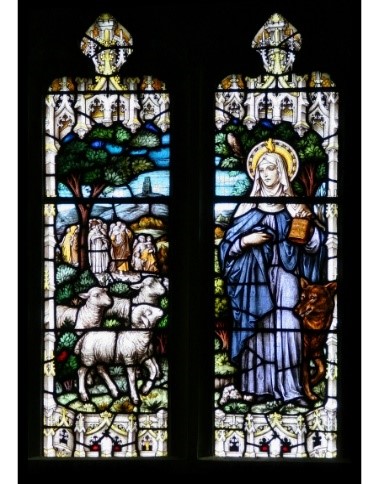


Window Two: “St Bride” in Church of St John the Baptist, Church of England, Glastonbury, England
The second window, titled St Bride, dates to 1925 and is to be found in the Church of St John the Baptist, Glastonbury, England.

It comprises two panels, that on the left depicting three sheep, with, in the background, a crowd of followers standing at the foot of the famous Glastonbury Tor.

The right hand panel depicts St Bride herself, dressed as a conventional nun, carrying a bell, with her guardian wolf at her side. At her feet is a cluster of snowdrops.

I visited Glastonbury in 2010 for a ceremony on St Bride’s Mound, just outside the centre of town, and fell in love with this window when I paid a visit to the church. I have kept a postcard of this window close-by ever since. However, it was difficult to see what was at Bridie’s feet, and my own memory was hazy. Thus, I am immensely grateful to the delightful Nigelle de Visme, who lives in Glastonbury, for very kindly going to St John’s (twice!) and checking this out for me! Bridie Blessings Nigelle!


Conclusion
In conclusion, my journey has taken me through swathes of snowdrops (whether native or naturalized!) and I encountered some superb stained glass designers along the way: Harry Clarke in Dublin in the late nineteenth/early twentieth century; Sarah Pursers, who founded An Túr Gloine (Tower of Glass) stained glass workshop in Dublin around 1905 (wonderful to see a woman at the forefront of stained glass design in that period!); and in the twenty-first century, Plamen Petrov in the USA; and Laura and John Gilroy in Canada.

As I indicated at the beginning, this article is very much an initial exploration based on a small sample of windows and the symbolism is what we might expect: cows and sheep, the nun, the abbey, fire etc but I was not expecting as many windows to have featured oak leaves and acorns. And there are so many more windows to find! I am an associate of the Scottish Stained Glass Trust, which recently gained funding to record every stained glass window in Scotland. The same has been done in Wales in a project run by Aberystwyth University and I feel sure that there are similar projects in England and Ireland and elsewhere. In time, it will be much easier to find Bridie windows online!

It might be that this exploration will encourage you to grow your own snowdrops (they do wonderfully well in tubs) or has altered, or complemented, your way of looking at stained glass. You might want to look at windows on Pinterest yourself, and make your own comparisons.  Please let me know if you have St Bride, St Bridget or St Ffraed windows in buildings in your area. It would be marvellous to have a Bridie in Stained Glass Catalogue!

Meanwhile, at this sacred time of St Bride’s Day, Imbolc and Candlemas, may the fire of St Bride and the sweet snowdrop of Midwinter Spring bring light to guide you on your own path.

Bridie Blessings
Heather Upfield
3 February 2018

"Wendy Andrew, Painting Dreams"


Tuesday, January 30, 2018

Féile Bríde 2018: Light out of Darkness


Féile Bríde 2018: Light out of DarknessSaturday 3rd February 2018
Solas Bhríde, Kildare Town
Registration at 10.20am

"Life has given me many challenges, which I choose to take as opportunities to learn and grow. This is my choice. I learned this on death row. I chose life, health, forgiveness, and love. That choice saved me from bitterness and hatred that would have destroyed me from within. I have dedicated myself to an end to violence – in all its forms. This is the way I honour the lives that were sacrificed along the way. This is the way I give back to the universe. Love is the answer. Fear is the enemy. We must choose the world we want and work towards making it happen every day in our own lives."

These are the inspiring words of death row survivor, Sunny Jacobs, whose life reads like a Shakespearean tragedy, with injustice heaped upon further injustice, creating circumstances that would have crushed many people. An innocent woman wrongfully convicted of murder, her husband was executed, she lost other family members and she spent many years awaiting her own execution. But Sunny came shining through it all with dignity, strength, courage, compassion and hope. She is the perfectly encapsulation of this year’s Féile Bríde’s theme: ‘light out of darkness’.

Sunny and Peter Pringle, the last person to have been on death row in Ireland, have devoted themselves to promoting healing, peace and reconciliation. Together they have established The Sunny Centre – a sanctuary for others who suffer injustice, especially people who are wrongly convicted of crimes they did not commit and have spent time under sentence of death. We will hear their extraordinary stories at Féile Bríde this year.

Other speakers include the distinguished academic and activist Peadar Kirby, who plays a leading role in the Cloughjordan Eco-Village; UCC Professor Emeritus and life-long peace activist John Maguire; Hanny Van Geel of La Via Campesina, which promotes the rights of peasant communities around the world, and who describes herself as ‘rooted in farming’; and Rose Hogan who has a life-long commitment to agro-ecology and sustainable agriculture.

In a world marred by war and the woeful destruction of our exquisite planet, Féile Bríde is but one example of the many, many people and groups throughout our world who hope for and work towards a better future, a more just world and for the light to overcome the darkness.

And as the Spring birdsong heralds the end of another winter, we will also have music because, as Hans Christian Anderson said, “where words fail, music speaks”.

For more information, including the programme, go here: http://www.afri.ie/news-and-events/date-for-your-diary-feile-bride-2018/


Monday, January 29, 2018

Conference review for Brighid: Her Flame Burns Brightly 27 Jan 2018


Potia Pitchford gives a generous and pithy review of Land, Sea, Sky's Brighid conference in her blog, Musings of a Scottish Hearth Druid (Thoughts about living, loving and worshiping as a Hearth Druid. One woman's journey.)
To read it, follow this link.


Image: Header from Potia's blog.


Saturday, January 20, 2018

"Sun Among Stars: Poems & Prayers to Brigit of Ireland" by Mael Brigde.


It will be a while yet before it is out, but I have a book of my Brigit poems in preparation.

If you would like to know when it becomes available, feel free to private message on Facebook or leave a comment here with your email address (I will delete the comment as soon as I get your email address, to protect your privacy). I will let you know when the time of publication comes.

To read some of my Brigit poems, along with those of other writers, please have a look at Stone on the Belly. Blessings of Brigit on you! Have a wonderful Imbolc (so very soon).


Image
: "A hand holding a pen on the statue of Isaiah at Piazza Spagna in Rome" by gnuckx (Flickr: Roma Italy - Creative Commons by gnuckx) [Public domain or CC BY 2.0 (http://creativecommons.org/licenses/by/2.0)], via Wikimedia Commons.

Thursday, January 18, 2018

Vancouver Public Library Still Has a Copy of St. Brigid of Ireland, by Alice Curtayne


To my great surprise, the first full book I ever read about Saint Brigit, which I withdrew from the Vancouver Public Library (in British Columbia, Canada) long, long ago, is still there. If you live nearby, you could have access to this delightful book, written by an intelligent and believing Catholic Irishwoman. She dismisses the whole goddess connection, which makes her not alone in modern scholarship on the subject, but whatever your feelings on that issue, it is still one of the best books on the topic, evocative and informed, thoughtful and persuasive.

For my 2012 review of the book, click here.

St. Brigid of Ireland, by Alice Curtayne.
Publisher:New York, Sheed, 1954
Branch Call Number:235.2 B97s
Characteristics:122 p

Saturday, January 13, 2018

Imbolc Advent 2018


A snippet from Erin nighean Brìghde's Imbolc Advent 2018. (For the whole post, click here.)

Imbolc Advent 2018


brigit-goddess-of-dawn

Brighid’s return is immanent once again!  Gabhaim Molta Brìde!  All Praises to Brighid!
I want to sink into the contemplation and mysticism of the season, feel it work on my soul, and guide my spirit.  I consider myself to be practicing a mystical path, meaning that I find my greatest sense of spiritual ecstasy through direct communion with the deity who guides me, who is Brighid.  It is understanding that spiritual guidance can be given through communion, insight, intuition, meditation, contemplation, signs, deep readings, poetry, song, music, chant, dance, nature, solitude, and silence.  It is a simple practice of showing up and being present, listening and watching, digesting and reflecting, committing and enacting, and yet is difficult to encapsulate, describe, or discuss.  In my contemplative mystical practice, I seek to go beyond the outward-directed worship of deity, and also beyond the passive reception of prayer petitions into the realm of active participation in the mysteries by reaching out soulfully to them, finding them within me, and listening for guidance in enacting them in the world with my body, mind, and spirit.  I am feeling called to participate in the mysteries of Imbolc and Brighid, and so follow the ancestral path of myth and folklore to take me to the Well of Memory, searching for Imbas, inspiration, in how to enact this participation...


Friday, January 12, 2018

"Saint Brigid of Kildare Life, legend and cult" by Noel Kissane


Ooh! I have not heard of this book before. But here it is, for you to ogle.


Saint Brigid of Kildare

Life, legend and cult


Noel Kissane

Despite being the female patron saint of Ireland and one of the most remarkable women in Irish history, St Brigid has always been an elusive figure. Some scholars have argued that she never existed as a real person but was merely the Christian personification of the cult of a pagan goddess of the same name. This book reviews all the evidence – history, legend and folklore – and concludes that while she has many of the attributes of the goddess Brigid, she was certainly a real person. The book also reviews her cult and veneration in Ireland and overseas, from her lifetime down to the present day, as attested by placenames, holy wells and folklore, and also by the large numbers of churches (Roman Catholic and Church of Ireland), schools and GAA clubs dedicated to her.

Noel Kissane worked in the National Library of Ireland for over thirty years, where he held the positions of Education Officer and Keeper of Manuscripts. His doctorate was for his edition of the Metrical Life of St Brigid. His previous books include The Irish face (Dublin, 1986), Parnell: a documentary history (Dublin, 1994) and The Irish famine: a documentary history (Dublin, 1996).

Saint Brigid of Kildare, Life, legend and cult by Noel Kissane, Four Courts Press (2017).
Paperback €22.45
ISBN: 978-1-84682-632-0
June 2017. 360pp; ills.

Wednesday, January 10, 2018

Tooting My Horn


I know I have posted a couple of times about this upcoming conference and you have likely gotten the message, but I got a great surprise when I read the introduction to today's post featuring yours truly. So I thought I would share that with you.

Our most requested presenter was by far Mael Brigde. We were so tickled when she said yes to our request to join our conference. We've been itching to work with her for a good fifteen years or so since I first experienced the beauty of a Brighid Flame Tending practice. Can't wait!
Kindling Brigit's Flame
On Imbolc 1993, Mael Brigde launched the first modern Brigidine flame-tending group outside of the Catholic Church—the Daughters of the Flame. In her class she will speak of her own path with Brigit and her experience of leading a multi-faith group of women devoted to Brigit. She will touch on the history of Brigidine flame-tending, ancient and modern, and will address issues connected to modern flame-tending. These span the practical: how not to burn the house down while I’m asleep? to the personal: how do I come to know Brigit? to the ethical: how do we represent our understanding of Brigit to the world?
Mael Brigde will discuss the importance and difficulty of discovering the roots of various assumptions about Brigit, such as the origins of her perpetual flame, and how new understandings may at times challenge our beliefs. She will address how her changing understanding of Brigit affects her devotion and practice.
Finally, she will talk about the way flame-keepers care for each other as part of their practice, and speak to her priorities in tending both the flame and flame-keepers. We will have the opportunity to sing two Brigidine chants together, and there will be a chance for participants to express their intentions and uncertainties around flame-tending and starting a flame-tending group.
Mael Brigde's Bio: 
Mael Brigde is the founder of the Daughters of the Flame, a Brigidine flame-tending group which lit its first candle on Imbolc, 1993. She has since then only grown in her devotion to and appreciation of Brigit, and in her devotion to the women and men who follow Brigit. Mael Brigde began writing poems and prayers to Brigit very early on and has collected many of these in her upcoming book, Sun Among Stars: Poems & Prayers to Brigit of Ireland. She began publishing a general interest Brigit blog in 2004 (Brigit’s Sparkling Flame), and a Brigit poetry blog in 2015 (Stone on the Belly). She launched a major review of Brigit-related books in 2010 (“A Long Sip at the Well”), and in 2015 wrote “The Mythical Pairing of Brig and Bres: Its Origins and Meaning in Cath Maige Tuired (Revised)”. Both of these papers are available for free download through Brigit’s Sparkling Flame or Academia.edu. Mael Brigde lives in Vancouver, Canada.
You can find Mael Bridge at:
Here on Facebook: Mael Brigde

Images:
Carol Burnett By NBC photo by Elmer Holloway-stamp is faint. (eBay item photo front photo back) [Public domain], via Wikimedia Commons
Oak Leaf by Pria Graves
Daughters of the Flame: Keeping the perpetual flame for the Goddess Brigit
OBSIDIANMAGAZINE.COM

Tuesday, January 09, 2018

"Brighid: Her Flame Burns Brightly" Registration Now Open


Land Sea Sky Travel is delighted to announce that registration is now open for our upcoming online conference, Brighid: Her Flame Burns Brightly.
Pricing
$40 USD - Land Sea Sky Alumni
$40 USD- Before January 15th, early bird special!
$50 USD- After January 15th
Additionally, a Conference Pass is available for $325USD, which provides access to all eight conferences. This offers an overall savings of $125USD, since our Beltane and Samhain two-day conferences are $75USD each.
Scholarships Available
To apply for a scholarship, please email us a note, including why this conference is important to you, and what you hope to get out of it. There is no need to provide financial reasons for needing a scholarship. You may apply to other conferences in the future, even if you have received a scholarship from us in a past.
Wisdom of the Ages
To help us honor and host the youngest and eldest voices in our community, this conference is free to individuals under 21 and over 71 at the time of the conference. Please email us and ask for your Wisdom Of The Ages Pass. You may attend as many of our 2018 Year With Our God conferences as you wish on this pass.
Viewing Parties
Viewing Party passes for groups are a cost-effective and fun way of attending. Passes are $100USD for up to 10 people, and $200USD for larger groups. Each guest receives a Digital Download Welcome Packet, as well as a recording of the conference. Plan on gathering your guests together to watch the conference in person on a single screen. To take advantage of this, please send a separate email, including a list of your guests with their respective email addresses.
What's Included
Your registration gets you into our all-day online conference, held on Zoom, to watch our five

"Keepers of the Flame Twenty Day Vigil & Journey with Goddess Brighid" with Heidi Wyldewood


Upcoming at Imbolc: a self led course for women that will appear in your inbox a bit at a time over the twenty days. All I know about it is what you see here.

This is from the "About" page:

Heidi Wyldewood is facilitator of healing journeys, mentor, priestess, walker between the worlds and a sacred activist.  She is a keeper and creatrix of wild medicine and womb wisdom traditions, living life from the heart, often with the soles of her bare feet on Mother Earth.  Her main areas of interest and understanding, which she weaves into her sharings, are Goddess traditions; womb wisdom, both ancient and new; Toltec, Inkan and Celtic shamanism; symbolism within fairy tale, myth and folk lore; Earth Magick; yogic philosophy; mysticism, female empowerment and sacred sexuality...

...Heidi is the creator of the Brighid Path Essences, the founder of the New Forest and Southampton Red Tent and currently the UK Coordinator for the Worldwide Womb Blessing.  She is also the author of the Red Thread Journal.


Barefoot Heartsong
with
 Heidi Wyldewood

ReMembering               EmPowering               TransForming

embracing the cycles of earth, sun, moon and womb  
walking the wild, wise way

Mentoring, healing and education for women - teachings born of indigenous shamanic practice, earth magick and womb wisdom traditions


Join Heidi Wyldewood and Lou Hayden as they follow the tradition of priestesses keeping vigil over a Sacred Flame, the flame of Brighid.  Take a sacred journey with her, alongside a circle of sisters, learning some of her history, her symbols, songs and wisdom.

This self led course for women will deliver to your inbox throughout the days of vigil, inspiring you with meditations, songs, prayers, writing and self inquiry prompts, and crafting in a mixed media format.  You will also be guided though the Fire and Water of the Three Cauldrons for personal insight, transformation and awakening.  

This course also contains two energetic transmissions, one at each end of the course.  The first one

Tuesday, January 02, 2018

Update on Brigid Conference


From Land, Sea, Sky Travel: an update on their upcoming Brighid conference:

Hold tight, registration is still on the way! Did you know along with entrance into eight hours of classes from amazing presenters such as Morgan Daimler,Mael Brigde Lora O'Brien - Irish Author and Gemma McGowan you will also receive a digital download welcome pack with prayers, videos, photos and chants to Brighid and other Irish deities along with special discounts and offers from businesses on Brighid goodies? It's true! We are so excited about our digital download packets.

Saturday, December 30, 2017

Our Lady of Multiple Personalities


A couple of comments made by participants in one of my Brigit courses triggered a new understanding of how Brigit can help us today.

Many survivors of trauma, particularly childhood trauma, have learned to cope with their mental and emotional injuries by dissociating, by disappearing from a particular emotion, moment, memory as best they can. Sometimes this manifests as more than one personality to deal with the varied pressures of life.

One of the conundrums that faces many Brigidines is the question of who exactly is Brigit. Is she a goddess who became a saint? A saint reinterpretted as a goddess? A single goddess with three aspects (of smith, healer, and poet), or three goddesses, three sisters overseeing each of these arts, as the 9th century text Sanas Cormaic tells us?

Instead of this being a problem which must be solved or lived with in some way, this can be a beacon to those of us who struggle with past traumas in ways that invite us to split off from ourselves. For it is clear today that this powerful saint and these powerful goddesses, though unique and very different from one another, reside together in a single phenomenon that bestows much good on our world.

So to Brigit, Our Lady of Multiple Personalities, I give thanks and praise. To each Brigit, solid and real in herself, I give praise and thanks.

Blessings.
Mael Brigde


Notes:

eMentalHealth.ca has a useful page on dissociation, it's symptoms and treatments.

from the site of International Society for the Study of Trauma and Dissociation:

What is dissociation?


Dissociation is a word that is used to describe the disconnection or lack of connection between things usually associated with each other. Dissociated experiences are not integrated into the usual sense of self, resulting in discontinuities in conscious awareness (Anderson & Alexander, 1996; Frey, 2001; International Society for the Study of Dissociation, 2002; Maldonado, Butler, & Spiegel, 2002; Pascuzzi & Weber, 1997; Rauschenberger & Lynn, 1995; Simeon et al., 2001; Spiegel & Cardeña, 1991; Steinberg et al., 1990, 1993). In severe forms of dissociation, disconnection occurs in the usually integrated functions of consciousness, memory, identity, or perception. For example, someone may think about an event that was tremendously upsetting yet have no feelings about it. Clinically, this is termed emotional numbing, one of the hallmarks of post-traumatic stress disorder. Dissociation is a psychological process commonly found in persons seeking mental health treatment (Maldonado et al., 2002).

Dissociation may affect a person subjectively in the form of “made” thoughts, feelings, and actions. These are thoughts or emotions seemingly coming out of nowhere, or finding oneself carrying out an action as if it were controlled by a force other than oneself (Dell, 2001). Typically, a person feels “taken over” by an emotion that does not seem to makes sense at the time. Feeling suddenly, unbearably sad, without an apparent reason, and then having the sadness leave in much the same manner as it came, is an example. Or someone may find himself or herself doing something that they would not normally do but unable to stop themselves, almost as if they are being compelled to do it. This is sometimes described as the experience of being a “passenger” in one’s body, rather than the driver.

There are five main ways in which the dissociation of psychological processes changes the way a person experiences living: depersonalization, derealization, amnesia, identity confusion, and identity alteration. These are the main areas of investigation in the Structured Clinical Interview for Dissociative Disorders (SCID-D) (Steinberg, 1994a; Steinberg, Rounsaville, & Cicchetti, 1990). A dissociative disorder is suggested by the robust presence of any of the five features.


Image: Triple Goddess by Mael Brigde (1990).

Thursday, December 21, 2017

‎A Year With Our Gods: Brighid, An Online Conference with Land Sea Sky Travel


I ought to have posted about this conference already (oops--ball dropped) but I now have even more reason to do so: I am delighted to announce that I have been invited to be one of the presenters.

To stay on top of developments, follow the Facebook page or sign up for Land, Sea, Sky's mailing list at www.landseaskytravel.com.

From the Facebook page:

Land, Sea, Sky Travel is pleased to announce we will be hosting a series of online conferences, A Year With Our Gods: An Online Polytheist Conference in 2018. Over the course of the year, we will be hosting an eight-part series focusing on the holy days, equinoxes and solstices, each holding a specific theme relevant to Irish and Welsh Polytheists. 

Brighid: Her Flame Burns Brightly.
Our first conference is devoted to Brighid and Imbolc and will be online, Saturday, January 27 from 10:30AM-8:30PM EST. The conference may be accessed from any phone, tablet, or computer.

The conference will provide a balanced mix of hands-on, devotional, and experimental practice with academic and lore-based studies. In addition, a chat room will be provided to facilitate building friendships and meeting others interested in Brighid. Our keynote speaker is Morgan Daimler, author of Pagan Portals Brighid, and she will be making the main presentation, Imbolc & Brighid: Old Beliefs & Fresh Views.We are also pleased to have two Native Irish women, Lora O'Brien - Irish Author, and Brighid Priestess Gemma McGowan. Two other speakers will be announced soon.

To help make it accessible to all participants, especially those who cannot commit to attending the full eight hours, a recording of the entire conference is included. Participants will also receive a digital welcome pack with exciting content from each of our presenters along with other offerings from polytheist groups and polytheist or pagan run small businesses. During the conference, we will be giving away items such as Kindle books, tickets to a future conference in this series and other exciting surprises. If you own a pagan business and would like to be involved with our Welcome Packet or Give-Aways please get in touch. We are looking for quality groups and businesses to work with.

Pricing and registration will be available no later than January 1, 2018. Like and Follow this event page for updates or join our mailing list atwww.landseaskytravel.com Full and partial scholarships will be offered for the conference along with group viewing party discounts. Registration will be offered for free to individuals under the age of twenty-one and over the age of seventy-one.

Conferences will be held in accordance with Our Hospitality Statement

http://www.landseaskytravel.com/hospitality/


Monday, December 04, 2017

Pause (Brigit, Thanks)


I am loving spending time online answering the comments people are leaving on my Brigit courses.

Every time I am caused to slow down and contemplate her and her connection in our many lives, to reflect on her aspects or stories that have such meaning and provide inspiration and guidance, I feel as though any cliff I may be walking close to seems more like a stunning vista then a threatening brink. Every time I read how she has touched others and what they have done with their insights and inklings, I well up with happiness.

Thank you for your blessings, Brigits, sisters and saint!


Image: St_Birgit_Nieuwegracht_Utrecht (by Brbbl [CC BY-SA 3.0 ]