Friday, February 15, 2019
Review: Saint Brigid of Kildare: Life, Legend and Cult by Noel Kissane
Kissane, Noel. Saint Brigid of
Kildare: Life, Legend and Cult (2017).
Noel Kissane’s book on Saint Brigit is unlike any I have previously
read. Readable, immense in scope, it places her within the context of medieval
Irish and Continental Christianity while also examining the minutiae of her
cult.
Kissane traces the early development of Christianity in Ireland, such as
the process of conversion, and sets Saint Brigit in the context of bishops like
Palladius and Patrick. Important texts about or mentioning her are discussed, their
dates estimated and implications considered. Various older images of Saint
Brigit which we encounter on the internet are identified with their original
sources. The lives and intentions of authors of early poems and Lives dedicated
to her are delved into. Artistic depictions are listed. Her folklore, the
history of Brigidine nuns, cultural movements that drew inspiration from her
are examined—and so on and on.
If you were to attempt a pilgrimage through Europe dedicated to Saint
Brigit, this would be an essential reference book. Irish placenames linked to her,
monastic communities and churches connected to Kildare (ca. 1000 C.E.), and
current dedications from churches to Gaelic Athletic Associations are listed
and their history briefly recounted. The origin and movement of her various
relics (including more heads than most people can boast) is investigated, and he
details her cult across Europe, distinguishing between churches named for St.
Brigitta of Sweden versus those named for St. Brigit of Kildare, where to the
untrained eye these wouldn’t be easily teased apart.
I especially enjoyed reading Kissane’s depiction of life in Ireland
during her era—setting her tales against that essential background is not done
enough.[1]
He goes deeply into the role her supposed tribe, the Fothairt, played in that
society (working as mercenaries for other tribes) and what this implies for
her, and compares the claims of different locales for her birth, growing up, or
veiling ceremony. (I am now convinced it was Mac Caille, not Mél, who gave her
the veil, but you may come to a different conclusion.) Amply sourced and
footnoted, with an index that includes a breakdown by Irish county and town, it
has a bibliography to bring joy to the researcher’s heart. Such are the
delights of this book for Brigit scholars.
It is delightful, as well, to have so many oddities of the lore explained.
For instance, why do we sometimes encounter the suggestion that Cogitosus (author
of her earliest Life) was Brigit’s nephew? (Because of a misreading of a
garbled manuscript.) Could Patrick actually have converted Brigit? (Nope.) Why
did the Scottish claim her as their own? Was she ever in Glastonbury? Etc. Some of these are explained elsewhere,
of course, but no other text tackles so many of these questions as this one.
Little space is set aside for the goddess, naturally, as she is not the
subject of this book. However, I am disappointed that Kissane accepts without
really questioning, and offers as a statement of high probability if not fact,
the hypothesis, generally discounted by modern scholars (for utter lack of
evidence), that Kildare was a pagan community dedicated to the goddess Brigit.[2]
He even adds to the usual story his own details, such as that the saint may
have converted separately from the community (pg. 90), and that she probably
inherited a “countrywide network of established holy sites” (pg. 118). I fear
that his elaboration of these and related ideas will just add to the rampant confusion
around this. I am not opposed to him speculating. I simply wished he had made
it clearer that this scenario was unweighted by evidence, and had offered the contradictory
view as well. He has such a richness of factual matter here, and many of his
speculations throughout the book seem more carefully reasoned. In this area he
seems to lose sight of the boundary between conjecture and supportable theory. He
goes so far as to say, “It is almost certain that to some degree the early
Irish converts to Christianity conflated the saint with the goddess and
regarded the saint as retaining and manifesting certain of the qualities and functions
of the goddess” (pg. 93). But it is not
almost certain. Now, if he had said that it was almost certain that they saw
elements of a goddess in the saint, I
would be much happier. But to presume the existence of this Brigit goddess sanctuary
is venturing too far into conjecture to be certain of anything.
Another instance of unsupported speculation, much less worrying, is when
he states that the story of Brigit’s mother’s status is much more likely to be
correct in Vita Prima (slave) than in
Cogitosus’s Life (noble woman) because there would be no reason to invent her
illegitimacy. I can think of one good reason: Christ was born to a woman who
was unmarried at the time of his conception. As in other saints’ Lives, many of
the elements of Saint Brigit’s hagiography are meant to reflect moments in
Jesus’s life as a way of showing her holiness. They reflect but do not exactly
copy them. Could this be an instance of the same? I give this example only to
say that speculation is just that, and we should never take it, when
unsupported by excellent evidence, as any more likely than any other
explanation to be true.
There is another good reason for making her illegitimate. Cogitosus was apparently
a monk at Brigit’s monastery at Kildare (though a good while after her death);
the author of Vita Prima was loyal to Armagh, St. Patrick’s
seat of power. Kildare and Armagh were in the throes of a struggle
for ecclesiastical supremacy. As Lisa Bitel writes in Landscape with Two Saints, unlike in Cogitosus’s Life, in Vita Prima and other later Lives Brigit “submitted to male religious
officials, never competing directly for territory or space” (pg. 176).
In this way she is subtly shown to be Patrick’s inferior, making Armagh the
legitimate religious centre of Ireland. Would it not benefit such an agenda to
have her the daughter of a slave, where Patrick was the son of nobles?
But such matters hardly mar my pleasure in the book as a whole. There is
a goldmine of information here, including facts that, for all my scrutiny, I
have never come across before, and which put into a much clearer order the
normally shifting sea of matters Brigidine.
Highly recommended.
[1] See Christina
Harrington’s Women in a Celtic Church
and Lisa Bitel’s Landscape with Two
Saints for very fine exceptions to this rule, as well as Alice Curtayne’s
much earlier St. Brigid of Ireland
for a less academic and slightly more fanciful but nevertheless excellent
example.
[2] See Christina
Harrington’s Women in a Celtic Church
for a detailed explanation of how this hypothesis came about and the changes in
scholarship that have led to its general rejection today.
Friday, February 08, 2019
Review: Pagan Portals—Gods and Goddesses of Ireland by Morgan Daimler
Daimler, Morgan. Pagan Portals—Gods and Goddesses of Ireland: A Guide to Irish Deities (2016).
Once again I come
away from reading one of Morgan Daimler’s books with a sense of excitement and
the urge to wave it in front of all sorts of people saying, “You want this
book!” Why, in this case?
If you have ever
plunged into Irish mythological texts, or even modern writings about the Irish
deities, you will have quickly discovered that there are a LOT of names in there,
all baffling if you are unused to Irish spellings, or are unaware that there are
multiple forms and spellings for every name, not to mention the plethora of
different persons associated with each god or goddess. In one story he is
married to so-and-so, in another he is cavorting with someone else; here she is
a sympathetic character, there she is a trickster or a dupe. How do you keep
them all straight? And how begin to build a sense of each deity in his or her
own right and complexity? How winnow through opinion and fact, misinformation
and changing perceptions over time? How, on top of all of this, do you honour
those you are drawn to?
There are a number of
excellent tomes that cover Irish deities and myths in depth. Their worth is undeniable.
But if you want to narrow down your focus you would be hard pressed to find a
source that maps things out as clearly and beautifully as Pagan Portals—Gods and Goddesses of Ireland.
The Pagan Portals
series is a brilliant idea. Each book is short—in this case less than ninety pages—and
serves as an introduction to its subject that offers enough information to set
you clearly on your path without overwhelming you with detail. It is possible
to read one quickly enough to retain a good sense of the general scope of the
book, to leave you feeling less rather than more confused.
In this case, Daimler’s
purpose is to offer sound scholarly information about the deities in an easily accessible
style to assist those interested in following an Irish Pagan path. This book could
be of use both to newcomers to Irish Neo-Paganism and to those who have been
immersed for some while.
She tackles her topic
by dividing the book into three main sections covering the gods of the Tuatha Dé
Danann, the goddesses of the Tuatha Dé Danann, and Irish deities of different
or uncertain origins. Instead of limiting herself to the handful of deities we encounter
again and again, Daimler includes a number who are much more obscure. She somehow
strikes a balance between giving a satisfying survey of their names, relationships,
attributes, associations, and elements of their stories, and holding back
enough detail that the reader doesn’t end up becoming lost in the thickets.[1]
(It must be very hard to stop herself at times—she is well versed in her topic
and has many fascinating gems at her disposal.) She is concise and clear
without oversimplifying, frequently giving conflicting points of view and
allowing the reader to follow up on them if desired rather than simply offering
her own favourite theory and omitting all controversy. As well as those of Celtic
scholars, she offers perspectives of Irish Neo-Pagan practitioners, and ends
each entry with suggestions for how we might honour a given deity in our own lives.
In addition to the
individual entries, which range from less than half a page for a deity like
Neit, about whom little is known, to over four pages for Macha, Daimler offers
excellent advice on how to build a relationship with the deities—not a prescription
of rituals and offerings, but an approach to learning and relating that is as
wise as it is clear (and again, succinct). A bibliography and recommended
reading list are given at the end of the book.
I had not originally
thought to include this review in Brigit’s Sparkling Flame. I changed my mind
for the simple reason that Brigit is not an isolated goddess, but a part of a
rich tapestry of deities from a complex culture, and having a clearer sense,
even just a beginning sense, of some of the other gods and goddesses can only
strengthen our understanding of and relationship to her. I can think of no
better book to wave before Brigidines for this purpose than Pagan Portals—Gods and Goddesses of Ireland.
[1]
One detail I find especially
interesting which is not often included is the particular geographic area a
deity is linked to, where that is known.
Tuesday, February 05, 2019
Review – Poems for the season of Imbolc by Kris Hughes
Poems
for the Season of Imbolc by Kris Hughes
US$8.00
I recently received a very short, self-published chapbook by an author whose
writing I was not familiar with. I get nervous about reviewing people’s work—I don’t
like to hurt feelings but I also don’t like to say I love something when I really
don’t. Somehow the stakes seem even higher when it is self-published, I suppose
because they don’t obviously have anyone else promoting the work for them, so
more depends on one review, but equally they may well be depending entirely on
their own eyeball when it comes to editing, layout, and so on, which as many
writers have shown is not always a great idea. So it was with some trepidation
that I awaited delivery of this booklet.
It arrived shortly before Imbolc. To my relief, it looked pretty darn
good. The layout is done with an artist’s eye, though there is little
decoration; it is printed on nice paper; there were no wild claims on the back
cover: all promising signs.
Because of its subject matter, I wanted to review it right away so
people could know about it before the feast day, but it is my busiest time of
year and it just wasn’t possible. At last today I had a clear enough mental
space to sit down and read the whole thing at once and pay it the attention it (and
the author) deserved. I have to say—I love
it.
Twenty pages all told, including front and back matter, Poems for the season of Imbolc focusses
on the Scottish tales of Bride, Angus, and the Cailleach. There is a short and useful
introduction and then four poems, “If Angus Would Come,” “The Cailleach Becomes
Bride,” “Cailleach Rant,” and “Woman of the White Sky.”
Apart from “Cailleach Rant,” which is a prose poem of gathering power,
the poems are free verse, telling their stories pithily and beautifully. Their tone
ranges from lilting and passionate to wild and world-shaping, climaxing in a defiant
call to giant selfhood. I will give two small
tastes, but far better that you read the book all at once. Often this is not
the case with poetry. It’s best to take deep sips of one or two poems and then
sit with them before going back. But Poems
for the season of Imbolc is strongest when taken all together, from the
longing of Bride for Angus to the transformation of Cailleach to Bride to the
roar of the Cailleach to women everywhere, to the brief silence of the final
poem of praise to her.
… If Angus
would come
He would
search for me
Guided by
the light of a thousand candles
He would
know my abode
By the sark
I have hung on the window sill
It collects
the snow, to be wrung as dew
To ease his
wounds when he comes …
from “If Angus Would Come”
… I cackle
again from the treetops
raising a
storm that sends the cattle
lowing and
bucking in indignation
from sleet
like knives
for the
shelter of the dyke
The ponies
lower their
heads to the ground
tails
plastered to their legs …
from “The Cailleach Becomes Bride”
What does
it feel like when life turns out not to be a journey, after all, but an immense
impermanence?
from “Cailleach Rant”
Sunday, February 03, 2019
Thursday, January 31, 2019
Blessings of Imbolc!
There has been much excitement this year leading up to Imbolc. Clann Dord Fiann offered a three week daily devotion which many of us joined in on. I enjoyed it so much I am going to continue it. Land, Sea, Sky Travel put on a wonderful Brigit conference on 26 January, which consumed much of my bandwidth for weeks beforehand as I planned and organized my own contribution. And now Brigit lovers all over are posting images and stories and videos that teach and inspire and comfort us at this time.
Lora O'Brien sent a link out on her Irish Pagan School email listserve the other day that points us toward a great program on Brigit and her traditions by Blúiríní Béaloidis/Folklore Fragments on SoundCloud:
I am so happy to be surrounded by Brigit lovers and Brigit lore. May you all be blessed, this year and every year.
Blessings of Brigit
may Brigit bless you
with the lustre of her poetry
the vigour of her smithcraft
the mercy of her healing
and may you walk under
the protection of her blue mantle
all the days of your life.
Mael Brigde
Image: Brigit
by Maggie Jones
Wednesday, January 23, 2019
Amy Interviews Dolores Whelan
Amy Panetta interview Dolores Whelan, educator, spiritual guide, and author of "Ever Ancient, Ever New: Celtic Spirituality in the 21st Century." They discuss her book, her work, The Brigid of Faughart festival she organizes, and Brigid herself.
Amy is also offering an hour-long webinar in exchange for a donation. Most proceeds will go towards The Solas Bhride Centre in Kildare where so many beautiful Brigid sites are located. Back in Jan/Feb 2017, she taught a number of classes based on her Brigid work and she is excited that the class she was teaching is now online in this webinar! She also teaches the song, "Gabhaim Molta Bhride" in Irish Gaelic.
Sunday, January 20, 2019
Saturday, January 12, 2019
Revisiting Brighid & Imbolc: A Year With The Gods Conference 26 January 2019

Very soon we will be treated to a second online Brigit conference through Land, Sea, Sky Travel. I'm so excited! I will be presenting--my only presentation with them in the coming year--a deep dive into meditation on Brigit. There is so much more. Explore the various posts on their Facebook page and definitely consider one of the scholarships if they apply.
I love the group of people that Vyviane has gathered together. These conferences have had a huge impact on my practice and on my sense of connection with the wider community. They are accessible in every way, inspiring, friendly, and filled with new ideas and information and ways of looking at things. A real blessing.
JAN26
Revisiting Brighid & Imbolc: A Year With The Gods Conference
“The world is full of magic things, patiently waiting for our senses to grow sharper.” ~W.B. Yeats
Land, Sea, Sky Travel is pleased to announce we will be hosting a series of online conferences, A Year With Our Gods: An Online Polytheist Conference in 2019. Over the course of the year, we will be hosting an eight-part conference series. Each conference will hold a specific theme relevant to Irish, Welsh, Gallic, and Deovtional Polytheists. Our first conference is Revisiting Brighid & Imbolc and is meant to be a deeper dive into the work we stared last year with our very popular Brighid: A Fresh Perspective conference.
The conference will provide a balanced mix of hands-on, devotional, and experimental practice with academic and lore-based studies . In addition, a chat room will be provided to facilitate building friendships and meeting others interested in polytheism. Each conference will feature five presenters, a mix of well known faces and fresh voices.
The conference may be accessed from any phone, tablet, or computer.
To help make it accessible to all participants, especially those who cannot commit to attending the full eight hours, a recording of the entire conference is included with your registration ticket. Participants will also receive a digital welcome pack with exciting content from each of our presenters along with other offerings from polytheist groups and polytheist or pagan run small businesses. During the conference, we will be giving away items such as Kindle books, tickets to a future conference in this series, and other exciting surprises. If you own a pagan business and would like to be involved with our Welcome Packet or Give-Aways, please get in touch.
Full and partial scholarships will be offered for the conference along with group viewing party discounts. Registration will be offered for free to individuals under the age of twenty-one and over the age of seventy-one.
Land, Sea, Sky Travel is pleased to announce we will be hosting a series of online conferences, A Year With Our Gods: An Online Polytheist Conference in 2019. Over the course of the year, we will be hosting an eight-part conference series. Each conference will hold a specific theme relevant to Irish, Welsh, Gallic, and Deovtional Polytheists. Our first conference is Revisiting Brighid & Imbolc and is meant to be a deeper dive into the work we stared last year with our very popular Brighid: A Fresh Perspective conference.
The conference will provide a balanced mix of hands-on, devotional, and experimental practice with academic and lore-based studies . In addition, a chat room will be provided to facilitate building friendships and meeting others interested in polytheism. Each conference will feature five presenters, a mix of well known faces and fresh voices.
The conference may be accessed from any phone, tablet, or computer.
To help make it accessible to all participants, especially those who cannot commit to attending the full eight hours, a recording of the entire conference is included with your registration ticket. Participants will also receive a digital welcome pack with exciting content from each of our presenters along with other offerings from polytheist groups and polytheist or pagan run small businesses. During the conference, we will be giving away items such as Kindle books, tickets to a future conference in this series, and other exciting surprises. If you own a pagan business and would like to be involved with our Welcome Packet or Give-Aways, please get in touch.
Full and partial scholarships will be offered for the conference along with group viewing party discounts. Registration will be offered for free to individuals under the age of twenty-one and over the age of seventy-one.
Twenty Day Brigid Devotion with Clann Dord Fiann (Starts Today!)

I am very keen to participate in this shared-yet-solitary daily offering to Brigit as we move toward Imbolc. What a wonderful idea! We begin in less than an hour--8 PM Irish time, noon British Columbia time--but the devotion may be done any time during each twenty-four hour period. Whatever works best for you. I'll let Clann Dord Fiann explain.
FLAMEKEEPING/ BRIGIDMAS/ IMBOLG 2019
For 2019 Clann Dord Fiann are working each evening from the 12th of January to the 31st with a 20 day devotional work with and to Brigid. As part of the extension of our work to have a public face, we invite others to join this activity if they wish. It is solitary and requires no other involvement.
Each day at 8pm (Irish time) we light a candle to Brigid and speak or sing the text of Gabhaim molta Bríghde/ I Give Praise to Brigid, a traditional Irish song and poem. This time is ideal, but need not be followed if not fitting with your life. This may be done at any time each day. We will post daily reminders at 7 daily for the 20 days. For those who would like to work with the text as gaeilge, but who do not speak the language, Gaol Naofa has a phonetic version. http://www.gaolnaofa.org/library/music/gabhaim-molta-bride/ . For the first 19 days we light and extinguish the candle after speaking Gabhaim molta Bríghde and a period of reflection. On the 20th day, Brigids eve, reeds are gathered for crosses, and an effigy of Brigid is brought to the place of the candle, be it an image or a Brideóg. An accompanying verse may be desired of this arrival of Brigid. A historical example is:
Oiche Bhríde brichíneach
Bain an ceann den croiceanach,
Gabhaigí ar na glúnaí,
Déanaigí umhlú
Is ligigí isteach Bríd Bheannaithe.
‘Sé beatha, ‘sé beatha, sé beatha.
"On St Brigid’s night
Take the head off the rushes,
Go on your knees,
Make obeisance
And let St Brigid in.
You’re welcome, you’re welcome, your welcome."
The candle is lit in a safe container and allowed to burn out in the company of Brigid, for on the 20th day Brigid keeps the flame.
___________________
Gabhaim molta Bríghde Text (Gaeilge/ English)
Gabhaim molta Bríghde, iníon í le hÉireann
Iníon le gach tír í, molaimís go léir í.
Lóchrann geal na Laighneach, soils’ ar feadh na tíre
Ceann ar óigheacht Éireann, ceann na mban
Tig an Geimhreadh dian dubh, gearra lena géire
Ach ar lá le Bríghde, gar dúinn Earrach Éireann.
Iníon le gach tír í, molaimís go léir í.
Gabhaim molta Bríghde, iníon í le hÉireann
I give praise to Brigid, daughter of Ireland
Daughter of all lands, let us praise her.
The bright torch of Leinster, shining across the country
The leader of Ireland’s youth, leader of women.
The house of Winter is dark, cutting with its sharpness
But on Brigid’s Day, Spring in Ireland draws near to us.
I give praise to Brigid, daughter of Ireland
Daughter of all lands, let us praise her.
Wednesday, December 12, 2018
Brigantia #2: Funding Unsuccessful
![]() |
|
Saturday, December 01, 2018
An Dagda's First Books Have Launched!

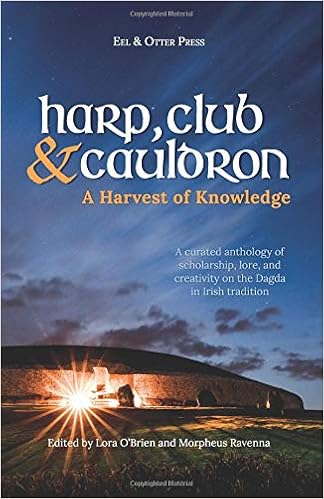
Harp, Club, and Cauldron - A Harvest of Knowledge: A curated
anthology of scholarship, lore, and creative writings on the Dagda in Irish
tradition edited by Morpheus Ravenna and Lora O'Brien (2018)
I'm
excited. Two separate books on The Good God, An Dagda, father of the goddesses
Brigit, are now available. In my time of devotion to Brigit I have come to know her parent somewhat and fallen in love with him. I am thrilled to have these two opportunities to know him more.
Until
now, those interested in The Dagda have had to scrape together their information from
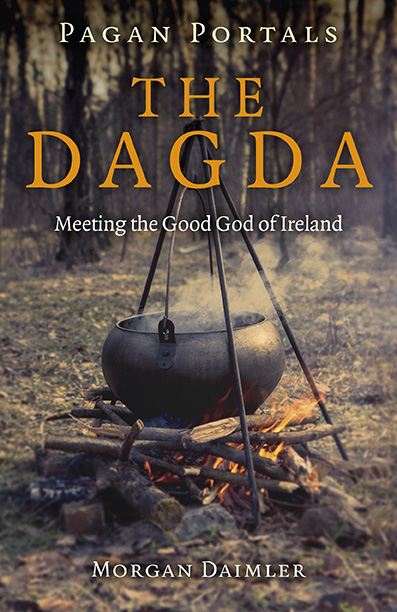
widely dispersed sources. In late October Morgan Daimler's Pagan Portals
book, The Dagda, was released. A slim volume, like all Pagan Portals titles,
it is the first book entirely devoted to this important Irish god. I haven't
read it yet, but it sits on the table awaiting my attention. I've read
several of Morgan's books and have never been disappointed.
Minutes
ago, Morpheus Ravenna and Lora O'Brien launched their anthology Harp,
Club, and Cauldron - A Harvest of Knowledge. Many respected (and beloved)
writers and artists have contributed to the book: Isolde Carmody and Chris
Thompson from Story Archaeology, Anthony Murphy, author of Mythical
Ireland: New Light on the Ancient Past, Segomâros Widugeni, author
of Ancient Fire: An Introduction to Gaulish Celtic Polytheism, Valerie
Herron, the artist responsible for the delightful works in Ravenna's book on
the The Morrigan, The Book of the Great Queen, Morgan Daimler herself, and many others. (I have a poem in there, myself, speaking
with Brigit about her father.) Having had a glimpse of the ebook, I am more than ever looking forward to having the book
in my hands, .
Now
is a great time to have the profile of the Dagda raised. A god of many
abilities, protector of his people and linked to the health and balance of his
land, he is a powerful ally in a world filled with disharmony and fear. His
cauldron of plenty, his harp that can bring sorrow, laughter, or sleep to those
who listen, his club which kills with one end and restores to life with the
other, his great appetites and his ability to do what needs to be done under
any circumstances--An Dagda's influence needs to be felt now more than ever.
It
may take a few hours for the anthology to become available--the button is
pushed, but Amazon sometimes takes a while to catch up. So if you get a
"not currently available" note, fear not. It's on the way.
For
those of you who have grown interested in or close with An Dagda, you
might also want to join the Facebook group The Dagda's Hearth. I'll see you
there, perhaps?
Friday, November 30, 2018
Review: Brigantia #1 (Comic)
Brigantia #1, Chris Mole and Melissa Trender (2017):
Link to Kickstarter for #2
Brigantia #1, Chris Mole and Melissa Trender (2017):
I was surprised and thrilled when I saw Nimue Brown's retweet of Chris Mole's Kickstarter announcement for Brigantia #2. I had not known that #1 existed and I wanted to know more. A quick look at the Kickstarter page told me this was a comic I definitely wanted to read. A seven foot tall, red-haired goddess who fights to protect her people, who is hurled through time to our century, who is wonderfully drawn.
Link to Kickstarter for #2
Brigantia #1, Chris Mole and Melissa Trender (2017):
I was surprised and thrilled when I saw Nimue Brown's retweet of Chris Mole's Kickstarter announcement for Brigantia #2. I had not known that #1 existed and I wanted to know more. A quick look at the Kickstarter page told me this was a comic I definitely wanted to read. A seven foot tall, red-haired goddess who fights to protect her people, who is hurled through time to our century, who is wonderfully drawn.
So here I am with #1. I love the liveliness and clarity of the art. A goddess and a god in mortal combat open the issue, followed by the abrupt arrival of Brigantia in the London Underground. The land still speaks to her, but it is strange and incomprehensible; her people, those who believe in her, are long gone. Yet when she was taken from them they were in desperate need of her protection.
Now, one voice rises in prayer to her, her nemesis appears again, and the battle continues.
A fast-moving and enjoyable read based on the goddess of the Brigantes, Brigantia #1 combines the exhilaration of the superhero comic with a sensibility for the land and her people. It will appeal to Pagans and non-Pagans alike.
Now! To raise the funds for #2! Just a few days left for the Kickstarter campaign. Donate as little as a £ to enable artist Melissa Trender to work full-time on the project and get it to us by May 2019. (Rewards abound, and I personally have my eye on paper copies of both issues.)
Wednesday, November 28, 2018
Brigantia Comic on Kickstarter!
Oh, so terribly cool! I hadn't heard of this comic, completely missed issue one. Now issue two is seeking funds to support the artist and allow her to work on it full time, pay the letterer, and cover printing costs. Have a look at their fund-raising video and the gorgeous art at this address:
Brigantia Kickstarter
From their page:
Hurled forwards through time by a magical portal, Brigantia - a Pagan goddess - seeks to defeat the foe who deceived her and return to the world she calls home.
Welcome! The purpose of this campaign is to raise the production and print funds (to pay for the cost of artwork, lettering and printing) of issue #2 of Brigantia, an independent comic book series by writer Chris Mole, artist Melissa Trender and letterer Aditya Bidikar.
Our goal is to create a full-colour, 36-page comic book (UK Standard size, 246x163mm) which continues the story of Brigantia, illustrated and lettered to a professional standard.
Issue #1 of the comic was released in September 2017 after a successful Kickstarter campaign and is now available online and on Comixology and Comichaus:
Monday, November 26, 2018
Saint Brigid Art at Trinity Stores
Brigid of 100, 000 Welcomes
by Brother Mickey McGrath
Trinity Stores is having a sale on its products, and these include seven separate images of Saint Brigid by different artists, including Brother Robert Lentz (Saint Brigid and Saint Darlughdacha), and Brother Mickey McGrath. The images are available on a variety of products, from notecards to votive candles to mugs and t-shirts and of course framed prints.
Saint Brigid at Trinity Stores
Friday, October 26, 2018
Sacred Smithing -- A Whole Nother Marriage Ritual

from Goddess Temple Weddings
My friend Sister Oystercatcher sent me the Samhain newsletter from Glastonbury, and my attention was grabbed by one of the elements they offer in their wedding ceremonies: sacred smithing. They don't mention Brigit but those of you dedicated to Brigit, Smith might want to consider something like this when you tie the knot.
|
Sunday, September 16, 2018
Dreaming of You.
I had a dream last night that I was in Ireland. I had just arrived, and the first thing I did was go to Kildare. The sisters there (not the ones I met before--Srs. Mary and Phil, who actually live at Solas Bhríde) were busy organizing a massive rumble sale. I wish I could remember more detail, but what I do recall brought a chuckle today when I pondered it.
The sister I was talking with--very briefly as she buzzed around doing her work--was thin, elderly, and filled with energy. She was bossy as well as busy, used to giving orders and having them acted upon. She scowled a bit, annoyed with me asking where I should put my backpack and small suitcase so they wouldn't get mixed up with the merchandise. I put them where I thought she'd indicated and got lost in the rooms they had converted over to a marketplace for the fund-raiser.
It was good to be in Ireland. I enjoyed the nun and the people I bumped into, and everyone was keen on getting their bargains. Eventually I found my way back to the place where I thought I'd stored my things, and they were gone. I searched and couldn't find them. I asked the sister, and she shrugged it off, still busy and not really interested.
The only other thing I really remember is thinking to myself, "This happened last year when I came to Kildare, too. Every time I come I lose everything I've brought with me."
When I was reflecting on this dream today I asked myself who that nun was. Was she Sr. Mary? Clearly not. She was the superior, equally clearly. And then it struck me. She was Saint Brigit. And then this clicked in: everything I have ends up with her. Doing her work, supporting her community. And I don't mind. I really, really don't mind.
I left the place with a sense of amusement. Whether I had it in the dream I don't know--I don't think so. I think I was worried about what I was going to do without my stuff. But I didn't need to worry. I was in no real difficulty.
Thinking further about it now I recall the abundance reflected in Saint Brigit's stories. No one ever need do without. If she takes your stuff, she has a good purpose, and you don't go hungry. No one does hospitality like her. Even if she does get a little distracted and abrupt sometimes.
Image: "Little boy putting money in nun's collection tray," Photographer: Elinor Wiltshire. Collection: Wiltshire Photographic Collection. Date: 1969. Permissions: National Library of Ireland on The Commons.
Subscribe to:
Posts (Atom)